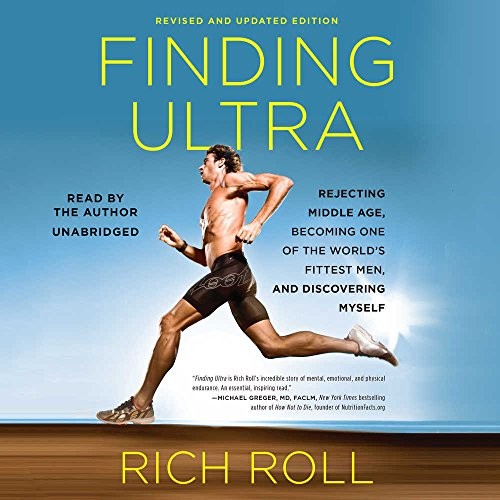
Finding Ultra by Rich Roll is a 2012 memoir book about ultraendurance, addiction recovery, plant-based diet. Recovery from addiction sometimes finds a healthy expression in extreme physical challenges — the same temperament that produces addiction can be redirected into endurance training.
Summary
Finding Ultra is Rich Roll's memoir of going from overweight, alcoholic attorney at age forty to competing in the Ultraman World Championship — a three-day, 320-mile endurance race — on a fully plant-based diet. The arc is classic redemption narrative, but Roll's account has enough specificity and self-awareness to avoid the genre's predictability. He does not arrive at transformation through a single revelation but through a slow accumulation of decisions, each requiring the previous one.
Roll's background is swimming: he was a nationally ranked collegiate swimmer at Stanford before alcohol derailed his career and, eventually, his life. The memoir opens with him fat and winded at age forty, climbing a staircase and stopping halfway. This is the catalyst. He starts running and cycling, eventually competes in triathlons, and then — in a pattern familiar to people with addictive temperaments who find a healthy substitute — he escalates to the most extreme events he can find.
The plant-based dimension is central to the book's argument. Roll transitioned to a whole-food, plant-based diet, eliminating all animal products, and attributes much of his athletic transformation to it. He partners with his wife Julie Piatt, a vegan chef, whose influence on the dietary experiment is documented throughout. Roll acknowledges he cannot know with certainty how much his results were caused by the plant-based diet versus training, sobriety, or motivation, but the experiment produced enough results to make him a convert.
The Ultraman race account in the final section is the book's most gripping writing — five days in Hawaii, extreme distances, mechanical failures, and the physical limit of what a middle-aged body can do. Roll's account of finding his edge is genuine rather than performed, and the descriptions of training — the loneliness of long training hours, the negotiation between discipline and obsession — are more honest than most athletic memoirs. The book is as much about recovery from addiction and the search for a life with meaning as it is about endurance sport, and it works better as the former than as a dietary prescription.
Talk to Finding Ultra like its author wrote you back.
Get the ideas that fit your life — not generic summaries.
- Chat with the book
- Audiobook-style main ideas
- Adapts to your life and goals
- Helps you take action
Key takeaways
- 1.
Recovery from addiction sometimes finds a healthy expression in extreme physical challenges — the same temperament that produces addiction can be redirected into endurance training.
- 2.
Athletic potential at forty is not exhausted: Roll completed his first Ironman triathlon with months of training after a decade of sedentary, unhealthy living.
- 3.
A whole-food, plant-based diet supported extreme endurance performance without protein deficiency — Roll's experience challenges the assumption that animal protein is required for athletic recovery.
- 4.
Community and accountability matter in both recovery and athletic training: Roll's sobriety was reinforced by his support network and his athletic ambitions were shaped by training partners.
- 5.
The transition to elite endurance sport required reconstructing identity — from attorney to athlete — and that identity shift was as important as the physical work.
- 6.
Midlife reinvention is possible but requires sustained discomfort: the transformation Roll describes was not a weekend retreat but years of daily choices under resistance.
- 7.
The line between discipline and compulsion is real and difficult to navigate: Roll's account is honest about the ways his extreme training risked substituting one obsession for another.
- 8.
Purpose and meaning in daily life were as important to Roll's sobriety and health as any specific dietary or training intervention.
Discussion questions
Use these on your own, with a book club, or as chat starters in Superbook. Book club version, ready to copy or print →
- 1.
Roll's athletic transformation was possible partly because of his addictive personality redirected toward a healthy goal. Does that suggest something about the relationship between extreme personality traits and peak performance?
- 2.
He attributes his performance partly to his plant-based diet but acknowledges he can't isolate variables. How much credit do you think the diet deserves versus other factors?
- 3.
The memoir begins with Roll stopping halfway up a staircase at forty. What's the equivalent moment in your own life that you look back on as a turning point?
- 4.
He is honest that extreme endurance training can shade into compulsion. Where do you think the line is between healthy dedication and unhealthy obsession in athletic pursuits?
- 5.
Roll's wife Julie is central to his dietary transformation and his daily life. How does having a partner who shares your values affect the sustainability of major lifestyle changes?
- 6.
The book argues that plant-based eating can support extreme athletic performance. Does personal anecdote like Roll's change your view on what athletes need to eat?
- 7.
He went from collegiate swimmer to practicing alcoholic to elite ultraendurance athlete in midlife. What does that trajectory suggest about the role of identity in health and performance?
- 8.
Sobriety is the foundation on which everything else in the book is built. How does the addiction recovery frame change the meaning of the athletic achievement?
- 9.
Roll left a lucrative legal career to pursue this transformation. How much material sacrifice is a realistic precondition for the kind of reinvention he describes?
- 10.
The Ultraman race takes place in remote Hawaii over multiple days. What makes extreme endurance events appealing to people who have already conquered ordinary fitness goals?
- 11.
If you could apply one thing from Roll's approach to reinvention to a goal in your own life, what would it be?
- 12.
The book has been criticized for making its transformation seem more accessible than it is. Is the story inspirational, or does it inadvertently set an unrealistic bar?
Themes
Frequently asked questions
-
Is Finding Ultra worth reading if you're not an endurance athlete?
Yes. The athletic content is really a vehicle for a story about addiction, identity, and midlife reinvention. Most readers who connect with it do so because of the recovery narrative and the question of what it takes to completely transform your life in middle age, not because they want to run ultras.
-
Does Finding Ultra prove that plant-based diets are better for athletic performance?
No — it's a single anecdote. Roll's transformation involved sobriety, intensive training, caloric clarity, and renewed purpose alongside the dietary change. His performance doesn't prove causation in any direction, but it does demonstrate that extreme athletic performance is compatible with a whole-food, plant-based diet.
-
How long is Finding Ultra?
Around six hours at average reading pace. The book balances personal narrative with sections on training and diet; the pacing is generally engaging though the dietary sections are more informational than narrative.
-
Is Finding Ultra appropriate for people in recovery from addiction?
Many people in recovery find it highly useful — Roll is honest about his experience with alcoholism and the ongoing work of sobriety. Some may find the extreme exercise replacement concerning; the book itself acknowledges this tension. It's not a recovery guide, but the recovery thread is authentic and detailed.
-
Who should read Finding Ultra?
People interested in the possibility of dramatic midlife health transformation, athletes curious about plant-based performance, and anyone drawn to addiction recovery memoirs with a physical redemption arc. Also useful for anyone whose relationship with extreme fitness has a complicated psychological dimension.