Talk to Finite and Infinite Games like its author wrote you back.
Get the ideas that fit your life — not generic summaries.
- Chat with the book
- Audiobook-style main ideas
- Adapts to your life and goals
- Helps you take action
What it argues
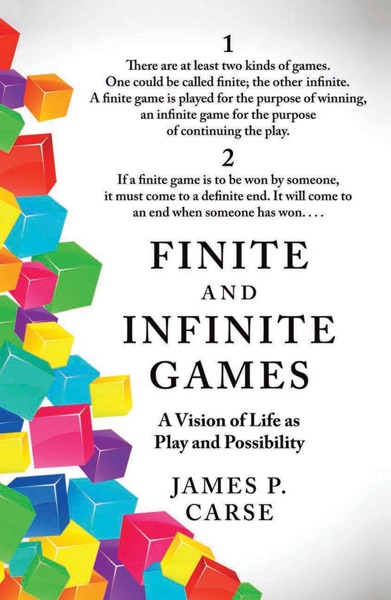
Finite and Infinite Games is James Carse's 1986 philosophical meditation on two fundamentally different ways of engaging with the world. The finite game has a beginning and an end, a clear winner and loser, and everyone plays to win within agreed rules. The infinite game has no fixed endpoint; the only goal is to keep play going, and the rules shift to include anyone who might otherwise be forced out.
Carse applies this distinction everywhere: to business, war, politics, religion, art, and personal identity. A finite player wages war to win it. An infinite player wages war — or, more precisely, refuses to wage war in its finite sense — to eliminate the conditions that make adversarial conflict necessary. A company that plays finite games acquires market share and builds walls; one that plays infinite games cultivates relationships and keeps the field alive. The distinction is not between competition and cooperation so much as between two orientations toward time, power, and possibility.
What it gets right
- 1.
Finite games are played to win; infinite games are played to keep playing. The fundamental purpose is different, not just the stakes.
- 2.
Finite players play within boundaries; infinite players play with boundaries. The infinite player can see the rules as contingent and renegotiate them.
- 3.
Power in finite games comes from strength accumulated from past victories. Power in infinite games comes from openness to a future that hasn't yet been determined.
What it covers
Who wrote it
James P. Carse (1932–2020) was a professor of religion at New York University, where he taught for thirty years and served as director of religious studies. He wrote numerous books at the intersection of theology, philosophy, and culture, including The Religious Case Against Belief and Breakfast at the Victory. Finite and Infinite Games, published in 1986, became his most widely read work and found audiences far beyond academic philosophy, attracting readers in business strategy, game design, and personal development. Carse was known for a style of philosophical writing that favored provocation over systematization.
