Finite and Infinite Games by James P. Carse is a 1986 philosophy book about games and play, power and freedom, storytelling. Finite games are played to win; infinite games are played to keep playing. The fundamental purpose is different, not just the stakes.
Summary
Finite and Infinite Games is James Carse's 1986 philosophical meditation on two fundamentally different ways of engaging with the world. The finite game has a beginning and an end, a clear winner and loser, and everyone plays to win within agreed rules. The infinite game has no fixed endpoint; the only goal is to keep play going, and the rules shift to include anyone who might otherwise be forced out.
Carse applies this distinction everywhere: to business, war, politics, religion, art, and personal identity. A finite player wages war to win it. An infinite player wages war — or, more precisely, refuses to wage war in its finite sense — to eliminate the conditions that make adversarial conflict necessary. A company that plays finite games acquires market share and builds walls; one that plays infinite games cultivates relationships and keeps the field alive. The distinction is not between competition and cooperation so much as between two orientations toward time, power, and possibility.
The book is written in numbered aphorisms rather than sustained argument, which either works for you or it doesn't. Carse is writing philosophy in the mode of Wittgenstein's Tractatus or Pascal's Pensées — dense, elliptical, meant to provoke rather than resolve. Some passages arrive like a cold glass of water. Others feel deliberately opaque. The structure rewards rereading and marginalia more than linear consumption.
Where the book goes deepest is in its account of power. Finite players draw strength from titles, roles, and victories — from the past. Infinite players draw strength from surprise, from the irreducibly open future. Carse argues that genuine culture is infinite play: not the repetition of traditions but their ongoing creation. Storytelling, he writes, does not describe the world; it opens the world. For a slim philosophical text, Finite and Infinite Games has had disproportionate influence on how business leaders, designers, and theologians think about the games they're actually playing.
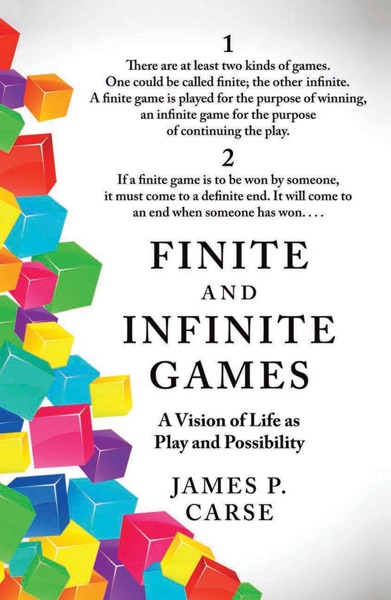
Talk to Finite and Infinite Games like its author wrote you back.
Get the ideas that fit your life — not generic summaries.
- Chat with the book
- Audiobook-style main ideas
- Adapts to your life and goals
- Helps you take action
Key takeaways
- 1.
Finite games are played to win; infinite games are played to keep playing. The fundamental purpose is different, not just the stakes.
- 2.
Finite players play within boundaries; infinite players play with boundaries. The infinite player can see the rules as contingent and renegotiate them.
- 3.
Power in finite games comes from strength accumulated from past victories. Power in infinite games comes from openness to a future that hasn't yet been determined.
- 4.
Titles and roles are the currency of finite games. An infinite player wears these like a costume, not like a skin — taking them on and off as the situation calls for.
- 5.
Infinite players are not serious in the way finite players are. They are playful: they take nothing so finally that it cannot be reconsidered.
- 6.
Culture is the ongoing creation of new possibilities, not the preservation of old ones. Societies that treat culture as a museum to be curated are playing a finite game.
- 7.
Genuine storytelling is infinite play. It doesn't close down meaning — it opens up possibility, inviting listeners to continue the story themselves.
- 8.
The infinite player does not try to eliminate opposition; they try to prevent anyone from being so defeated that they cannot continue to play.
Discussion questions
Use these on your own, with a book club, or as chat starters in Superbook. Book club version, ready to copy or print →
- 1.
Think of one arena of your life — work, a relationship, a creative practice — where you have been playing a finite game. What would it look like to shift to infinite play?
- 2.
Carse says finite players are serious while infinite players are playful. What's the difference between being playful and being irresponsible?
- 3.
Which institutions you belong to seem designed around finite games? Which seem oriented toward infinite ones? What does the difference feel like from inside?
- 4.
Carse argues titles are costumes for infinite players but skins for finite ones. Do you wear your professional identity as a costume or a skin?
- 5.
In what relationships in your life do you feel most like an infinite player? What conditions make that possible?
- 6.
The book claims that storytelling opens the world rather than describes it. Can you think of a story that changed what you thought was possible for you?
- 7.
Carse says strength in finite play comes from the past, while genuine power in infinite play comes from openness to the future. Where in your life are you drawing on accumulated titles rather than live possibility?
- 8.
What's an example of an institution — company, government, religion — that lost its infinite character and became purely self-perpetuating?
- 9.
The book was written in 1986. Which of its ideas feel more true now than they did then, and which feel less relevant?
- 10.
Carse argues that you cannot play a finite game alone. Does the same apply to infinite games, or is solitary infinite play possible?
- 11.
If you had to describe your relationship with work as either finite or infinite play, which would it be, and how did it get that way?
- 12.
What would you have to give up to become a more genuinely infinite player in the area of your life where you most want change?
Themes
Frequently asked questions
-
What is Finite and Infinite Games about?
It's a philosophical argument that all human activity can be understood as either finite play — bounded contests with winners and losers — or infinite play, whose only goal is to keep the game going. Carse applies the distinction to war, business, art, religion, and identity, arguing that most institutions are finite games in disguise.
-
Is Finite and Infinite Games worth reading?
For readers drawn to philosophical provocation, yes. The prose is aphoristic and dense; it rewards slow reading and is not a quick practical guide. If you want frameworks you can immediately apply, the book will frustrate you. If you want a lens that reshapes how you think about competition, culture, and power, it delivers.
-
How long is Finite and Infinite Games?
The book is under 200 pages, but the writing is compressed enough that most readers take longer than the page count suggests. Expect two to three hours of focused reading, plus time to sit with the ideas.
-
Who has been influenced by this book?
Simon Sinek drew on Carse's framework for his concept of the infinite game in business leadership. The book has been cited by game designers, theologians, startup founders, and military strategists. Its influence is unusually broad for an academic philosophy text.
-
What's the most important idea in Finite and Infinite Games?
That the orientation you bring to any activity — playing to win versus playing to keep playing — shapes everything about how you think, compete, and relate. Most people play finite games without knowing it, treating open-ended situations as contests with endpoints that don't actually exist.
Similar books
The Art of Learning
Josh Waitzkin
Antifragile: Things That Gain from Disorder
Nassim Nicholas Taleb
The Obstacle Is the Way
Ryan Holiday
Flow: The Psychology of Optimal Experience
Mihaly Csikszentmihalyi
