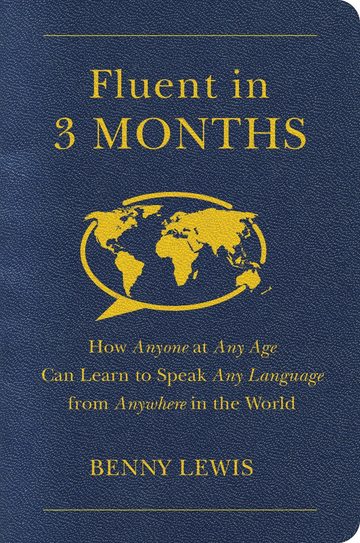
Talk to Fluent in 3 Months like its author wrote you back.
Get the ideas that fit your life — not generic summaries.
- Chat with the book
- Audiobook-style main ideas
- Adapts to your life and goals
- Helps you take action
Fluent in 3 Months, in detail
Fluent in 3 Months is Benny Lewis's argument that the main thing standing between you and a new language is not talent, age or grammar — it's your refusal to open your mouth and be bad at it. Lewis, an Irish 'language hacker' who now speaks a long list of languages, was for years the opposite: monolingual, convinced he had no gift for it, and living in Spain for six months while barely speaking Spanish. The book is the method he built after he stopped hiding in English and started, awkwardly, to talk.
Its central rule is 'speak from day one.' You do not wait until you feel ready, because that day never comes; you have real conversations with native speakers from your very first lesson, armed with a small script and a willingness to make mistakes. Lewis reframes errors as the feedback that drives progress rather than evidence of failure, and he redefines the goal: fluency, in his usage, is comfortable social conversation — roughly a B2 level where you can live your life in the language — not flawless, native-like perfection.
Around that rule sits a toolkit of 'language hacks.' Lewis finds conversation partners online from day one, uses spaced-repetition apps and vivid mnemonics to memorize vocabulary quickly, learns high-frequency conversational connectors so his speech flows, and prepares in advance for the predictable early exchanges. He sets concrete 'missions' with deadlines, engineers immersion wherever he is rather than assuming he must move abroad, and treats attitude and motivation — knowing exactly why you want the language — as more decisive than any single study technique.
This is a motivational and tactical book, not a curriculum. Its great strength is psychological: it dismantles the excuses that keep adults silent and gives them permission to start today. Its limits are the flip side — the 'three months' and 'fluent' framings are optimistic and assume serious, near-full-time effort, and the book is thin on structured grammar, reading, writing and the road to genuine advanced accuracy. It works best as the push that gets you speaking, ideally paired with a more systematic resource for the depth it deliberately skips.
The big ideas
- 1.
Speak from day one. You learn to talk by talking, badly, from your very first lesson — not after months of silent study.
- 2.
Talent and age are excuses, not barriers. Lewis had no gift and started as an adult; attitude and motivation matter far more than a 'language gene.'
- 3.
Redefine fluency. Aim for comfortable social conversation, roughly a B2 level, rather than native perfection — a reachable goal keeps you going.
