Talk to Forged in Crisis like its author wrote you back.
Get the ideas that fit your life — not generic summaries.
- Chat with the book
- Audiobook-style main ideas
- Adapts to your life and goals
- Helps you take action
What it argues
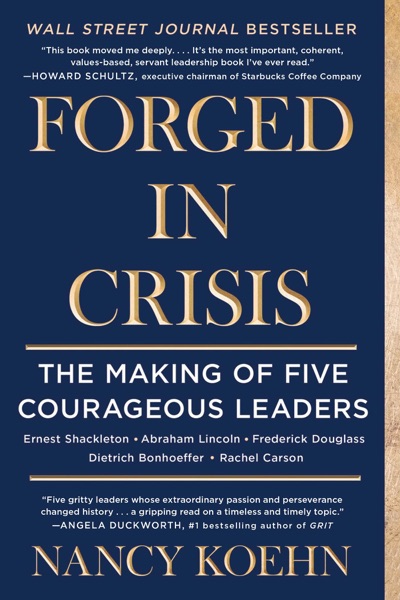
Nancy Koehn, a historian at Harvard Business School, profiles five historical leaders who were forged — not simply demonstrated — by crisis: Ernest Shackleton, Abraham Lincoln, Frederick Douglass, Dietrich Bonhoeffer, and Rachel Carson. The choice of subjects is deliberately non-obvious. These are not profiles of people who had leadership talents and then encountered a crisis that allowed them to use them. Koehn's argument is stronger: these individuals became the leaders they became because of adversity, not before it. The crisis was the crucible.
The book is structured as interlocking biographies, each developed at substantial length. Shackleton's Antarctic disaster — the Endurance trapped in ice, the two-year ordeal to bring all twenty-seven crew members home alive — is the most purely narrative account. Koehn uses it to examine how he managed fear, maintained group cohesion, and made decisions under conditions of near-total information deprivation. Lincoln's section is longer and politically more textured, tracing his development from a backwoods self-taught lawyer to a president navigating the most destructive war in American history while managing a fractious cabinet and a doubtful public.
What it gets right
- 1.
Leadership capacity is not fixed at birth or developed in comfortable circumstances. Genuine crisis changes people, and those who survive it with their character intact often emerge more capable.
- 2.
Emotional regulation under pressure is a learnable skill. Shackleton's success with the Endurance crew depended on his ability to manage his own fear before managing anyone else's.
- 3.
Moral clarity is a form of leadership capital. Douglass and Bonhoeffer both drew their authority from an uncompromising commitment to a clear moral position, which made followers trust them even when outcomes were uncertain.
What it covers
Who wrote it
Nancy Koehn is a historian at the Harvard Business School, where she has taught since 1991. Her research focuses on entrepreneurship, leadership, and business history, and she has written several books including Brand New: How Entrepreneurs Earned Consumers' Trust from Wedgwood to Dell. She is a frequent commentator on leadership for major publications and has been recognized as one of the most influential business historians working today. Forged in Crisis was published in 2017 and became a recommended text in executive education programs at Harvard and elsewhere.
