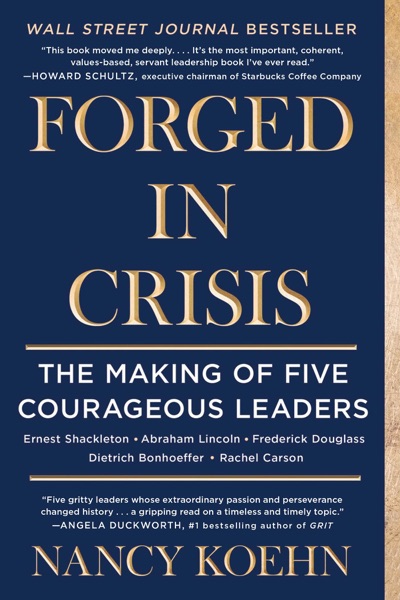
Forged in Crisis by Nancy Koehn is a 2017 history book about leadership, crisis, resilience. Leadership capacity is not fixed at birth or developed in comfortable circumstances. Genuine crisis changes people, and those who survive it with their character intact often emerge more capable.
Summary
Nancy Koehn, a historian at Harvard Business School, profiles five historical leaders who were forged — not simply demonstrated — by crisis: Ernest Shackleton, Abraham Lincoln, Frederick Douglass, Dietrich Bonhoeffer, and Rachel Carson. The choice of subjects is deliberately non-obvious. These are not profiles of people who had leadership talents and then encountered a crisis that allowed them to use them. Koehn's argument is stronger: these individuals became the leaders they became because of adversity, not before it. The crisis was the crucible.
The book is structured as interlocking biographies, each developed at substantial length. Shackleton's Antarctic disaster — the Endurance trapped in ice, the two-year ordeal to bring all twenty-seven crew members home alive — is the most purely narrative account. Koehn uses it to examine how he managed fear, maintained group cohesion, and made decisions under conditions of near-total information deprivation. Lincoln's section is longer and politically more textured, tracing his development from a backwoods self-taught lawyer to a president navigating the most destructive war in American history while managing a fractious cabinet and a doubtful public.
Douglass and Bonhoeffer are the book's moral centers. Douglass escaped slavery, taught himself to read, and became one of the most powerful orators and writers of the nineteenth century — his leadership was constituted by a refusal to accept a world that treated him as less than human. Bonhoeffer's section is the most tragic: a German theologian who chose to resist the Nazi regime when most of his church did not, and who was executed by the SS weeks before the war ended. Carson's profile connects the personal — years of illness, professional marginalization, the death of her beloved friend — to the public legacy of Silent Spring and the birth of the environmental movement.
Koehn draws consistent themes across all five: the importance of inner work (self-knowledge, emotional regulation, genuine conviction), the willingness to act on moral clarity even when the outcome is uncertain, and the way that sustained adversity strips away what is inessential and leaves a more capable person. The book avoids the hero-worship register that mars many leadership books by holding each figure to critical scrutiny.
Talk to Forged in Crisis like its author wrote you back.
Get the ideas that fit your life — not generic summaries.
- Chat with the book
- Audiobook-style main ideas
- Adapts to your life and goals
- Helps you take action
Key takeaways
- 1.
Leadership capacity is not fixed at birth or developed in comfortable circumstances. Genuine crisis changes people, and those who survive it with their character intact often emerge more capable.
- 2.
Emotional regulation under pressure is a learnable skill. Shackleton's success with the Endurance crew depended on his ability to manage his own fear before managing anyone else's.
- 3.
Moral clarity is a form of leadership capital. Douglass and Bonhoeffer both drew their authority from an uncompromising commitment to a clear moral position, which made followers trust them even when outcomes were uncertain.
- 4.
The inner work — journaling, prayer, self-examination, sustained solitude — appears in all five subjects. None of them led well without sustained practice of some kind of reflective self-knowledge.
- 5.
Leadership in crisis requires honesty about the actual situation. Lincoln's greatness was partly his refusal to pretend, to himself or to others, that things were better than they were.
- 6.
Rachel Carson's case shows that leadership can emerge from expertise combined with moral courage. She was not naturally a public figure, but the importance of what she knew compelled her to act.
- 7.
All five leaders faced significant failure before their defining moments. The pattern suggests that failure is not an impediment to leadership development but often a precondition.
- 8.
Bonhoeffer's example is the hardest: moral leadership sometimes requires acting on principle with full knowledge that you will not survive to see the outcome. That is a test that few leadership frameworks honestly address.
Discussion questions
Use these on your own, with a book club, or as chat starters in Superbook. Book club version, ready to copy or print →
- 1.
Koehn argues that these five people were made by their crises, not just demonstrated by them. Do you think that's true in your own experience — has adversity changed your character, or revealed it?
- 2.
Which of the five profiles did you find most instructive for your own life, and why?
- 3.
Shackleton kept his crew alive in part through deliberate morale management — performances of confidence he may not have felt. Is that kind of strategic emotional management honest leadership or calculated manipulation?
- 4.
Lincoln managed a cabinet full of people who initially thought him unequal to the presidency. What does his approach to that challenge suggest about how to earn authority you weren't granted?
- 5.
Frederick Douglass's leadership came from a refusal to accept his situation as permanent or legitimate. What does that kind of moral clarity require, and what makes it so rare?
- 6.
Bonhoeffer knew his resistance would likely not save him. How do you think about moral action when the probability of it achieving its goal is very low?
- 7.
All five of Koehn's subjects practiced some form of inner work — self-examination, journaling, prayer. What is your equivalent practice, and how seriously do you take it?
- 8.
The book is about historical figures in extreme circumstances. What is transferable to ordinary professional life, and what are the limits of the analogy?
- 9.
Carson's Silent Spring is one of the most consequential books of the twentieth century. What did it require of her to write it, and what do you think would have happened if she hadn't?
- 10.
Koehn is a business school historian writing about moral and historical leadership. What does that institutional context give her — and what does it miss?
- 11.
Which of the five leaders faced the greatest personal cost for their leadership, and how do you evaluate whether that cost was worth paying?
- 12.
What crisis in your own life, large or small, changed who you are as a leader or decision-maker?
Themes
Frequently asked questions
-
Is Forged in Crisis primarily a history book or a leadership book?
Both. It is rigorously historical — the biographical profiles are detailed and sourced — and explicitly analytical about what the five subjects teach about leadership. Readers who want narrative history and readers who want leadership frameworks both get something substantial.
-
Do I need to know these five historical figures already?
No. Koehn provides enough biographical context that each profile stands alone. Readers who already know Shackleton's story or Lincoln's presidency will get more analytical depth from those sections, but the book is designed to be accessible without prior knowledge.
-
Is the book inspiring or analytical in tone?
More analytical than inspiring, which is one of its strengths. Koehn does not shy away from the costs, failures, and limitations of her subjects. The result is more credible and more useful than hagiography.
-
How does the book treat Bonhoeffer specifically?
With care and appropriate gravity. Koehn takes the theological context seriously and doesn't reduce Bonhoeffer to a secular resistance hero. The profile acknowledges the genuine religious conviction that shaped his choices and the theological arguments he made for resistance.
-
Who should read this book?
Leaders who want historical perspective on what leadership under genuine adversity actually required. Also useful for anyone going through a difficult professional or personal period who wants frameworks from people who faced conditions significantly worse.
Similar books
Team of Rivals: The Political Genius of Abraham Lincoln
Doris Kearns Goodwin
Endurance: Shackleton's Incredible Voyage
Alfred Lansing
Unbroken: A World War II Story of Survival, Resilience, and Redemption
Laura Hillenbrand
Long Walk to Freedom
Nelson Mandela
