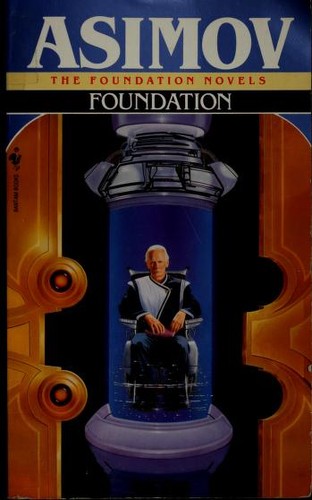
Talk to Foundation like its author wrote you back.
Get the ideas that fit your life — not generic summaries.
- Chat with the book
- Audiobook-style main ideas
- Adapts to your life and goals
- Helps you take action
What it argues
Foundation opens at the peak of a twelve-thousand-year empire that mathematician Hari Seldon knows is about to collapse. Using psychohistory — a statistical science capable of predicting the behavior of large populations — Seldon calculates that the fall is inevitable but that its aftermath, a dark age lasting thirty thousand years, can be compressed to a single millennium. His instrument is the Foundation: a colony of scientists and encyclopedists placed at the edge of the galaxy to preserve knowledge and shorten the night.
What makes the novel more interesting than its premise suggests is that Seldon is not a character so much as a mechanism. The real action is a series of vignettes spanning centuries, each built around a crisis the Foundation must navigate without knowing whether Seldon anticipated it. The drama is not whether civilization survives but how — whether through cunning diplomacy, manufactured religion, or the brute leverage of economic monopoly. Asimov is less interested in individual psychology than in the chess-game dynamics of institutions and power.
What it gets right
- 1.
Psychohistory posits that individual free will is real but that mass human behavior follows statistical laws — a deeply deterministic worldview dressed as science.
- 2.
The Foundation survives each crisis not through superior force but by understanding the structural logic of power better than its opponents do.
- 3.
Religion, trade, and force are progressive instruments — Seldon's plan requires each crisis to be solved by the simplest available lever before escalating to the next.
What it covers
Who wrote it
Isaac Asimov (1920–1992) was an American biochemist and one of the most prolific science fiction writers in history, with more than five hundred published books across science fiction, popular science, history, and mystery. He is best known for the Foundation series, the Robot series, and the short story collection I, Robot, which introduced the Three Laws of Robotics. Asimov shared the Hugo Award for best all-time science fiction series for Foundation in 1966. He taught biochemistry at Boston University for most of his career and wrote popular science books intended to make science accessible to general readers.
