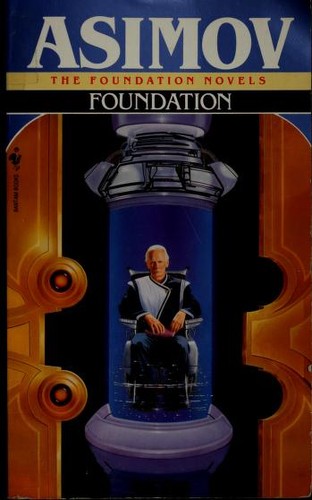
Foundation by Isaac Asimov is a 1951 science fiction book about decline of empire, prediction and free will, knowledge as power. Psychohistory posits that individual free will is real but that mass human behavior follows statistical laws — a deeply deterministic worldview dressed as science.
Summary
Foundation opens at the peak of a twelve-thousand-year empire that mathematician Hari Seldon knows is about to collapse. Using psychohistory — a statistical science capable of predicting the behavior of large populations — Seldon calculates that the fall is inevitable but that its aftermath, a dark age lasting thirty thousand years, can be compressed to a single millennium. His instrument is the Foundation: a colony of scientists and encyclopedists placed at the edge of the galaxy to preserve knowledge and shorten the night.
What makes the novel more interesting than its premise suggests is that Seldon is not a character so much as a mechanism. The real action is a series of vignettes spanning centuries, each built around a crisis the Foundation must navigate without knowing whether Seldon anticipated it. The drama is not whether civilization survives but how — whether through cunning diplomacy, manufactured religion, or the brute leverage of economic monopoly. Asimov is less interested in individual psychology than in the chess-game dynamics of institutions and power.
The book is technically a fix-up of stories originally published in Astounding Science Fiction between 1942 and 1950, which gives it an episodic quality. Each section reads as a self-contained crisis with its own protagonist. The writing is economical to the point of spareness. You will not find lush description or deep interiority. What you get is plot, dialogue, and idea — delivered with the confident clarity of a writer who trusts his concepts to carry the weight.
Readers who want character-driven fiction will find Foundation cold. The people are mouthpieces for historical forces, and Asimov is openly more interested in the forces. Those who enjoy large-scale political and intellectual speculation, who have ever wondered what it would look like to engineer the future, or who want to understand why this series became the founding text of modern science fiction will find it rewarding. It holds up not as a novel in the literary sense but as an idea machine that still runs cleanly.
Talk to Foundation like its author wrote you back.
Get the ideas that fit your life — not generic summaries.
- Chat with the book
- Audiobook-style main ideas
- Adapts to your life and goals
- Helps you take action
Key takeaways
- 1.
Psychohistory posits that individual free will is real but that mass human behavior follows statistical laws — a deeply deterministic worldview dressed as science.
- 2.
The Foundation survives each crisis not through superior force but by understanding the structural logic of power better than its opponents do.
- 3.
Religion, trade, and force are progressive instruments — Seldon's plan requires each crisis to be solved by the simplest available lever before escalating to the next.
- 4.
The book treats history as something that can be managed by sufficiently rational actors with sufficiently long time horizons — an idea that is both seductive and deeply contestable.
- 5.
Knowledge hoarding is portrayed as the ultimate strategic weapon: the Encyclopedia Foundation's real value is not the encyclopedia itself but the concentration of technical expertise.
- 6.
Asimov's Galactic Empire is consciously modeled on Gibbon's Rome — the parallels between Foundation's storyline and The Decline and Fall of the Roman Empire are structural, not incidental.
- 7.
The series raises the question of whether the Seldon Plan is prophecy or self-fulfilling manipulation — the Foundation's belief in the plan may be what makes the plan work.
- 8.
Each generation believes it is the pivot of history; the novel's long view suggests they are all roughly interchangeable actors in a process larger than any of them.
Discussion questions
Use these on your own, with a book club, or as chat starters in Superbook. Book club version, ready to copy or print →
- 1.
Psychohistory can predict mass behavior but not individual actions. Does that feel true to you as a description of how history actually works?
- 2.
The Foundation survives its first crises partly through manufactured religion. Is that a cynical move by Asimov, or does the novel present it as morally neutral?
- 3.
Each section of the book has a different protagonist who essentially serves as a placeholder. Does that structural choice undercut emotional investment, or is it the point?
- 4.
Seldon's plan assumes that a small group of sufficiently rational people can steer civilizational outcomes over centuries. How much do you believe that?
- 5.
The Galactic Empire falls despite its enormous size and technological sophistication. What parallels, if any, do you see with contemporary institutions?
- 6.
The Foundation's strategy shifts from encyclopedist colony to religious authority to trading empire. Which of these seems most believable as a lever of power?
- 7.
Compared to Dune, which also deals with long-term manipulation of history — where does Foundation land harder, and where does it feel weaker?
- 8.
The women in this novel are almost entirely absent. Does that absence affect your reading in 2026, or do you bracket it as a product of 1940s pulp science fiction?
- 9.
Asimov treats economics and political science as sciences with predictive power. Has the last century of history made that view more or less plausible?
- 10.
Is the Seldon Plan a story about the power of expertise, or a story about the limits of expertise — or both?
- 11.
The novel ends with the Foundation apparently on track. Does that resolution feel earned, or does it feel too tidy?
- 12.
Foundation was written during World War II and the early Cold War. How much does that context shape what feels urgent in the book?
Themes
Frequently asked questions
-
Is Foundation worth reading if you don't usually like science fiction?
Possibly. Foundation is much closer to political philosophy and historical speculation than to action-oriented sci-fi. If you've enjoyed Sapiens or books about the rise and fall of empires, the intellectual project here is similar — it's just wrapped in a galactic setting.
-
Is Foundation hard to read?
No. Asimov's prose is clean and direct. The episodic structure means each section resets with new characters and stakes. The difficulty, if any, is adjusting to a style that prioritizes ideas and plot over character depth.
-
Do I need to read the whole Foundation series?
The original trilogy (Foundation, Foundation and Empire, Second Foundation) forms a complete arc. The first book stands alone reasonably well. The later prequels and sequels Asimov wrote in the 1980s are considered weaker by most readers.
-
Why is Foundation considered so influential?
It established a template for civilizational-scale science fiction that dozens of later writers have borrowed from — including Frank Herbert's Dune. The concept of psychohistory influenced real social scientists, and Elon Musk has cited it as a formative text.
-
Is there a TV adaptation?
Yes. Apple TV+ launched a Foundation series in 2021. It significantly expands the characters and adds storylines not in the books to compensate for Asimov's minimal characterization. It has been renewed for multiple seasons.