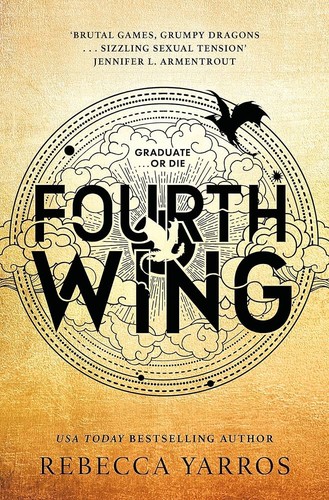
Talk to Fourth Wing like its author wrote you back.
Get the ideas that fit your life — not generic summaries.
- Chat with the book
- Audiobook-style main ideas
- Adapts to your life and goals
- Helps you take action
Fourth Wing, in detail
Violet Sorrengail was supposed to enter the Scribes Quadrant — small, physically fragile, the daughter of a general who knows the odds. Instead her mother orders her into the Riders Quadrant at Basgiath War College, where cadets bond with dragons or die trying. The attrition is real and intentional; the institution is designed to produce soldiers, not scholars. Violet enters knowing she is the wrong kind of person for this place and spends the first act of the novel proving everyone right and then wrong.
The world Rebecca Yarros has built is a militarized fantasy with strict hierarchies, secret histories, and a war that is not exactly what the cadets have been taught it is. The romance between Violet and Xaden Riorson — a section leader whose father was executed for treason and who has every reason to see Violet as an enemy — is the emotional engine of the book, but it operates alongside genuine geopolitical mystery. The novel is interested in what institutions hide from the people they train, and what it costs to learn the truth.
Yarros writes with a romance author's instincts applied to fantasy infrastructure: the world-building is functional rather than exhaustive, the prose is propulsive, and the emotional beats are hit with precision. The dragon-bonding system is distinctive — dragons are not mounts but partners with their own agency and opinions, which gives the central relationships more texture than the standard fantasy animal companion. The book is long but paced as a thriller, with reveals staged to keep readers moving.
Fourth Wing became one of the best-selling fantasy novels of 2023, finding an audience that spans romance readers new to fantasy and fantasy readers who wanted something more emotionally direct. Those who need their world-building rigorously systematic or their prose literary may bounce off it. But as popular fantasy — fast, emotionally intense, genuinely surprising in its third act — it does exactly what it sets out to do.
The big ideas
- 1.
Violet's arc is about physical vulnerability as a surface under which the actually dangerous kind of power — intelligence, stubbornness, magical aptitude — is concealed until it isn't.
- 2.
The novel treats institutions — the war college, the military chain of command, the history taught to cadets — as mechanisms for manufacturing consent to things people wouldn't consent to if they knew the truth.
- 3.
The Xaden-Violet relationship works because both characters have real reasons to distrust the other, and the novel doesn't collapse those reasons too quickly.
