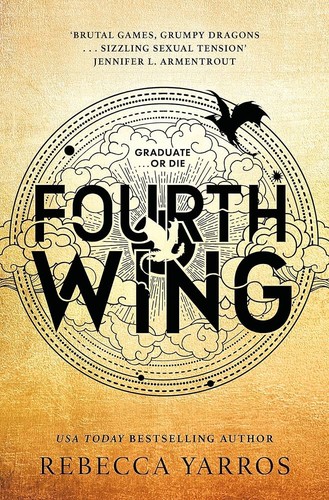
Fourth Wing by Rebecca Yarros is a 2023 fantasy book about war and sacrifice, power and loyalty, love and forbidden desire. Violet's arc is about physical vulnerability as a surface under which the actually dangerous kind of power — intelligence, stubbornness, magical aptitude — is concealed until it isn't.
Summary
Violet Sorrengail was supposed to enter the Scribes Quadrant — small, physically fragile, the daughter of a general who knows the odds. Instead her mother orders her into the Riders Quadrant at Basgiath War College, where cadets bond with dragons or die trying. The attrition is real and intentional; the institution is designed to produce soldiers, not scholars. Violet enters knowing she is the wrong kind of person for this place and spends the first act of the novel proving everyone right and then wrong.
The world Rebecca Yarros has built is a militarized fantasy with strict hierarchies, secret histories, and a war that is not exactly what the cadets have been taught it is. The romance between Violet and Xaden Riorson — a section leader whose father was executed for treason and who has every reason to see Violet as an enemy — is the emotional engine of the book, but it operates alongside genuine geopolitical mystery. The novel is interested in what institutions hide from the people they train, and what it costs to learn the truth.
Yarros writes with a romance author's instincts applied to fantasy infrastructure: the world-building is functional rather than exhaustive, the prose is propulsive, and the emotional beats are hit with precision. The dragon-bonding system is distinctive — dragons are not mounts but partners with their own agency and opinions, which gives the central relationships more texture than the standard fantasy animal companion. The book is long but paced as a thriller, with reveals staged to keep readers moving.
Fourth Wing became one of the best-selling fantasy novels of 2023, finding an audience that spans romance readers new to fantasy and fantasy readers who wanted something more emotionally direct. Those who need their world-building rigorously systematic or their prose literary may bounce off it. But as popular fantasy — fast, emotionally intense, genuinely surprising in its third act — it does exactly what it sets out to do.
Talk to Fourth Wing like its author wrote you back.
Get the ideas that fit your life — not generic summaries.
- Chat with the book
- Audiobook-style main ideas
- Adapts to your life and goals
- Helps you take action
Key takeaways
- 1.
Violet's arc is about physical vulnerability as a surface under which the actually dangerous kind of power — intelligence, stubbornness, magical aptitude — is concealed until it isn't.
- 2.
The novel treats institutions — the war college, the military chain of command, the history taught to cadets — as mechanisms for manufacturing consent to things people wouldn't consent to if they knew the truth.
- 3.
The Xaden-Violet relationship works because both characters have real reasons to distrust the other, and the novel doesn't collapse those reasons too quickly.
- 4.
Dragons as autonomous bonding partners rather than animals or tools changes the power dynamic in interesting ways: the dragon chooses the rider, not the other way around.
- 5.
The book's central mystery — what is the war actually about — runs underneath the romance plot and gives the story stakes beyond the personal.
- 6.
Loyalty in this world is complicated: loyalty to family, to the institution, to the truth, and to the person you love are all in genuine conflict.
- 7.
Fourth Wing uses the war college setting to ask how much the powerful rely on the ignorance of those they send to fight for them.
- 8.
The ending refuses the tidy resolution the romance genre trains readers to expect, which is part of why readers moved immediately to Iron Flame.
Discussion questions
Use these on your own, with a book club, or as chat starters in Superbook. Book club version, ready to copy or print →
- 1.
Violet's mother orders her into the Riders Quadrant knowing it might kill her. What reading of that choice is the novel endorsing, if any?
- 2.
The cadets are taught a version of history that turns out to be incomplete. At what point, if ever, does the institution's lie become unforgivable?
- 3.
Xaden keeps information from Violet for reasons he believes are protective. Does the novel treat this as reasonable or as its own kind of betrayal?
- 4.
The dragon bonding system selects for something — but the novel is ambiguous about what. What do you think the dragons are actually choosing for?
- 5.
Fourth Wing is a romance with fantasy scaffolding, or a fantasy with romance scaffolding, depending on who you ask. Which reading did you bring to it, and did it change what you got from the book?
- 6.
The attrition at Basgiath — cadets dying in training — is framed as necessary by the institution. How does the novel want us to feel about that framing by the end?
- 7.
Violet's physical fragility is established early as a near-disqualifier. How does the book use that setup, and is the resolution satisfying or too convenient?
- 8.
The friendship dynamics among the cadets feel distinct from the romance plot. Which relationships in the book felt most truthful to you?
- 9.
The third-act reveal recontextualizes much of what came before. Looking back, were there earlier moments where the truth was visible if you'd known to look?
- 10.
What does the book suggest about the relationship between personal loyalty and institutional loyalty when they conflict?
- 11.
Fourth Wing sold partly on word of mouth from romance readers crossing into fantasy. If you came from romance, what did fantasy add? If you came from fantasy, what did the romance sensibility add?
- 12.
The ending is a cliffhanger. Does a cliffhanger feel earned here, or does it feel like obligation to the series?
Themes
Frequently asked questions
-
Is Fourth Wing worth reading if I don't usually read fantasy?
Probably yes, especially if you read romance. Yarros writes with a romance author's instincts — fast pacing, intense emotional relationships, satisfying beats — applied to a fantasy setting that's accessible rather than exhaustive. The world-building is enough to orient you without demanding deep prior investment in the genre.
-
Is Fourth Wing appropriate for young adult readers?
It's written for adults and contains explicit romantic content. It's often described as 'romantasy' marketed to adults, though many younger readers have found it through BookTok.
-
What is Fourth Wing about, in one sentence?
A physically fragile young woman is forced into a military academy where cadets bond with dragons or die, and falls for the section leader who has every reason to want her gone.
-
Do I need to read Iron Flame immediately after?
The first book ends on a significant cliffhanger. Most readers find moving directly to Iron Flame preferable to waiting, though it works as a standalone in terms of the central relationship arc.
-
Who shouldn't read Fourth Wing?
Readers who need rigorous internal consistency in fantasy world-building, or who find explicit romantic content disruptive to fantasy immersion, will likely struggle. The book prioritizes feeling over system.