Talk to Free to Choose: A Personal Statement like its author wrote you back.
Get the ideas that fit your life — not generic summaries.
- Chat with the book
- Audiobook-style main ideas
- Adapts to your life and goals
- Helps you take action
What it argues
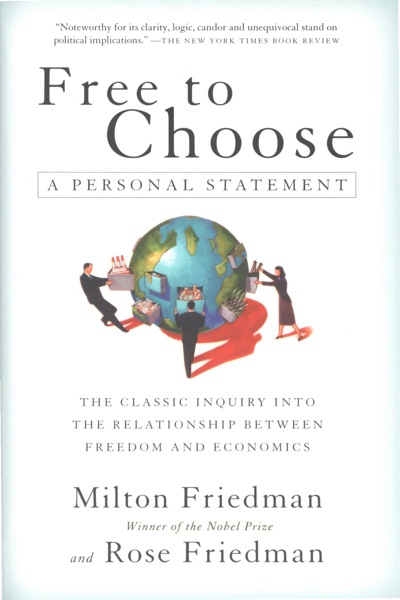
Free to Choose began as a ten-part television series on PBS in 1980, later expanded into the book Milton and Rose Friedman wrote together. Its purpose was explicitly popular — to explain the case for free markets and limited government to a general audience at a moment when the Keynesian consensus was cracking and stagflation had made the post-war economic settlement look broken. It remains one of the most widely read books in popular economic liberalism.
The Friedmans structure the argument around a core claim: that economic freedom and political freedom are inseparable, and that government expansion of the economic role of the state tends to erode personal liberty over time. Chapter by chapter they work through specific domains — the Federal Reserve, trade policy, welfare programs, education, consumer protection regulation — arguing in each case that market mechanisms allocate resources more efficiently and protect individual choice better than government programs. The writing is clear and accessible, deliberately avoiding academic hedging.
What it gets right
- 1.
Economic freedom and political freedom reinforce each other; as the state expands its economic role, individual liberty tends to contract.
- 2.
The Federal Reserve's tight money policy in 1929–1932 turned a stock market crash into the Great Depression — a monetary contraction of roughly one-third of the money supply.
- 3.
Free trade benefits all parties through comparative advantage: restrictions on trade protect particular industries at the expense of the general consumer.
What it covers
Who wrote it
Milton Friedman (1912–2006) was an American economist at the University of Chicago who won the Nobel Prize in Economics in 1976. He is best known for his work on monetarism, his critique of Keynesian economics, and his advocacy of free market policies. Rose Friedman (1910–2009) was an economist in her own right who co-authored several of Milton's most important popular works. Together they wrote A Monetary History of the United States and several books for general readers including Free to Choose, which accompanied the landmark PBS television series of the same name.
