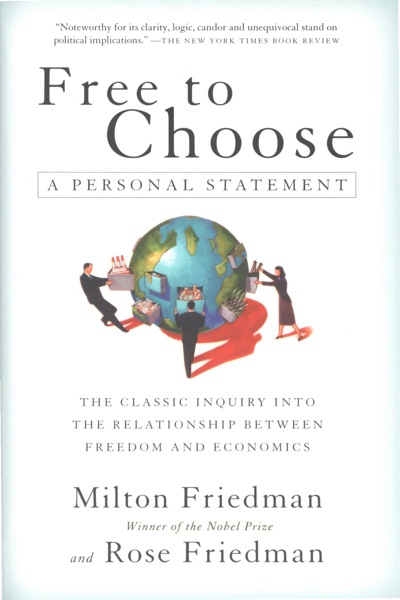
Free to Choose: A Personal Statement by Milton Friedman and Rose Friedman is a 1980 economics book about free markets, individual liberty, government intervention. Economic freedom and political freedom reinforce each other; as the state expands its economic role, individual liberty tends to contract.
Summary
Free to Choose began as a ten-part television series on PBS in 1980, later expanded into the book Milton and Rose Friedman wrote together. Its purpose was explicitly popular — to explain the case for free markets and limited government to a general audience at a moment when the Keynesian consensus was cracking and stagflation had made the post-war economic settlement look broken. It remains one of the most widely read books in popular economic liberalism.
The Friedmans structure the argument around a core claim: that economic freedom and political freedom are inseparable, and that government expansion of the economic role of the state tends to erode personal liberty over time. Chapter by chapter they work through specific domains — the Federal Reserve, trade policy, welfare programs, education, consumer protection regulation — arguing in each case that market mechanisms allocate resources more efficiently and protect individual choice better than government programs. The writing is clear and accessible, deliberately avoiding academic hedging.
The book's strongest sections concern monetary policy. Friedman's analysis of the Federal Reserve's role in turning a recession into the Great Depression remains influential and is presented accessibly here. His case for free trade, while not novel, is lucid. The analysis of welfare programs — arguing that they trap recipients in dependency and that a negative income tax would be more effective — is provocative and contested but genuinely engages with the mechanics of the problem rather than dismissing it.
Where critics push back hardest is on the political theory. The Friedmans assume a sharp boundary between economic and political liberty that many political economists dispute. Their analysis of regulation tends to assume regulators are captured and markets are self-correcting, a picture that looks more complicated in the wake of the 2008 financial crisis. The book reflects the confident monetarist moment of 1980 and should be read with some historical awareness of what economic thinking has revised since.
Talk to Free to Choose: A Personal Statement like its author wrote you back.
Get the ideas that fit your life — not generic summaries.
- Chat with the book
- Audiobook-style main ideas
- Adapts to your life and goals
- Helps you take action
Key takeaways
- 1.
Economic freedom and political freedom reinforce each other; as the state expands its economic role, individual liberty tends to contract.
- 2.
The Federal Reserve's tight money policy in 1929–1932 turned a stock market crash into the Great Depression — a monetary contraction of roughly one-third of the money supply.
- 3.
Free trade benefits all parties through comparative advantage: restrictions on trade protect particular industries at the expense of the general consumer.
- 4.
Government welfare programs often create dependency rather than solving poverty; a negative income tax would provide a floor of support with fewer distortions.
- 5.
Regulation frequently ends up protecting established businesses from competition rather than protecting consumers — regulatory capture is a predictable outcome.
- 6.
Prices coordinate economic activity without central direction by transmitting information about scarcity, preference, and cost across millions of actors simultaneously.
- 7.
The invisible hand of the market — voluntary exchange driven by self-interest — produces social coordination that no planned system has successfully replicated.
- 8.
School choice through vouchers would improve education by introducing competition, forcing schools to improve or lose students to better alternatives.
Discussion questions
Use these on your own, with a book club, or as chat starters in Superbook. Book club version, ready to copy or print →
- 1.
The Friedmans argue economic and political freedom are inseparable. Can you think of cases where they seem to pull in opposite directions?
- 2.
Their analysis of the Great Depression assigns primary blame to the Federal Reserve. How does this account hold up against other explanations you've encountered?
- 3.
The book argues against most regulation on grounds of regulatory capture. Is capture inevitable, or are there regulatory structures that have resisted it?
- 4.
Free trade is presented as clearly beneficial. How do you weigh the aggregate gains against the concentrated losses in specific communities and industries?
- 5.
The negative income tax proposal has been adopted in modified forms in various countries. What are the arguments for it compared to categorical welfare programs?
- 6.
The Friedmans wrote in 1980. Which of their predictions about government expansion and its effects have proved accurate? Which have not?
- 7.
School vouchers are one of their most contested proposals. What evidence has accumulated about voucher programs since 1980?
- 8.
How much of the book's argument depends on the assumption that markets correct themselves over time? Where does that assumption seem most and least defensible?
- 9.
The Friedmans distinguish between equality of opportunity and equality of outcome. Where do you think that line should be drawn in a just society?
- 10.
Many countries with large public sectors also have high economic freedom rankings. Does this complicate the Friedmans' core thesis?
- 11.
The book is a deliberate polemic as well as an economic argument. How does that affect how you read the empirical claims?
- 12.
What would Milton Friedman make of the growth in concentrated market power in technology, banking, and media since 1980?
Themes
Frequently asked questions
-
What is Free to Choose about?
It is the Friedmans' argument for free markets and limited government, covering monetary policy, trade, welfare, education, and regulation. Originally a PBS television series, it became one of the most influential popular books in economic liberalism.
-
Is Free to Choose still relevant today?
Yes as an intellectual document, though with caveats. Its monetary history analysis remains important. Some policy prescriptions look dated after the 2008 financial crisis and the growth of market concentration in industries the book assumed would self-correct through competition.
-
How long does it take to read Free to Choose?
About five to six hours for most readers. The chapters are self-contained and aimed at a general audience, so the book moves quickly despite its substantive arguments.
-
Who should read Free to Choose?
Anyone who wants to understand the intellectual foundations of modern free-market conservatism and libertarianism, students of economic policy, and readers interested in the economic debates of the late twentieth century that still shape current politics.
-
How does Free to Choose relate to Capitalism and Freedom?
Capitalism and Freedom, published in 1962, is Friedman's more academic earlier statement of similar ideas. Free to Choose covers much of the same ground but was written for a broader audience and updated to address the economic conditions of 1980.
Similar books
Capitalism and Freedom
Milton Friedman
The Road to Serfdom
F. A. Hayek
Why Nations Fail: The Origins of Power, Prosperity, and Poverty
Daron Acemoglu and James A. Robinson
The Wealth of Nations
Adam Smith
