Talk to Gödel, Escher, Bach like its author wrote you back.
Get the ideas that fit your life — not generic summaries.
- Chat with the book
- Audiobook-style main ideas
- Adapts to your life and goals
- Helps you take action
Gödel, Escher, Bach, in detail
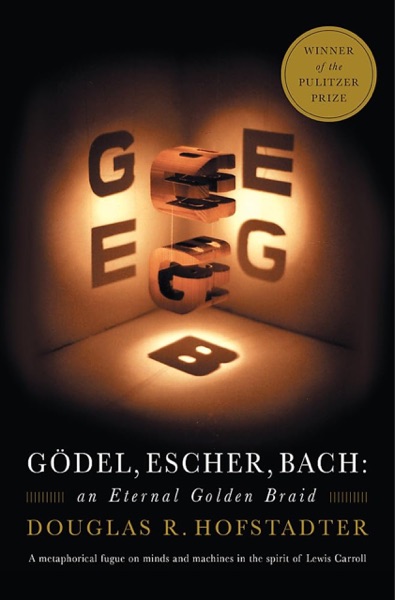
Douglas Hofstadter's Pulitzer Prize-winning debut, published in 1979, asks how meaning can arise from formal rules — how a biological machine can think, feel, and experience self-awareness. To answer this, Hofstadter weaves together the work of three figures: the mathematician Kurt Gödel, whose incompleteness theorems showed that any sufficiently powerful formal system contains statements it cannot prove; the visual artist M.C. Escher, whose drawings feature paradoxical loops of figures drawing themselves and staircases that ascend forever; and the composer J.S. Bach, whose fugues and canons use self-reference and recursive structure to create music of extraordinary depth.
The book's central concept is the "strange loop": a hierarchical structure in which you follow a series of steps and arrive back where you started, but at a different level. Gödel's proof is a strange loop — a statement about provability inside a formal system that refers to itself. Escher's drawings are strange loops — visual hierarchies that fold back on themselves. Bach's Musical Offering contains a modulating canon that rises through keys until it arrives back at the original pitch, one octave higher. Hofstadter argues that consciousness itself is a strange loop: the brain's ability to represent itself is what creates the "I" that feels, believes, and wonders.
The book is structured through alternating chapters and dialogues. The dialogues — featuring characters named Achilles and the Tortoise, derived from Zeno's paradoxes — enact the concepts the chapters explain. These dialogues are themselves strange loops: they demonstrate self-reference while discussing it. Topics covered include formal logic, number theory, the theory of computation, Zen koans, molecular biology, Turing machines, and the structure of Bach's counterpoint. The range is extraordinary, and Hofstadter moves between them with a playfulness that makes even the hardest sections engaging.
The book is genuinely difficult. Some passages on formal logic and number theory require concentration from readers without that background. But the payoff is substantial: GEB offers one of the most original and sustained attempts to think about what minds are, how they arise from material processes, and what the limits of formal systems imply for both mathematics and artificial intelligence. It remains as thought-provoking now as when it was published.
The big ideas
- 1.
Strange loops are hierarchical structures where moving through levels eventually brings you back to the starting point. Hofstadter argues they are the core structure underlying consciousness.
- 2.
Gödel's incompleteness theorems show that any sufficiently powerful formal system contains true statements it cannot prove. Self-reference — the system talking about itself — is the mechanism that creates this irreducible incompleteness.
- 3.
Consciousness arises from the brain's capacity to represent itself. The 'I' is not a separate entity but an emergent pattern created by the brain modeling its own activity.
