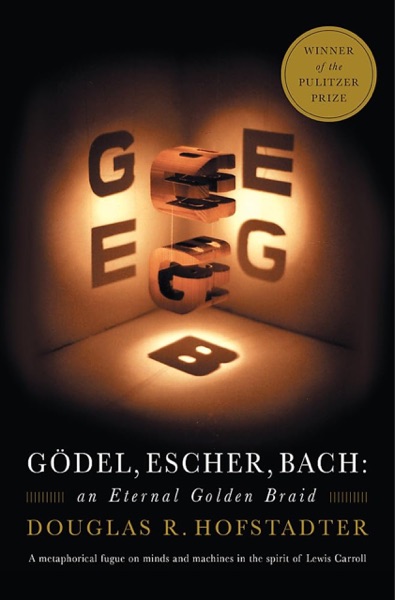
Gödel, Escher, Bach by Douglas Hofstadter is a 1979 science book about self-reference, consciousness, formal systems. Strange loops are hierarchical structures where moving through levels eventually brings you back to the starting point. Hofstadter argues they are the core structure underlying consciousness.
Summary
Douglas Hofstadter's Pulitzer Prize-winning debut, published in 1979, asks how meaning can arise from formal rules — how a biological machine can think, feel, and experience self-awareness. To answer this, Hofstadter weaves together the work of three figures: the mathematician Kurt Gödel, whose incompleteness theorems showed that any sufficiently powerful formal system contains statements it cannot prove; the visual artist M.C. Escher, whose drawings feature paradoxical loops of figures drawing themselves and staircases that ascend forever; and the composer J.S. Bach, whose fugues and canons use self-reference and recursive structure to create music of extraordinary depth.
The book's central concept is the "strange loop": a hierarchical structure in which you follow a series of steps and arrive back where you started, but at a different level. Gödel's proof is a strange loop — a statement about provability inside a formal system that refers to itself. Escher's drawings are strange loops — visual hierarchies that fold back on themselves. Bach's Musical Offering contains a modulating canon that rises through keys until it arrives back at the original pitch, one octave higher. Hofstadter argues that consciousness itself is a strange loop: the brain's ability to represent itself is what creates the "I" that feels, believes, and wonders.
The book is structured through alternating chapters and dialogues. The dialogues — featuring characters named Achilles and the Tortoise, derived from Zeno's paradoxes — enact the concepts the chapters explain. These dialogues are themselves strange loops: they demonstrate self-reference while discussing it. Topics covered include formal logic, number theory, the theory of computation, Zen koans, molecular biology, Turing machines, and the structure of Bach's counterpoint. The range is extraordinary, and Hofstadter moves between them with a playfulness that makes even the hardest sections engaging.
The book is genuinely difficult. Some passages on formal logic and number theory require concentration from readers without that background. But the payoff is substantial: GEB offers one of the most original and sustained attempts to think about what minds are, how they arise from material processes, and what the limits of formal systems imply for both mathematics and artificial intelligence. It remains as thought-provoking now as when it was published.
Talk to Gödel, Escher, Bach like its author wrote you back.
Get the ideas that fit your life — not generic summaries.
- Chat with the book
- Audiobook-style main ideas
- Adapts to your life and goals
- Helps you take action
Key takeaways
- 1.
Strange loops are hierarchical structures where moving through levels eventually brings you back to the starting point. Hofstadter argues they are the core structure underlying consciousness.
- 2.
Gödel's incompleteness theorems show that any sufficiently powerful formal system contains true statements it cannot prove. Self-reference — the system talking about itself — is the mechanism that creates this irreducible incompleteness.
- 3.
Consciousness arises from the brain's capacity to represent itself. The 'I' is not a separate entity but an emergent pattern created by the brain modeling its own activity.
- 4.
Meaning emerges from isomorphism — the structural correspondence between symbols and what they represent. This is how meaningless formal manipulation of symbols can give rise to genuine understanding.
- 5.
Any system powerful enough to express arithmetic is either incomplete (containing true but unprovable statements) or inconsistent (able to prove false statements). There is no escaping this tradeoff.
- 6.
The Turing Test captures something real about intelligence: if a system behaves indistinguishably from a thinking being across all contexts, the distinction between simulation and reality becomes philosophically empty.
- 7.
Recursion — rules that apply to their own output — is the structural principle behind language, music, mathematics, and ultimately mind. It is what allows finite systems to generate infinite complexity.
- 8.
The unity of the self is a kind of illusion produced by a complex system that has no single control center. What feels like a unified 'I' is a crowd of processes that, at human timescales, behave as one.
Discussion questions
Use these on your own, with a book club, or as chat starters in Superbook. Book club version, ready to copy or print →
- 1.
Hofstadter argues that the 'I' is an emergent strange loop rather than a foundational entity. Does that claim feel liberating, disturbing, or simply correct to you?
- 2.
Gödel showed that no formal system can be both complete and consistent. Does this limit feel threatening to mathematics and science, or does it feel like an interesting quirk with no practical importance?
- 3.
The book uses Bach's music as a structural model for how recursive self-reference creates depth. Do you hear Bach differently after reading GEB? What do you notice?
- 4.
Hofstadter was writing about AI in 1979, before the current wave of machine learning. How have his predictions and concerns held up? What did he get right and what did he miss?
- 5.
The dialogues between Achilles and the Tortoise are themselves strange loops — they enact what they describe. Did you find them illuminating or frustrating? Why?
- 6.
Hofstadter argues consciousness requires a certain level of self-representational complexity. Does that claim give you any intuition about whether AI systems today are conscious or not?
- 7.
The book connects Gödel, Escher, and Bach as illustrators of the same deep principle. Do you find that connection illuminating or forced? Are there other figures who belong in the same grouping?
- 8.
Escher's drawings create loops that are visually compelling but logically impossible. What is the emotional effect of an impossible loop? Why does it feel significant?
- 9.
GEB is partly about the limits of formal systems. Do you think there are genuine limits to what AI can do — problems it cannot solve even in principle — or do you think the incompleteness results don't apply to machine learning?
- 10.
The book is famously difficult and rewarding. Did you feel the difficulty was justified — that the complexity was necessary — or did parts feel unnecessarily obscure?
- 11.
Hofstadter's central claim about consciousness being a strange loop is a philosophical position, not an established scientific fact. How much weight do you give it? What would count as evidence for or against it?
- 12.
If the self is an emergent pattern rather than a substance, what implications does that have for personal identity over time? Are you the same person you were ten years ago in any meaningful sense?
Themes
Frequently asked questions
-
Is Gödel, Escher, Bach worth reading?
Yes, if you are willing to commit serious time and attention. It is one of the most original books written about minds, meaning, and formal systems. Readers who give it the patience it requires consistently describe it as one of the most intellectually rewarding books they've encountered.
-
How hard is Gödel, Escher, Bach to read?
Genuinely difficult in places. The dialogues and conceptual illustrations are accessible; the formal logic and number theory sections require focus. Readers without mathematics backgrounds can still follow the main arguments, but some sections will be slow going.
-
What is the central claim of Gödel, Escher, Bach?
That consciousness arises from strange loops — self-referential hierarchical structures in the brain. Hofstadter uses Gödel's incompleteness theorems, Escher's visual paradoxes, and Bach's recursive musical structures as different manifestations of the same deep principle.
-
Do I need to know music theory or mathematics to read this book?
Not formally. Hofstadter explains the relevant concepts as he goes. Some musical ear helps for the Bach sections; some comfort with logical notation helps for the Gödel sections. But the book was written for curious general readers, not specialists.
-
How long does it take to read?
At average reading pace, about thirteen hours. Most readers take much longer because the material rewards re-reading and pausing to think. It is not a book to rush through.