Memoir · Book club
Gang Leader for a Day book club questions
Here are 12 book club questions for Gang Leader for a Day by Sudhir Venkatesh, ordered to open easily and end somewhere worth arguing about. Copy them, print them, or bring them up one at a time.
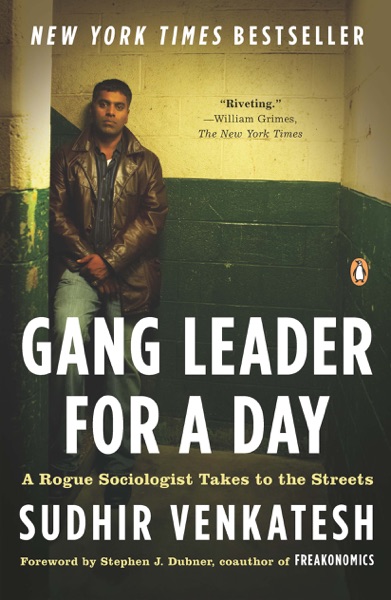
Gang Leader for a Day is Sudhir Venkatesh's account of the decade he spent doing ethnographic fieldwork in the Robert Taylor Homes, a Chicago public housing project, beginning in the late 1980s.
Sudhir Venkatesh · 2008 · 6h 0m
Full summary and key takeaways →The 12 questions
- 1.
Venkatesh arrived with a clipboard to conduct a survey and ended up spending a decade embedded in the community. What does this say about the limits and possibilities of standard social science methodology?
- 2.
J.T.'s gang functioned as a kind of local government. How should we think about institutions that emerge to fill vacuums left by the state — are they replacements, adaptations, or part of what perpetuates the vacuum?
- 3.
Venkatesh was present during crimes and violence and did not intervene or report. How do you evaluate his ethical choices — was the knowledge produced worth the cost?
- 4.
The book is written for a general audience, not an academic one. What is gained and lost in making ethnographic research accessible this way — to the researcher, to the community, to the reader?
- 5.
The residents Venkatesh describes have complicated relationships with the gang — not simply as victims. Does this complicate how you think about criminal organizations in poor communities?
- 6.
The Robert Taylor Homes were demolished in the 2000s. Does the dispersal of their residents represent progress — and what does the answer depend on?
- 7.
Several residents of the Robert Taylor Homes come across as more complex and capable than the 'victim of poverty' framing typically allows. What does the book do well and poorly in representing them?
- 8.
Venkatesh's access depended on his relationship with J.T. Does that relationship compromise the research — and if so, can ethnographic knowledge be obtained without similar compromises?
- 9.
The 'gang leader for a day' episode is comic and disturbing at the same time. What does it reveal about J.T.'s understanding of power — and about Venkatesh's position in the community?
- 10.
Who benefited most from Venkatesh's decade of research — the academic community, Venkatesh himself, the residents, or some other party? Does the distribution of benefit matter?
- 11.
The book was published in 2008, drawing on research from the late 1980s through late 1990s. How much do you think the conditions it describes persist in American cities today?
- 12.
Venkatesh acknowledges he was never entirely sure where his role as observer ended and his role as participant began. Is that ambiguity an ethical failure or an honest account of how fieldwork actually works?
How to run the discussion
- Pick six to eight, not all of them. An hour of real discussion covers fewer questions than anyone expects, and racing the list is what makes a book club feel like homework.
- Open with what people noticed, not what they concluded. Asking for a verdict first hardens opinions before anyone has heard each other.
- Let the disagreement run. The questions below that split a room are the ones worth the time; the ones everyone answers the same way can be skipped.
- Ask the quiet person a specific question. A direct, narrow question is far easier to answer than an open invitation to contribute.
Themes worth steering toward
If the conversation stalls, these are the threads that usually restart it.
Common questions
What are good book club questions for Gang Leader for a Day?
Here are 12 book club questions for Gang Leader for a Day by Sudhir Venkatesh, ordered to open easily and end somewhere worth arguing about. The strongest openers ask what each reader noticed rather than what they concluded, and the discussion usually turns on urban poverty, ethnographic research, community and power.
How long should a book club discussion of Gang Leader for a Day last?
Most groups run 60 to 90 minutes of actual discussion. That is roughly six to eight questions, not all of them, so pick the ones that suit your group rather than working down the list in order.
What are the main themes in Gang Leader for a Day?
Urban poverty, Ethnographic research, Community and power, Race and inequality, Research ethics. Those are the threads most likely to divide a room, which makes them the useful places to steer a discussion that has gone quiet.
Picking the next one? See books like Gang Leader for a Day or questions for other book club picks.
