Talk to Goliath like its author wrote you back.
Get the ideas that fit your life — not generic summaries.
- Chat with the book
- Audiobook-style main ideas
- Adapts to your life and goals
- Helps you take action
Goliath, in detail
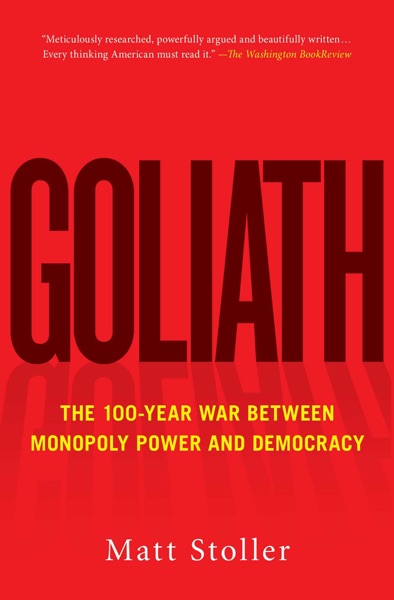
Goliath is Matt Stoller's history of monopoly power in America, arguing that the concentration of corporate power in the late twentieth and early twenty-first centuries is not a novel development but a return to a pattern that Americans once recognized as a fundamental threat to democratic governance — and successfully resisted through antitrust law. The book traces two opposing political traditions: the Brandeisian tradition that treated bigness as inherently dangerous to democratic participation, and the Chicago School tradition that dismissed structural concerns and focused only on whether concentration produced consumer harm measurable as higher prices.
Stoller's central claim is that the Chicago School revolution in antitrust thinking — associated with Robert Bork's 1978 book The Antitrust Paradox — didn't just change legal doctrine. It changed what Americans thought was acceptable, possible, and worth fighting about. By reducing antitrust to a question of consumer prices in the short term, it removed from the table the questions about power, political participation, and the dignity of work that had animated anti-monopoly politics since the Gilded Age. What followed was three decades of mergers, acquisitions, and market concentration in banking, retail, agriculture, media, and technology that the old regulatory framework would never have permitted.
The history is detailed and stretches from the Progressive Era through New Deal banking regulation to the deregulation campaigns of the 1970s and 1980s. Stoller is particularly good on figures like Wright Patman, the Texas congressman who spent decades fighting big banking and whose political defeat in the early 1970s marked the collapse of the anti-monopoly political tradition in Congress. He shows how the consumer welfare standard became orthodoxy not through academic persuasion alone but through a coordinated funding effort by business interests to reshape legal education and judicial appointments.
The book's weakness is that it moves at an academic pace and occasionally loses track of the current policy implications in its historical depth. But for readers who want to understand why American economic policy looks the way it does — why the phrase "trust-busting" sounds antique, why airline or banking or agricultural concentration is accepted as natural, and why the language of antitrust shifted from political economy to microeconomics — Goliath is a thorough and well-argued account.
The big ideas
- 1.
Anti-monopoly politics was once a mainstream American tradition. The Progressive Era and New Deal both defined concentrated corporate power as a threat to democratic self-governance, not just economic efficiency.
- 2.
The consumer welfare standard, associated with Robert Bork, redefined antitrust law to ask only whether a merger produces short-term consumer price harm. This change removed structural concerns about power from the analysis.
- 3.
The shift in antitrust doctrine in the 1970s and 1980s was not primarily academic. It was funded and organized by business interests that understood the policy implications and invested in changing the legal culture.
