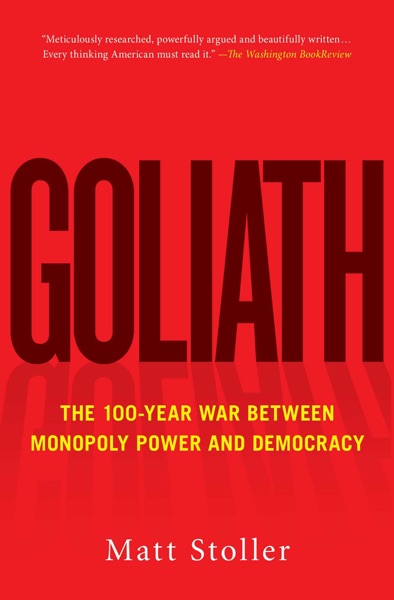
Goliath by Matt Stoller is a 2019 economics book about monopoly power, political economy, antitrust. Anti-monopoly politics was once a mainstream American tradition. The Progressive Era and New Deal both defined concentrated corporate power as a threat to democratic self-governance, not just economic efficiency.
Summary
Goliath is Matt Stoller's history of monopoly power in America, arguing that the concentration of corporate power in the late twentieth and early twenty-first centuries is not a novel development but a return to a pattern that Americans once recognized as a fundamental threat to democratic governance — and successfully resisted through antitrust law. The book traces two opposing political traditions: the Brandeisian tradition that treated bigness as inherently dangerous to democratic participation, and the Chicago School tradition that dismissed structural concerns and focused only on whether concentration produced consumer harm measurable as higher prices.
Stoller's central claim is that the Chicago School revolution in antitrust thinking — associated with Robert Bork's 1978 book The Antitrust Paradox — didn't just change legal doctrine. It changed what Americans thought was acceptable, possible, and worth fighting about. By reducing antitrust to a question of consumer prices in the short term, it removed from the table the questions about power, political participation, and the dignity of work that had animated anti-monopoly politics since the Gilded Age. What followed was three decades of mergers, acquisitions, and market concentration in banking, retail, agriculture, media, and technology that the old regulatory framework would never have permitted.
The history is detailed and stretches from the Progressive Era through New Deal banking regulation to the deregulation campaigns of the 1970s and 1980s. Stoller is particularly good on figures like Wright Patman, the Texas congressman who spent decades fighting big banking and whose political defeat in the early 1970s marked the collapse of the anti-monopoly political tradition in Congress. He shows how the consumer welfare standard became orthodoxy not through academic persuasion alone but through a coordinated funding effort by business interests to reshape legal education and judicial appointments.
The book's weakness is that it moves at an academic pace and occasionally loses track of the current policy implications in its historical depth. But for readers who want to understand why American economic policy looks the way it does — why the phrase "trust-busting" sounds antique, why airline or banking or agricultural concentration is accepted as natural, and why the language of antitrust shifted from political economy to microeconomics — Goliath is a thorough and well-argued account.
Talk to Goliath like its author wrote you back.
Get the ideas that fit your life — not generic summaries.
- Chat with the book
- Audiobook-style main ideas
- Adapts to your life and goals
- Helps you take action
Key takeaways
- 1.
Anti-monopoly politics was once a mainstream American tradition. The Progressive Era and New Deal both defined concentrated corporate power as a threat to democratic self-governance, not just economic efficiency.
- 2.
The consumer welfare standard, associated with Robert Bork, redefined antitrust law to ask only whether a merger produces short-term consumer price harm. This change removed structural concerns about power from the analysis.
- 3.
The shift in antitrust doctrine in the 1970s and 1980s was not primarily academic. It was funded and organized by business interests that understood the policy implications and invested in changing the legal culture.
- 4.
Wright Patman's defeat symbolizes the collapse of the anti-monopoly political tradition in Congress. Understanding who Patman was explains why that tradition disappeared from Democratic politics for a generation.
- 5.
Concentration in banking, retail, agriculture, media, and technology accelerated after the antitrust retreat. Stoller documents how each sector's dynamics changed as the constraint of competition was removed.
- 6.
The New Deal banking regulations that survived into the 1970s were not just economic policy — they were structural decisions about who should have power and how fragmented it should be.
- 7.
Big Tech's dominance follows the same structural pattern as earlier monopolies in rail, oil, and banking. The tools used to address those monopolies are available; the political will to use them is the variable.
- 8.
A political movement to address concentration requires a language and a theory of harm that goes beyond consumer prices — one that addresses power, work, and democratic participation.
Discussion questions
Use these on your own, with a book club, or as chat starters in Superbook. Book club version, ready to copy or print →
- 1.
Stoller argues that the consumer welfare standard is too narrow to capture the harms of monopoly. Do you find the alternative — a broader structural concern about power — convincing as a legal and policy standard?
- 2.
The anti-monopoly tradition Stoller describes was bipartisan. Why does that kind of politics seem harder to sustain today, and what would it take to revive it?
- 3.
The Chicago School revolution happened partly through targeted funding of legal education and judicial appointments. What does that story suggest about how policy change actually works?
- 4.
Think about an industry you know well. Is concentration in that industry a problem, and if so, what kind — price harm, quality reduction, labor market effects, political power, something else?
- 5.
Stoller is sympathetic to the anti-monopoly tradition. Are there places where he understates the benefits of scale economies or network effects that make concentration genuinely efficient?
- 6.
Wright Patman fought big banking for decades and largely lost. What does his story suggest about the relationship between correct analysis and political success?
- 7.
Big Tech platforms are different from old industrial monopolies in significant ways — their services are often free, and their network effects create genuine value. Does antitrust law designed for railroads and oil companies apply to them?
- 8.
Stoller argues that concentration reduces the dignity of work as well as consumer welfare. Is labor market harm a compelling antitrust justification, or should workers' concerns be addressed through separate policy?
- 9.
The book covers a long historical arc. Which period do you think Stoller explains most persuasively, and which feels like a stretch?
- 10.
The language of antitrust shifted from political economy to microeconomics. Does the restoration of political-economy language make the argument stronger or does it risk being dismissed as ideological?
- 11.
What would a serious bipartisan anti-monopoly policy agenda look like today, and what industries would be its primary targets?
- 12.
Stoller's analysis implies that the problem is political will, not missing policy tools. Do you agree, or are there genuine legal and institutional barriers that would need to be rebuilt?
Themes
Frequently asked questions
-
What is Goliath by Matt Stoller about?
It's a history of monopoly power in America and the political tradition that once fought it. Stoller argues that the consumer welfare standard that now governs antitrust law replaced a broader anti-monopoly tradition that treated concentrated corporate power as a threat to democracy, not just consumer prices.
-
Is Goliath a partisan book?
It's written from a left-of-center perspective, but Stoller draws on a tradition of anti-monopoly politics that was bipartisan through most of the twentieth century. His heroes include both progressive Democrats and Republican trustbusters. Readers across the political spectrum who are skeptical of concentrated corporate power will find material here.
-
How long is Goliath?
About 500 pages. It's a dense historical argument and takes most readers eight to nine hours. The book is organized chronologically, so readers interested in specific periods can dip in.
-
Who should read Goliath?
Anyone interested in antitrust policy, political economy, or the history of corporate power in America. It's particularly useful for people who work in or around Big Tech, finance, or agriculture and want a historical framework for the market structure questions they encounter.
-
What's Stoller's proposed solution?
He argues for restoring the anti-monopoly political tradition — applying antitrust law to structural concerns about power, not just consumer price effects — and names specific industries and mergers that should have been blocked. He's more precise about the diagnosis than the precise remedies, but structural breakups and stronger merger review are the core of what he advocates.
Similar books
The Age of Surveillance Capitalism: The Fight for a Human Future at the New Frontier of Power
Shoshana Zuboff
The Shock Doctrine: The Rise of Disaster Capitalism
Naomi Klein
Basic Economics: A Common Sense Guide to the Economy
Thomas Sowell
The Narrow Corridor: States, Societies, and the Fate of Liberty
Daron Acemoglu and James A. Robinson
