Talk to Good Omens like its author wrote you back.
Get the ideas that fit your life — not generic summaries.
- Chat with the book
- Audiobook-style main ideas
- Adapts to your life and goals
- Helps you take action
What it argues
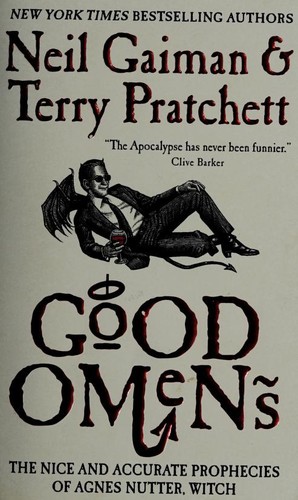
Good Omens is a comic fantasy novel about the impending apocalypse and the attempts of an angel and a demon — Aziraphale and Crowley, who have been stationed on Earth since the Beginning — to prevent it. Neither of them particularly wants the world to end: Aziraphale has grown fond of bookshops and fine dining; Crowley has developed a taste for his Bentley and annoying houseplants. They have, over six thousand years of proximity, developed a working relationship that has drifted into something considerably warmer. When the Antichrist is misplaced at birth and grows up as an ordinary English boy who has no idea who he is, the forces of Heaven and Hell find their schedule disrupted in ways neither anticipated.
The book is about free will in the most practical sense: whether beings created for a purpose can choose differently. Aziraphale and Crowley are the novel's argument that they can. They are not reformers or rebels — they are, respectively, a bit fussy and a bit lazy — but their attachment to the world they've been asked to destroy or defend turns out to be enough. The Antichrist, raised as a normal child with normal human values, turns out to be the novel's actual moral center: someone with enormous destructive power who uses it to assert that the world, despite everything, is worth keeping.
What it gets right
- 1.
Aziraphale and Crowley's relationship — six thousand years of nominal opposition and actual friendship — is the novel's argument that belonging to different sides does not preclude genuine connection.
- 2.
Adam Young, the Antichrist, is the novel's real hero: a child who has the power to remake the world and chooses to keep it messy and human instead. The book's deepest optimism lives in that choice.
- 3.
Both Heaven and Hell are portrayed as bureaucracies — with middle managers, paperwork, and institutional inertia. This is not cynicism but precision: institutions are indifferent to the good of the people inside them.
What it covers
Who wrote it
Terry Pratchett (1948–2015) was a British author best known for the Discworld series, a satirical fantasy of over 40 novels. He was one of the best-selling British authors of the 20th century and was knighted in 2009. Neil Gaiman is a British-American author whose work spans novels, short stories, comics, and screenplays; he is best known for American Gods, Neverwhere, and the Sandman graphic novel series. Good Omens, their only novel-length collaboration, was written largely by correspondence and remains one of the most beloved British comic novels of the late 20th century.
