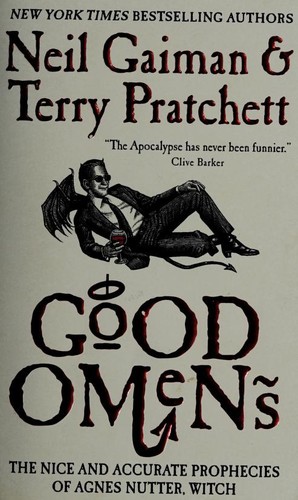
Good Omens by Terry Pratchett & Neil Gaiman is a 1990 fantasy book about free will and destiny, good versus evil, friendship across difference. Aziraphale and Crowley's relationship — six thousand years of nominal opposition and actual friendship — is the novel's argument that belonging to different sides does not preclude genuine connection.
Summary
Good Omens is a comic fantasy novel about the impending apocalypse and the attempts of an angel and a demon — Aziraphale and Crowley, who have been stationed on Earth since the Beginning — to prevent it. Neither of them particularly wants the world to end: Aziraphale has grown fond of bookshops and fine dining; Crowley has developed a taste for his Bentley and annoying houseplants. They have, over six thousand years of proximity, developed a working relationship that has drifted into something considerably warmer. When the Antichrist is misplaced at birth and grows up as an ordinary English boy who has no idea who he is, the forces of Heaven and Hell find their schedule disrupted in ways neither anticipated.
The book is about free will in the most practical sense: whether beings created for a purpose can choose differently. Aziraphale and Crowley are the novel's argument that they can. They are not reformers or rebels — they are, respectively, a bit fussy and a bit lazy — but their attachment to the world they've been asked to destroy or defend turns out to be enough. The Antichrist, raised as a normal child with normal human values, turns out to be the novel's actual moral center: someone with enormous destructive power who uses it to assert that the world, despite everything, is worth keeping.
Pratchett and Gaiman wrote Good Omens as a genuine collaboration — the seams are largely invisible — and the result is a novel with both Pratchett's satirical bureaucratic absurdism and Gaiman's mythological romanticism. The footnotes are a feature, not a bug. The novel moves fast, is frequently very funny, and has a genuine emotional underpinning that the comedy serves rather than undermines. Pratchett in particular was writing about humanity's capacity for mess and decency simultaneously, and that affection for flawed human life runs through every page.
Good Omens has aged unusually well for a 1990 comic novel — its theology is sharp, its environmental anxiety is prescient, and its central relationship reads as warmly and clearly queer to modern readers even though neither the text nor its authors (at the time) would have used that label. The Amazon adaptation made it explicit. Readers who enjoy British comic writing, Douglas Adams adjacency, and theological farce with genuine heart will find it close to perfect.
Talk to Good Omens like its author wrote you back.
Get the ideas that fit your life — not generic summaries.
- Chat with the book
- Audiobook-style main ideas
- Adapts to your life and goals
- Helps you take action
Key takeaways
- 1.
Aziraphale and Crowley's relationship — six thousand years of nominal opposition and actual friendship — is the novel's argument that belonging to different sides does not preclude genuine connection.
- 2.
Adam Young, the Antichrist, is the novel's real hero: a child who has the power to remake the world and chooses to keep it messy and human instead. The book's deepest optimism lives in that choice.
- 3.
Both Heaven and Hell are portrayed as bureaucracies — with middle managers, paperwork, and institutional inertia. This is not cynicism but precision: institutions are indifferent to the good of the people inside them.
- 4.
The comedy and the genuine affection for humanity are the same thing. Pratchett and Gaiman are not laughing at people — they are laughing at the systems that try to reduce people to instruments.
- 5.
The book's theology is coherent: if God is ineffable and the Plan is unknowable, then the agents of that Plan cannot know they're serving it. That uncertainty is the ground on which every character makes a real choice.
- 6.
The Them — Adam's gang of ordinary English children — is the novel's most underrated element. Children who have not yet been told who to be are presented as the clearest-eyed observers in the book.
- 7.
The footnotes function as a second narrative voice — the authors speaking directly about humanity's odd relationship with time, death, and small pleasures. They are worth reading.
- 8.
The ending is about restoration, not triumph. The world continues — imperfect, chaotic, fully human. That's the novel's answer to the question of what makes the world worth saving.
Discussion questions
Use these on your own, with a book club, or as chat starters in Superbook. Book club version, ready to copy or print →
- 1.
Aziraphale and Crowley have been at cross-purposes for six thousand years and ended up, functionally, on the same side. What does the novel suggest about the relationship between institutional loyalty and personal values?
- 2.
Both Heaven and Hell want the war to happen. What does the novel imply about why institutions sometimes need conflict even when it's against their stated purpose?
- 3.
Adam has the power to rebuild the world according to his whims and instead chooses to leave it as it is. Is that a conservative choice, a radical one, or something else?
- 4.
The book is a comedy, but its central emotional investment — Aziraphale and Crowley's friendship — is sincere. Did the tonal mixture work for you? Is there anything the comedy prevents the novel from doing?
- 5.
The witchfinder Shadwell and the medium Madame Tracy are comic characters who nonetheless drive the plot's emotional resolution. What does their story add to the novel's argument about ordinary people versus cosmic forces?
- 6.
Pratchett and Gaiman both claim they can barely remember who wrote what. Does the collaboration feel seamless to you, or can you detect different registers?
- 7.
The novel's treatment of Aziraphale and Crowley has been read as queerness by most modern readers and most definitively by the Amazon adaptation. Does making that explicit change how the novel works?
- 8.
The prophecies of Agnes Nutter are presented as perfectly accurate but perfectly useless because no one can interpret them until after the fact. What does that device say about the relationship between prophecy and free will?
- 9.
Compare the novel's theological argument — that the agents of good and evil cannot know God's actual plan — with a book like C.S. Lewis's The Screwtape Letters, which makes a different use of the same territory. What does each book think theology is for?
- 10.
The environmental subplot — the Horseman Pollution replacing Pestilence — lands quite differently in 2026 than it would have in 1990. Has the novel's satire aged into something more serious? Does that improve or complicate it?
- 11.
The Antichrist is raised to be a normal English boy and turns out to have normal English values. Is the novel arguing that ordinary human values are good enough, or is it saying something more specific about childhood and moral formation?
- 12.
Good Omens is frequently compared to Douglas Adams's Hitchhiker's Guide in terms of comic register. Where do they overlap, and where is Pratchett and Gaiman's sensibility different?
Themes
Frequently asked questions
-
Is Good Omens worth reading in 2026?
Yes. The comedy is as sharp as ever, the central relationship is more explicitly resonant than it was in 1990, and the book's theology and environmental satire have aged into something more pointed. It's also very funny. If you enjoyed the Amazon series, the novel has more of everything.
-
How does the Amazon Good Omens series compare to the book?
The series is faithful to the novel and extends it considerably, particularly in the second season. Gaiman was closely involved. Most readers who love the book also love the series. The series makes explicit what the novel implies about Aziraphale and Crowley.
-
Is Good Omens hard to read?
Not at all. It reads fast and is frequently very funny. The footnotes are worth reading — skip them and you lose one of the best parts of the book. British readers may catch more of the satire, but it translates well.
-
Who shouldn't read Good Omens?
Readers who find theological humor disrespectful or who want a straightforward fantasy plot without comedy. The book is fundamentally a farce — if that register doesn't work for you, neither will this.
-
What's the read order for Good Omens and the rest of Pratchett's and Gaiman's work?
Good Omens stands alone. For more Pratchett, start with Small Gods or Guards! Guards! in Discworld. For more Gaiman, start with American Gods or Neverwhere.