Talk to Good Strategy Bad Strategy like its author wrote you back.
Get the ideas that fit your life — not generic summaries.
- Chat with the book
- Audiobook-style main ideas
- Adapts to your life and goals
- Helps you take action
What it argues
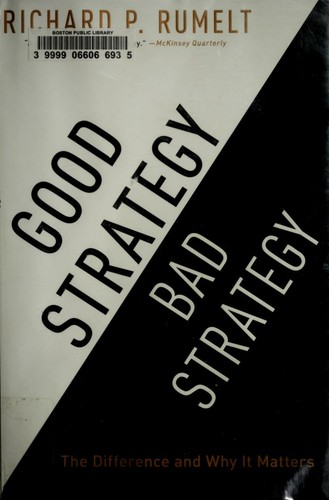
Good Strategy Bad Strategy is Richard Rumelt's indictment of the strategic planning process as it is practiced in most organizations, and his articulation of what genuine strategy actually requires. Rumelt is one of the most respected strategy scholars alive, and the book is both a diagnosis of what passes for strategy and a framework for producing real strategy instead.
The core diagnosis is that most organizations produce "bad strategy" — documents and presentations that list goals, aspirations, and mission statements without ever identifying the actual challenge or how to overcome it. Bad strategy is recognizable by four hallmarks: fluff (strategic buzzwords that disguise the absence of thought), failing to face the challenge (not clearly naming the problem being solved), mistaking goals for strategy (stating desired outcomes without specifying how to achieve them), and bad strategic objectives (vague or impractical targets that can't guide action).
What it gets right
- 1.
Bad strategy is not the absence of strategy — it is the pretense of strategy through mission statements, goals, and buzzwords that avoid naming the actual challenge.
- 2.
The kernel of good strategy: a diagnosis (what is the nature of the challenge?), a guiding policy (what approach addresses it?), and coherent actions (what specifically will we do?).
- 3.
Diagnosis is the most undervalued element. Without a clear diagnosis of the actual problem, guiding policy and actions cannot be coherently designed.
What it covers
Who wrote it
Richard Rumelt is a professor emeritus at the UCLA Anderson School of Management and one of the most influential strategy scholars of the past fifty years. He studied under business historian Alfred Chandler and was a faculty member at INSEAD and Harvard before joining UCLA. He has consulted for companies including Intel, Shell, and the US Army. Good Strategy Bad Strategy, published in 2011, distills decades of research and consulting work into a single coherent framework. He followed it with The Crux in 2022, which focuses specifically on the diagnosis step.
