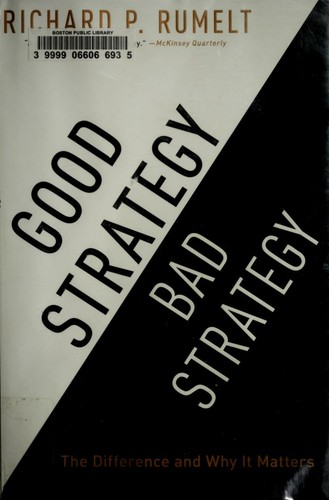
Good Strategy Bad Strategy by Richard Rumelt is a 2011 business book about strategy, leadership, competition. Bad strategy is not the absence of strategy — it is the pretense of strategy through mission statements, goals, and buzzwords that avoid naming the actual challenge.
Summary
Good Strategy Bad Strategy is Richard Rumelt's indictment of the strategic planning process as it is practiced in most organizations, and his articulation of what genuine strategy actually requires. Rumelt is one of the most respected strategy scholars alive, and the book is both a diagnosis of what passes for strategy and a framework for producing real strategy instead.
The core diagnosis is that most organizations produce "bad strategy" — documents and presentations that list goals, aspirations, and mission statements without ever identifying the actual challenge or how to overcome it. Bad strategy is recognizable by four hallmarks: fluff (strategic buzzwords that disguise the absence of thought), failing to face the challenge (not clearly naming the problem being solved), mistaking goals for strategy (stating desired outcomes without specifying how to achieve them), and bad strategic objectives (vague or impractical targets that can't guide action).
Rumelt's definition of good strategy is built around the "kernel": diagnosis, guiding policy, and coherent actions. The diagnosis defines the challenge — what is the specific nature of the obstacle or opportunity? The guiding policy specifies the approach to addressing the challenge, ruling out some actions and concentrating resources on others. Coherent actions are the specific steps, resource allocations, and organizational changes that implement the policy. Without all three, you don't have a strategy — you have a wish list.
The book is organized into two halves: the first diagnoses bad strategy with examples from politics, military history, and business; the second explains what makes strategy good, with case studies including Apple's return under Jobs, Nvidia's bet on graphics processors, and the US's containment strategy during the Cold War. Rumelt writes in a clear, sometimes acerbic voice — he is not gentle about strategic pretension — and the book is more intellectually ambitious than most business strategy books.
Talk to Good Strategy Bad Strategy like its author wrote you back.
Get the ideas that fit your life — not generic summaries.
- Chat with the book
- Audiobook-style main ideas
- Adapts to your life and goals
- Helps you take action
Key takeaways
- 1.
Bad strategy is not the absence of strategy — it is the pretense of strategy through mission statements, goals, and buzzwords that avoid naming the actual challenge.
- 2.
The kernel of good strategy: a diagnosis (what is the nature of the challenge?), a guiding policy (what approach addresses it?), and coherent actions (what specifically will we do?).
- 3.
Diagnosis is the most undervalued element. Without a clear diagnosis of the actual problem, guiding policy and actions cannot be coherently designed.
- 4.
Goals are not strategies. Stating that you want to grow revenue by 30% or become the market leader does not tell anyone what to do differently. Strategy specifies the approach.
- 5.
Leverage is the amplification of effort. Good strategy identifies the precise point where action will have disproportionate impact, then concentrates resources there.
- 6.
Strategic coherence means that every element of the organization — resources, capabilities, choices — reinforces the same guiding logic. Incoherence dissipates effort.
- 7.
Proximate objectives are specific enough that the organization knows how to move toward them. Distant or vague objectives, even ambitious ones, do not guide action.
- 8.
Strategy requires making choices that rule things out. A strategy that tries to be everything to everyone is not a strategy — it's a failure to choose.
Discussion questions
Use these on your own, with a book club, or as chat starters in Superbook. Book club version, ready to copy or print →
- 1.
Rumelt identifies four hallmarks of bad strategy: fluff, failure to face the challenge, goals mistaken for strategy, and bad strategic objectives. Which of these do you see most often in organizations you know?
- 2.
Apply Rumelt's kernel — diagnosis, guiding policy, coherent actions — to a strategic decision you've seen recently. Were all three elements present? What was missing?
- 3.
Why is diagnosis so often skipped or rushed in strategic planning? What organizational pressures push teams to jump from challenge to solution?
- 4.
Rumelt says strategy requires making choices that rule things out. What does a company lose — politically, emotionally, practically — when it makes a real strategic choice?
- 5.
Can an organization have too much strategic coherence? What happens when the guiding policy is correct but every action is too tightly aligned to it?
- 6.
Rumelt argues that the strategic planning process itself generates bad strategy because it invites everyone to contribute goals rather than forcing diagnosis. How would you redesign a typical planning cycle to produce better strategy?
- 7.
What's the difference between a guiding policy and a mission statement? Why does one guide action and the other often doesn't?
- 8.
Rumelt's Apple and Nvidia case studies show strategies that worked because they bet on specific technical advantages. How do you identify a genuine leverage point before its value is proven?
- 9.
He is critical of academic strategy frameworks, including aspects of Porter's Five Forces. Do you agree that they sometimes substitute analysis for thinking? What would you add or change?
- 10.
What is proximate versus distant objectives in Rumelt's framework, and how do you calibrate the right level of ambition in strategic objectives?
- 11.
Military strategy features prominently in the book. What transfers cleanly from military strategy to business strategy, and where does the analogy break down?
- 12.
If you had to write a one-page strategy for something you care about right now — a company, a project, your career — using Rumelt's kernel, what would your diagnosis be?
Themes
Frequently asked questions
-
Is Good Strategy Bad Strategy worth reading?
Yes, especially for anyone involved in strategic planning who suspects that what they produce doesn't actually guide decisions. Rumelt is one of the most precise thinkers on strategy, and the kernel framework is immediately applicable to organizational planning processes.
-
Who should read Good Strategy Bad Strategy?
Senior leaders, strategy consultants, and anyone who has sat through a strategy offsite and left without knowing what to do differently on Monday. The book is also useful for business school students who want a rigorous alternative to the frameworks taught in most strategy courses.
-
What is Rumelt's definition of strategy?
Good strategy has three parts: a diagnosis that defines the challenge clearly, a guiding policy that specifies the approach, and coherent actions that implement the policy. The diagnosis is the most distinctive element — most strategic documents skip it entirely.
-
How difficult is Good Strategy Bad Strategy to read?
It is accessible and well-written. Rumelt uses historical and contemporary case studies throughout. The book is denser than a typical business book but not academic in style. Most readers finish it in six to eight hours.
-
How does Good Strategy Bad Strategy compare to Playing to Win?
Good Strategy Bad Strategy is more focused on identifying bad strategy and articulating what strategy actually requires. Playing to Win is more prescriptive — it provides a framework of five choices for building strategy. The two books complement each other well.
Similar books
Competitive Strategy
Michael E. Porter
Playing to Win: How Strategy Really Works
Roger L. Martin and A.G. Lafley
Blue Ocean Strategy
W. Chan Kim and Renée Mauborgne
The Innovator's Dilemma
Clayton M. Christensen
