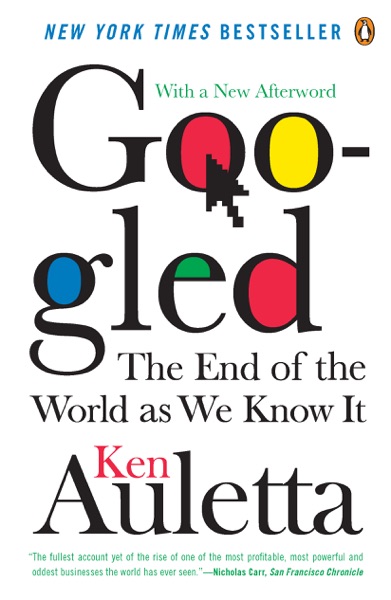
Talk to Googled: The End of the World As We Know It like its author wrote you back.
Get the ideas that fit your life — not generic summaries.
- Chat with the book
- Audiobook-style main ideas
- Adapts to your life and goals
- Helps you take action
What it argues
Ken Auletta has been writing about media and power for the New Yorker since the 1990s, and Googled is his attempt to explain what Google did to the industries that preceded it. Published in 2009, just over a decade after Google's founding, the book was written with unusual access: Auletta interviewed Sergey Brin, Larry Page, and Eric Schmidt, and many of the executives at the newspapers, television networks, and advertising agencies that Google was quietly destroying.
The book's structure alternates between Google's history and the industries it disrupted. On one side: the story of how two Stanford graduate students built a search algorithm, added advertising that worked when traditional advertising was failing, and assembled an engineering culture that treated every problem as a data problem. On the other side: the story of newspaper publishers, television executives, and Madison Avenue veterans who understood something was happening to them but couldn't figure out what, or how to respond. Auletta is sympathetic to both sides — he does not treat the incumbents as simply slow or venal, and he does not treat Google as simply heroic.
What it gets right
- 1.
Google's original insight was that advertising that worked — that delivered customers who actually wanted what was being sold — was worth far more than advertising that reached large audiences indiscriminately.
- 2.
The advertising cross-subsidy model that paid for newspapers, television news, and magazines was not protected by law or consumer loyalty — it was protected only by the absence of a better alternative. Google provided one.
- 3.
Google's engineering culture treated every problem as a data problem. This was not just a management philosophy; it was incompatible with the judgment-and-relationship culture of media and advertising incumbents.
What it covers
Who wrote it
Ken Auletta has written about power, media, and technology for the New Yorker since 1992. He is the author of more than a dozen books, including Greed and Glory on Wall Street, Three Blind Mice (on the television networks), World War 3.0 (on Microsoft's antitrust case), and The Highwaymen (on media moguls). His decades covering the intersection of media and money gave him the contacts and perspective to write Googled with access most journalists couldn't obtain. He is widely regarded as one of the most authoritative chroniclers of media industry power in the United States.
