Googled: The End of the World As We Know It by Ken Auletta is a 2009 business book about technology disruption, media industry, corporate culture. Google's original insight was that advertising that worked — that delivered customers who actually wanted what was being sold — was worth far more than advertising that reached large audiences indiscriminately.
Summary
Ken Auletta has been writing about media and power for the New Yorker since the 1990s, and Googled is his attempt to explain what Google did to the industries that preceded it. Published in 2009, just over a decade after Google's founding, the book was written with unusual access: Auletta interviewed Sergey Brin, Larry Page, and Eric Schmidt, and many of the executives at the newspapers, television networks, and advertising agencies that Google was quietly destroying.
The book's structure alternates between Google's history and the industries it disrupted. On one side: the story of how two Stanford graduate students built a search algorithm, added advertising that worked when traditional advertising was failing, and assembled an engineering culture that treated every problem as a data problem. On the other side: the story of newspaper publishers, television executives, and Madison Avenue veterans who understood something was happening to them but couldn't figure out what, or how to respond. Auletta is sympathetic to both sides — he does not treat the incumbents as simply slow or venal, and he does not treat Google as simply heroic.
The core of his argument is that Google's disruption was not primarily technological. It was cultural and epistemological. Google's engineering culture — data-driven, skeptical of intuition, committed to transparency — was genuinely foreign to industries built on relationships, expertise, and the soft knowledge of what audiences want. Google didn't just take market share from newspapers and TV. It undermined the business model (the advertising cross-subsidy) that paid for journalism and original programming, and it did so without understanding or caring much about what it was eliminating.
The book was published before the full effects of that disruption were visible. Much of what Auletta predicted — the hollowing out of local journalism, the collapse of classified advertising, the restructuring of the advertising industry around programmatic buying — has now happened. Re-reading Googled today, the prescient passages are striking. Auletta sees the threat more clearly than most of the executives he interviews. Where the book shows its age is in its treatment of Facebook, Twitter, and the social web as peripheral developments rather than the next wave of disruption that would, in turn, challenge Google itself.
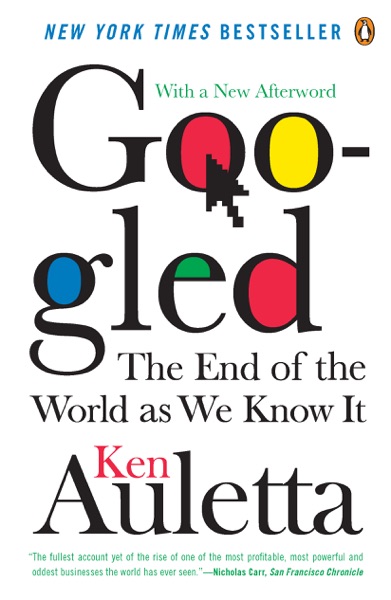
Talk to Googled: The End of the World As We Know It like its author wrote you back.
Get the ideas that fit your life — not generic summaries.
- Chat with the book
- Audiobook-style main ideas
- Adapts to your life and goals
- Helps you take action
Key takeaways
- 1.
Google's original insight was that advertising that worked — that delivered customers who actually wanted what was being sold — was worth far more than advertising that reached large audiences indiscriminately.
- 2.
The advertising cross-subsidy model that paid for newspapers, television news, and magazines was not protected by law or consumer loyalty — it was protected only by the absence of a better alternative. Google provided one.
- 3.
Google's engineering culture treated every problem as a data problem. This was not just a management philosophy; it was incompatible with the judgment-and-relationship culture of media and advertising incumbents.
- 4.
The 'Don't be evil' culture at early Google was genuine, but it coexisted with aggressive competitive behavior that the company didn't characterize as evil because it defined evil as protecting its own ad revenues rather than as damaging competitors.
- 5.
Newspapers didn't fail because readers stopped caring about news. They failed because the advertising revenue that subsidized reporting migrated to Google and, later, social platforms that provided better targeting at lower cost.
- 6.
Eric Schmidt's role as adult CEO alongside Brin and Page was a deliberate attempt to bring operational discipline to an engineering culture that treated business as a second-order concern.
- 7.
Television networks and film studios were less immediately threatened than newspapers because their content — premium video — was harder to displace. But the underlying economics were changing in the same direction.
- 8.
Google's belief in radical transparency — open data, public information — was in direct conflict with industries whose business models depended on information asymmetry.
Discussion questions
Use these on your own, with a book club, or as chat starters in Superbook. Book club version, ready to copy or print →
- 1.
Auletta portrays the newspaper and advertising executives as smart people who failed to adapt. What would adapting actually have looked like in 2005? Was it possible?
- 2.
Google's early motto was 'Don't be evil.' How does that slogan look in retrospect, given what the company became? Was it sincere, naive, or self-serving?
- 3.
The advertising cross-subsidy paid for local journalism. Should the companies that benefited from destroying it — Google, Facebook — have any obligation to replace what was lost?
- 4.
Google treats everything as a data problem. What are the things that data analysis handles well, and what does it systematically miss or distort?
- 5.
Auletta had unusual access to Google's leadership. Does the book feel like he was too close to his sources, or does the access improve the account?
- 6.
The book was published in 2009, before Facebook's rise and before mobile fully transformed search. Which of Auletta's predictions have aged well, and which look wrong now?
- 7.
Schmidt, Brin, and Page all have backgrounds as computer scientists. Does technical training produce a specific kind of business blindspot? What are its benefits and costs?
- 8.
Google disrupted industries whose disruption had significant social costs — local journalism, in particular. How should we weigh market efficiency against the social functions that inefficient markets were supporting?
- 9.
Auletta finds the media executives often more sympathetic than their detractors do. Does he convince you to see their situation as genuinely difficult rather than simply self-protective?
- 10.
What does the Google story suggest about the durability of Google's own position? What are the equivalent structural vulnerabilities that a future disruptor might exploit?
- 11.
The book's title is 'The End of the World As We Know It.' Was it? What was the world that ended, and what replaced it?
Themes
Frequently asked questions
-
Is Googled worth reading in 2026?
Yes, as a historical document and as a lens for thinking about technology disruption cycles. Much of what it predicted has happened. The book's account of how incumbents fail to respond to new entrants is still applicable to industries facing disruption today.
-
How does Googled compare to more recent Google books?
Googled focuses on Google's first decade and its impact on media rather than on Google's internal politics or later controversies. It's more about disruption than about corporate culture. Readers wanting the inside story of Google's later years will need other sources.
-
What is the main argument of Googled?
That Google didn't just take market share from incumbent media companies — it destroyed the advertising cross-subsidy model that paid for journalism and original programming, through a combination of superior targeting and a fundamentally different epistemological culture.
-
Who should read Googled?
People interested in media history, technology disruption, and the economics of attention and advertising. Also useful for anyone thinking about the social costs of market efficiency — the book documents a case where the market won but society paid a price.
-
How long does it take to read?
About seven hours at average reading pace. The chapters alternate between Google's history and the industries it affected, which makes it readable in segments. The writing is accessible journalism rather than academic analysis.
Similar books
No Filter: The Inside Story of Instagram
Sarah Frier
Super Pumped: The Battle for Uber
Mike Isaac
The Everything Store: Jeff Bezos and the Age of Amazon
Brad Stone
Only the Paranoid Survive
Andrew S. Grove
