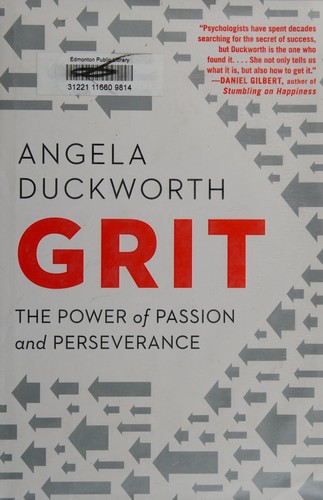
Talk to Grit: The Power of Passion and Perseverance like its author wrote you back.
Get the ideas that fit your life — not generic summaries.
- Chat with the book
- Audiobook-style main ideas
- Adapts to your life and goals
- Helps you take action
Grit: The Power of Passion and Perseverance, in detail
Duckworth's central claim is that talent is overrated. In study after study -- West Point cadets, National Spelling Bee finalists, rookie teachers in high-poverty schools, sales representatives, and cadets at the military academy -- the predictor of who finished and who excelled was not IQ, physical ability, or natural gift. It was grit: the combination of passion and perseverance for long-term goals. Grit means working hard not just for a week but for years, staying the course when progress is slow or invisible, and caring enough about the goal that setbacks don't permanently knock you off course. Duckworth coined the concept during a teaching career in which she noticed that her most talented students were not always her best performers.
Duckworth builds grit as a two-part construct. Passion, in her formulation, is not the electric excitement people feel about a new hobby. It is the quiet, durable commitment to a top-level goal that organizes everything else. Perseverance is the habit of returning to the work after failure, boredom, or discouragement. She presents a four-level hierarchy of goals, from small daily tasks up to a single animating purpose, and argues that gritty people have unusual clarity about where they're headed. The book draws on her own research, interviews with high achievers in sports, business, education, and the military, and on foundational ideas from William James and pioneering psychologist Francis Galton. Her core research instrument, the Grit Scale -- a ten-item questionnaire separating passion scores from perseverance scores -- is included so readers can benchmark themselves.
The second half turns to how grit develops. Duckworth argues it grows from four psychological assets: interest, practice, purpose, and hope. Interest comes first -- you cannot sustain effort toward something that bores you. Deliberate practice is the engine: not just showing up but pushing just beyond your current ability, attending carefully to feedback, and repeating. Purpose -- the belief that your work matters to others, not just to yourself -- deepens the motivation to keep going through difficulty. Hope is what sustains effort when progress is not visible. She also examines whether grit can be taught to children, finding that parenting style, culture, and peer environment all shape it, though none are destiny. The chapter on the hard thing rule -- her family's rule that everyone must practice something genuinely difficult -- gives parents a concrete experiment to try at home.
Duckworth is careful not to oversell. Grit is not an argument against talent, and she doesn't claim effort is the only variable that matters. The book acknowledges that passion and perseverance need to be pointed at the right goals, and that circumstances -- poverty, discrimination, lack of access to mentors -- can make grit harder to sustain regardless of character or resolve. Some critics have noted that the Grit Scale's predictive power varies across contexts and cultures, and that grit overlaps substantially with conscientiousness in the big-five personality literature. Read as psychology rather than motivation, Grit offers a more rigorous frame for thinking about long-term achievement than the talent narratives that dominate most success literature.
The big ideas
- 1.
Grit -- the combination of passion and perseverance for long-term goals -- predicts achievement better than talent or IQ across competitive, demanding fields.
- 2.
Passion, in Duckworth's definition, is not excitement or enthusiasm for novelty. It is durable commitment to a single top-level goal that stays stable for years.
- 3.
Deliberate practice is central to grit: not just putting in hours but working at the edge of current ability, getting feedback, and correcting errors deliberately.
