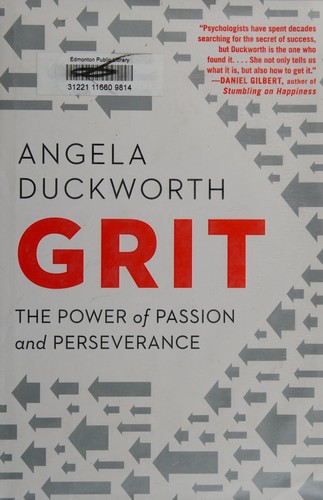
Grit: The Power of Passion and Perseverance by Angela Duckworth is a 2016 psychology book about perseverance, achievement, deliberate practice. Grit -- the combination of passion and perseverance for long-term goals -- predicts achievement better than talent or IQ across competitive, demanding fields.
Summary
Duckworth's central claim is that talent is overrated. In study after study -- West Point cadets, National Spelling Bee finalists, rookie teachers in high-poverty schools, sales representatives, and cadets at the military academy -- the predictor of who finished and who excelled was not IQ, physical ability, or natural gift. It was grit: the combination of passion and perseverance for long-term goals. Grit means working hard not just for a week but for years, staying the course when progress is slow or invisible, and caring enough about the goal that setbacks don't permanently knock you off course. Duckworth coined the concept during a teaching career in which she noticed that her most talented students were not always her best performers.
Duckworth builds grit as a two-part construct. Passion, in her formulation, is not the electric excitement people feel about a new hobby. It is the quiet, durable commitment to a top-level goal that organizes everything else. Perseverance is the habit of returning to the work after failure, boredom, or discouragement. She presents a four-level hierarchy of goals, from small daily tasks up to a single animating purpose, and argues that gritty people have unusual clarity about where they're headed. The book draws on her own research, interviews with high achievers in sports, business, education, and the military, and on foundational ideas from William James and pioneering psychologist Francis Galton. Her core research instrument, the Grit Scale -- a ten-item questionnaire separating passion scores from perseverance scores -- is included so readers can benchmark themselves.
The second half turns to how grit develops. Duckworth argues it grows from four psychological assets: interest, practice, purpose, and hope. Interest comes first -- you cannot sustain effort toward something that bores you. Deliberate practice is the engine: not just showing up but pushing just beyond your current ability, attending carefully to feedback, and repeating. Purpose -- the belief that your work matters to others, not just to yourself -- deepens the motivation to keep going through difficulty. Hope is what sustains effort when progress is not visible. She also examines whether grit can be taught to children, finding that parenting style, culture, and peer environment all shape it, though none are destiny. The chapter on the hard thing rule -- her family's rule that everyone must practice something genuinely difficult -- gives parents a concrete experiment to try at home.
Duckworth is careful not to oversell. Grit is not an argument against talent, and she doesn't claim effort is the only variable that matters. The book acknowledges that passion and perseverance need to be pointed at the right goals, and that circumstances -- poverty, discrimination, lack of access to mentors -- can make grit harder to sustain regardless of character or resolve. Some critics have noted that the Grit Scale's predictive power varies across contexts and cultures, and that grit overlaps substantially with conscientiousness in the big-five personality literature. Read as psychology rather than motivation, Grit offers a more rigorous frame for thinking about long-term achievement than the talent narratives that dominate most success literature.
Talk to Grit: The Power of Passion and Perseverance like its author wrote you back.
Get the ideas that fit your life — not generic summaries.
- Chat with the book
- Audiobook-style main ideas
- Adapts to your life and goals
- Helps you take action
Key takeaways
- 1.
Grit -- the combination of passion and perseverance for long-term goals -- predicts achievement better than talent or IQ across competitive, demanding fields.
- 2.
Passion, in Duckworth's definition, is not excitement or enthusiasm for novelty. It is durable commitment to a single top-level goal that stays stable for years.
- 3.
Deliberate practice is central to grit: not just putting in hours but working at the edge of current ability, getting feedback, and correcting errors deliberately.
- 4.
Grit grows from four psychological assets: interest (genuine engagement), practice (effortful improvement), purpose (belief it matters to others), and hope (confidence in growth).
- 5.
The talent myth is pervasive but misleading. Effort counts twice in Duckworth's formula: talent times effort equals skill, and skill times effort equals achievement.
- 6.
Grit is partly character and partly circumstance. Parenting style, culture, and mentors shape it -- authoritative parents who are both demanding and warm tend to raise grittier children.
- 7.
The Grit Scale is a ten-item questionnaire scoring passion and perseverance separately. Grit scores increase with age, suggesting the trait can develop over time.
- 8.
Purpose deepens perseverance. People who connect their work to a contribution beyond themselves sustain effort longer than those who work purely for personal reward.
Discussion questions
Use these on your own, with a book club, or as chat starters in Superbook. Book club version, ready to copy or print →
- 1.
Duckworth argues that passion is not excitement but durable commitment to a top-level goal. What is your top-level goal right now, and how long have you been working toward it?
- 2.
The talent myth gives people a narrative for why they stopped. Where have you told yourself a talent story that may have actually been a persistence story?
- 3.
Deliberate practice requires working at the edge of ability and tolerating failure. What would that look like in the skill you most want to improve?
- 4.
Duckworth's four assets of grit are interest, practice, purpose, and hope. Which of the four is the weakest link for you personally?
- 5.
The hard thing rule requires everyone to practice something difficult. If you applied this to a child or team you lead, what would you require -- and would you do it yourself?
- 6.
Duckworth distinguishes between a fixed identity and a growth one. Where in your life are you still carrying a fixed-identity label you absorbed early?
- 7.
Hope, in Duckworth's model, is the belief that effort leads to growth. When has that belief been hardest to hold, and what restored it?
- 8.
Grit requires consistency of interest over years. Is there anything you have been genuinely interested in for more than a decade, and have you pursued it with sustained effort?
- 9.
The book suggests culture shapes grit: some environments make perseverance easier. What does your current environment do -- build grit or erode it?
- 10.
Duckworth is careful to say circumstances matter too. Where has lack of access, discrimination, or circumstance made persistence harder, and how do you think about that honestly?
- 11.
Purpose -- the sense that your work matters to others -- sustains effort. How would you rate the purpose you feel in your current work, and what would raise it?
- 12.
Duckworth's Grit Scale has been criticized for measuring what you have already done rather than predicting future performance. Does that limitation change how you read the book's claims?
Themes
Frequently asked questions
-
Is Grit worth reading?
Yes, particularly if you work in education, coaching, or any field where long-term performance matters. The research is real and the framing -- grit as passion plus perseverance, not just toughness -- is more nuanced than the motivational-poster version. If you want pure science, Duckworth's papers go deeper; if you want readable synthesis with personal examples, the book delivers.
-
What is the main idea of Grit?
That talent is overrated and effort counts twice. Duckworth's formula: talent times effort equals skill, skill times effort equals achievement. Grit -- durable passion and perseverance toward a long-term goal -- predicts success in competitive fields better than IQ or natural ability alone.
-
How long does it take to read Grit?
Around five to six hours at average reading pace for the 352-page book. The early chapters on the research are dense; the later chapters on how grit develops are lighter and more narrative.
-
Who should read Grit?
Parents, teachers, coaches, and anyone who works with people over long time horizons. Also useful for anyone who wants a psychological account of why they quit things -- or didn't. Less useful for readers looking for short-term productivity tactics.
-
What's the most actionable idea in Grit?
The hard thing rule: everyone in your household or team must practice something genuinely difficult requiring daily effort, and no one can quit mid-season. It is a concrete way to build the tolerance for difficulty that grit requires.
Similar books

Mindset: The New Psychology of Success
Carol S. Dweck
Outliers: The Story of Success
Malcolm Gladwell
Drive: The Surprising Truth About What Motivates Us
Daniel H. Pink
The Power of Habit
Charles Duhigg
Grit vs.
Deciding between two books? Grit vs Mindset .
