Talk to Guns, Germs, and Steel like its author wrote you back.
Get the ideas that fit your life — not generic summaries.
- Chat with the book
- Audiobook-style main ideas
- Adapts to your life and goals
- Helps you take action
What it argues
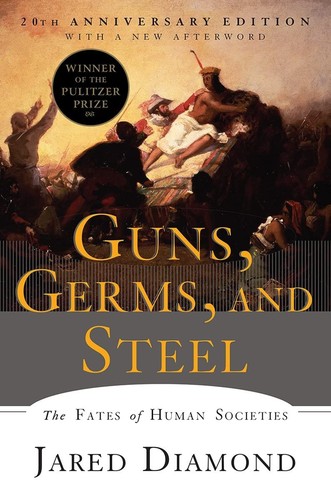
Guns, Germs, and Steel is Jared Diamond's attempt to answer a question posed to him by a Papua New Guinean politician named Yali: why did Europeans end up with so much cargo — wealth, technology, power — while other peoples had comparatively little? Diamond's answer is that the differences between civilizations aren't rooted in biology or intelligence. They're rooted in geography, and in the cascading advantages that certain geographic starting points made possible over thousands of years.
The core argument runs through agriculture. Some regions of the world — the Fertile Crescent, parts of China, a narrow band of the Americas — happened to contain wild plant and animal species that were domesticable. Once farming took hold, populations grew, surpluses accumulated, and people were freed from subsistence to specialize as soldiers, bureaucrats, priests, and inventors. Societies that domesticated animals also acquired diseases from them and, over generations, partial immunity. When those societies later contacted peoples with no such immunity, the germs did much of the killing before the guns even fired. The steel came from the metals and energy surplus that dense, settled populations could afford to develop.
What it gets right
- 1.
The gap between rich and poor civilizations traces back to geographic luck, not racial or cultural superiority. Where you started determined what you could build.
- 2.
Agriculture was the first domino. Regions with domesticable plants and animals grew denser populations, which enabled specialization, armies, writing, and technology.
- 3.
Eurasia's east-west axis let crops and livestock spread across similar climates. The Americas and Africa's north-south orientation slowed diffusion dramatically.
What it covers
Who wrote it
Jared Diamond is a professor of geography at UCLA and a Pulitzer Prize-winning author. He trained as a physiologist and ornithologist and has conducted field research in New Guinea for more than fifty years. His other books include The Third Chimpanzee, Why Is Sex Fun?, Collapse: How Societies Choose to Fail or Succeed, and The World Until Yesterday. Guns, Germs, and Steel won the Pulitzer Prize for General Nonfiction in 1998 and has been translated into more than thirty languages. Diamond is known for synthesizing findings across evolutionary biology, anthropology, ecology, and history into accessible, large-scale arguments.
