Talk to Guns, Germs, and Steel like its author wrote you back.
Get the ideas that fit your life — not generic summaries.
- Chat with the book
- Audiobook-style main ideas
- Adapts to your life and goals
- Helps you take action
Guns, Germs, and Steel, in detail
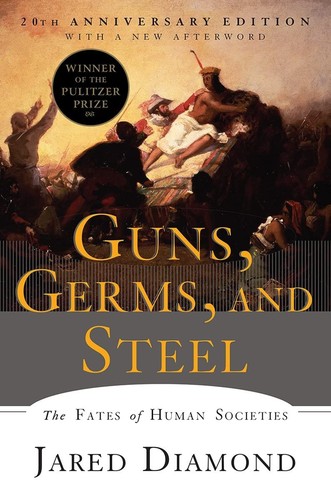
Guns, Germs, and Steel is Jared Diamond's attempt to answer a question posed to him by a Papua New Guinean politician named Yali: why did Europeans end up with so much cargo — wealth, technology, power — while other peoples had comparatively little? Diamond's answer is that the differences between civilizations aren't rooted in biology or intelligence. They're rooted in geography, and in the cascading advantages that certain geographic starting points made possible over thousands of years.
The core argument runs through agriculture. Some regions of the world — the Fertile Crescent, parts of China, a narrow band of the Americas — happened to contain wild plant and animal species that were domesticable. Once farming took hold, populations grew, surpluses accumulated, and people were freed from subsistence to specialize as soldiers, bureaucrats, priests, and inventors. Societies that domesticated animals also acquired diseases from them and, over generations, partial immunity. When those societies later contacted peoples with no such immunity, the germs did much of the killing before the guns even fired. The steel came from the metals and energy surplus that dense, settled populations could afford to develop.
Diamond extends the argument to explain why Eurasia specifically pulled ahead. The continent's east-west orientation allowed crops and animals to spread across similar latitudes — and therefore similar climates — without requiring adaptation. Africa and the Americas run north-south, so domesticated species faced radically different conditions as they traveled and spread far more slowly. Eurasia also happened to have more domesticable large mammals than any other region, and more high-yield wild grasses. The advantages weren't planned or earned through cleverness. They were accidents of biogeography, then compounded over millennia.
The book is exhaustive and sometimes repetitive, covering linguistics, archaeology, epidemiology, and evolutionary biology before converging on its central thesis. Diamond is careful to separate his geographic determinism from any claim that destiny was fixed — he argues that given different starting conditions, the roles of conqueror and conquered could easily have been reversed. That intellectual honesty is one of the book's strengths. Its weakness is that the argument occasionally oversimplifies, collapsing complex political and cultural processes into geography alone. Historians have pushed back on some of Diamond's readings of specific cases. But as a framework for thinking about long-run inequality at civilizational scale, Guns, Germs, and Steel remains one of the most ambitious and influential popular science books of the past thirty years.
The big ideas
- 1.
The gap between rich and poor civilizations traces back to geographic luck, not racial or cultural superiority. Where you started determined what you could build.
- 2.
Agriculture was the first domino. Regions with domesticable plants and animals grew denser populations, which enabled specialization, armies, writing, and technology.
- 3.
Eurasia's east-west axis let crops and livestock spread across similar climates. The Americas and Africa's north-south orientation slowed diffusion dramatically.
