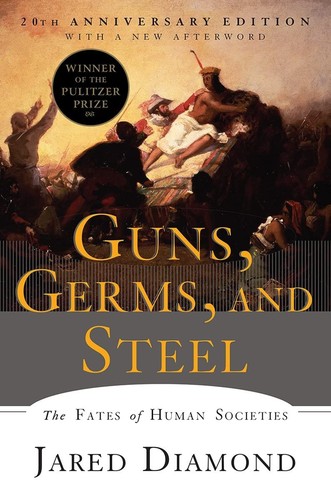
Guns, Germs, and Steel by Jared Diamond is a 1997 science book about geography, civilization, evolution of societies. The gap between rich and poor civilizations traces back to geographic luck, not racial or cultural superiority. Where you started determined what you could build.
Summary
Guns, Germs, and Steel is Jared Diamond's attempt to answer a question posed to him by a Papua New Guinean politician named Yali: why did Europeans end up with so much cargo — wealth, technology, power — while other peoples had comparatively little? Diamond's answer is that the differences between civilizations aren't rooted in biology or intelligence. They're rooted in geography, and in the cascading advantages that certain geographic starting points made possible over thousands of years.
The core argument runs through agriculture. Some regions of the world — the Fertile Crescent, parts of China, a narrow band of the Americas — happened to contain wild plant and animal species that were domesticable. Once farming took hold, populations grew, surpluses accumulated, and people were freed from subsistence to specialize as soldiers, bureaucrats, priests, and inventors. Societies that domesticated animals also acquired diseases from them and, over generations, partial immunity. When those societies later contacted peoples with no such immunity, the germs did much of the killing before the guns even fired. The steel came from the metals and energy surplus that dense, settled populations could afford to develop.
Diamond extends the argument to explain why Eurasia specifically pulled ahead. The continent's east-west orientation allowed crops and animals to spread across similar latitudes — and therefore similar climates — without requiring adaptation. Africa and the Americas run north-south, so domesticated species faced radically different conditions as they traveled and spread far more slowly. Eurasia also happened to have more domesticable large mammals than any other region, and more high-yield wild grasses. The advantages weren't planned or earned through cleverness. They were accidents of biogeography, then compounded over millennia.
The book is exhaustive and sometimes repetitive, covering linguistics, archaeology, epidemiology, and evolutionary biology before converging on its central thesis. Diamond is careful to separate his geographic determinism from any claim that destiny was fixed — he argues that given different starting conditions, the roles of conqueror and conquered could easily have been reversed. That intellectual honesty is one of the book's strengths. Its weakness is that the argument occasionally oversimplifies, collapsing complex political and cultural processes into geography alone. Historians have pushed back on some of Diamond's readings of specific cases. But as a framework for thinking about long-run inequality at civilizational scale, Guns, Germs, and Steel remains one of the most ambitious and influential popular science books of the past thirty years.
Talk to Guns, Germs, and Steel like its author wrote you back.
Get the ideas that fit your life — not generic summaries.
- Chat with the book
- Audiobook-style main ideas
- Adapts to your life and goals
- Helps you take action
Key takeaways
- 1.
The gap between rich and poor civilizations traces back to geographic luck, not racial or cultural superiority. Where you started determined what you could build.
- 2.
Agriculture was the first domino. Regions with domesticable plants and animals grew denser populations, which enabled specialization, armies, writing, and technology.
- 3.
Eurasia's east-west axis let crops and livestock spread across similar climates. The Americas and Africa's north-south orientation slowed diffusion dramatically.
- 4.
Disease was often the decisive weapon of conquest. Populations without exposure to livestock-derived diseases had no immunity and died in catastrophic numbers before military resistance could organize.
- 5.
Of the world's 148 large wild mammals, only 14 were ever domesticated. Most were native to Eurasia. The distribution wasn't random — it was continental biogeography.
- 6.
Writing, steel, and guns weren't inventions that came from nowhere. They were products of large, dense, literate, surplus-producing societies — which geography made possible in some places and not others.
- 7.
Proximate causes (guns, germs, steel) explain the immediate mechanics of conquest. Ultimate causes (geography, axis orientation, species distribution) explain why those proximate causes accumulated where they did.
- 8.
Diamond's framework implies that global inequality is the product of deep historical contingency, not inherent difference — and therefore that no civilization earned its advantage or deserved its disadvantage.
Discussion questions
Use these on your own, with a book club, or as chat starters in Superbook. Book club version, ready to copy or print →
- 1.
Diamond argues that geography determined civilizational outcomes more than culture or intelligence. Where does that argument feel most convincing to you, and where does it feel like an oversimplification?
- 2.
Yali's question — why do some people have more cargo than others — still resonates today. How does Diamond's answer change the way you think about modern global inequality?
- 3.
The book claims that if the Americas had been oriented east-west and Eurasia north-south, the direction of conquest might have been reversed. Does that reframing change anything about how you understand history?
- 4.
Diamond separates proximate causes from ultimate causes throughout the book. Pick a major historical event or current pattern of inequality and try to apply that same proximate-versus-ultimate distinction yourself.
- 5.
The argument that germs killed more people than guns in the conquest of the Americas is now widely accepted. What does it mean, morally, that so much destruction was unintentional?
- 6.
Diamond's thesis is environmental and geographic, not cultural. What does the argument leave out that you think matters for explaining why some societies developed the way they did?
- 7.
The fourteen domesticated large mammals were almost all Eurasian. Does knowing that feel satisfying as an explanation, or does it push the question back a level rather than answering it?
- 8.
Historians have criticized Diamond for glossing over the agency of colonized peoples and the specific decisions of colonizers. Is that a fair criticism of a book working at this scale of analysis?
- 9.
Range and Outliers both argue that success depends heavily on circumstance rather than innate talent. How does Diamond's civilizational argument compare to those individual-scale arguments?
- 10.
What aspect of the world you live in today looks different to you after reading this book? Is there anything you'd explain differently now?
- 11.
Diamond spent years in Papua New Guinea and opens the book with Yali's question from that context. How does the choice of starting point shape the argument that follows?
- 12.
The book was published in 1997. What has happened since then — in economics, climate, or technology — that either strengthens or complicates Diamond's framework?
Themes
Frequently asked questions
-
Is Guns, Germs, and Steel worth reading?
Yes, if you're interested in big-picture history or why the modern world looks the way it does. The central argument is genuinely illuminating and hard to dismiss. The book is long and occasionally repetitive, but the payoff is a coherent framework for thinking about long-run inequality that most history education never provides.
-
How long does it take to read Guns, Germs, and Steel?
Around eleven to twelve hours at average reading pace for the roughly 480-page text. It's a denser read than most popular science books. The early chapters on domestication and food production are the most detailed; the later chapters move faster once the framework is established.
-
What is the main argument of Guns, Germs, and Steel?
That geographic and environmental factors — not race or culture — explain why some civilizations conquered others. Regions with domesticable plants and animals developed agriculture, which produced dense populations, specialized labor, disease immunity, and technology. Those advantages compounded over thousands of years into the disparities we see today.
-
Who should read Guns, Germs, and Steel?
Readers curious about why global inequality exists, why certain regions dominated others historically, or how diseases shaped civilizations. It's also valuable for anyone who wants a scientific alternative to cultural or racial explanations of historical outcomes. Less useful if you're looking for detailed political or narrative history.
-
What's the most important idea in Guns, Germs, and Steel?
The distinction between proximate and ultimate causes. Guns, germs, and steel explain the mechanics of conquest, but the deeper question is why those things accumulated where they did. Diamond's answer — geographic luck, axis orientation, and species availability — reframes world history as contingency rather than destiny.
Similar books

Sapiens: A Brief History of Humankind
Yuval Noah Harari
Outliers: The Story of Success
Malcolm Gladwell
Behave: The Biology of Humans at Our Best and Worst
Robert M. Sapolsky
Range: Why Generalists Triumph in a Specialized World
David Epstein
Guns, Germs, and Steel vs.
Deciding between two books? Guns, Germs, and Steel vs Sapiens .
