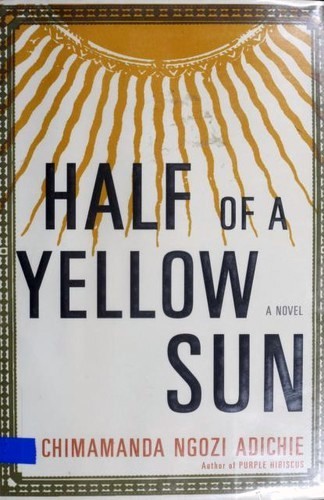
Talk to Half of a Yellow Sun like its author wrote you back.
Get the ideas that fit your life — not generic summaries.
- Chat with the book
- Audiobook-style main ideas
- Adapts to your life and goals
- Helps you take action
Half of a Yellow Sun, in detail
Half of a Yellow Sun is set before and during the Nigeria-Biafra war of 1967 to 1970, a conflict in which more than a million people died, most of them Igbo civilians from the secessionist Republic of Biafra. Adichie follows three characters across the years of crisis: Ugwu, a village boy who becomes houseboy to a radical university lecturer named Odenigbo; Olanna, Odenigbo's partner, a Lagos-raised woman of the intellectual class; and Richard, a British man writing about Igbo art who falls in love with Olanna's twin sister Kainene. The novel moves between the comfortable years before the war and the catastrophic years within it.
The title refers to the flag of Biafra — half of a rising yellow sun — and the novel is in part a work of cultural recovery. The Biafran war was largely erased from international consciousness, and Adichie grew up in a Nigeria where it was barely taught. She is writing to make visible what was lost: not as a polemic but as a lived experience reconstructed through characters whose ambitions, jealousies, love affairs, and choices become the texture of historical events.
Adichie's prose is confident and specific — she renders pre-war Enugu and Nsukka with the same clarity she brings to the refugee camps and bombed towns of the later sections. The shift in register between the two halves of the novel is the structure's great achievement: the contrast between the dinner parties and intellectual arguments of the 1960s and the starvation and displacement of the late 1960s is devastating precisely because Adichie refuses to treat it as inevitable. These people had full lives. The war took them.
This is a novel for readers who want historical fiction to do real historical work — to make you understand something about a conflict you likely knew almost nothing about, while caring deeply about invented people. It is emotionally demanding in the best sense. The ending does not redeem; it simply shows what is left, and what is left is enough to matter.
The big ideas
- 1.
Adichie recovers a war that was largely written out of international memory — reading the novel is partly an education in how thoroughly colonial frameworks erased Igbo suffering.
- 2.
The contrast between the two time periods is the novel's structural argument: the war is not a distant catastrophe but the destruction of specific, recognizable lives.
- 3.
Ugwu's arc — from village houseboy to university protégé to conscript — is the novel's most complete portrait of how war transforms ordinary people into perpetrators as well as victims.
