Half of a Yellow Sun by Chimamanda Ngozi Adichie is a 2006 historical fiction book about war and civilian life, nigerian identity, love and loyalty. Adichie recovers a war that was largely written out of international memory — reading the novel is partly an education in how thoroughly colonial frameworks erased Igbo suffering.
Summary
Half of a Yellow Sun is set before and during the Nigeria-Biafra war of 1967 to 1970, a conflict in which more than a million people died, most of them Igbo civilians from the secessionist Republic of Biafra. Adichie follows three characters across the years of crisis: Ugwu, a village boy who becomes houseboy to a radical university lecturer named Odenigbo; Olanna, Odenigbo's partner, a Lagos-raised woman of the intellectual class; and Richard, a British man writing about Igbo art who falls in love with Olanna's twin sister Kainene. The novel moves between the comfortable years before the war and the catastrophic years within it.
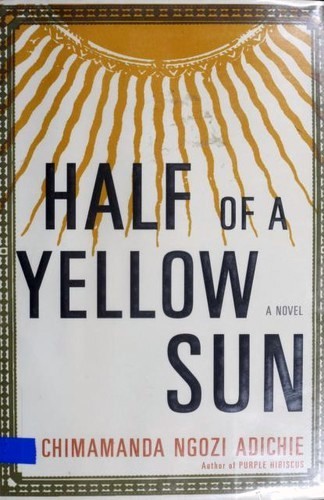
The title refers to the flag of Biafra — half of a rising yellow sun — and the novel is in part a work of cultural recovery. The Biafran war was largely erased from international consciousness, and Adichie grew up in a Nigeria where it was barely taught. She is writing to make visible what was lost: not as a polemic but as a lived experience reconstructed through characters whose ambitions, jealousies, love affairs, and choices become the texture of historical events.
Adichie's prose is confident and specific — she renders pre-war Enugu and Nsukka with the same clarity she brings to the refugee camps and bombed towns of the later sections. The shift in register between the two halves of the novel is the structure's great achievement: the contrast between the dinner parties and intellectual arguments of the 1960s and the starvation and displacement of the late 1960s is devastating precisely because Adichie refuses to treat it as inevitable. These people had full lives. The war took them.
This is a novel for readers who want historical fiction to do real historical work — to make you understand something about a conflict you likely knew almost nothing about, while caring deeply about invented people. It is emotionally demanding in the best sense. The ending does not redeem; it simply shows what is left, and what is left is enough to matter.
Talk to Half of a Yellow Sun like its author wrote you back.
Get the ideas that fit your life — not generic summaries.
- Chat with the book
- Audiobook-style main ideas
- Adapts to your life and goals
- Helps you take action
Key takeaways
- 1.
Adichie recovers a war that was largely written out of international memory — reading the novel is partly an education in how thoroughly colonial frameworks erased Igbo suffering.
- 2.
The contrast between the two time periods is the novel's structural argument: the war is not a distant catastrophe but the destruction of specific, recognizable lives.
- 3.
Ugwu's arc — from village houseboy to university protégé to conscript — is the novel's most complete portrait of how war transforms ordinary people into perpetrators as well as victims.
- 4.
Olanna and Odenigbo's relationship survives infidelity and catastrophe, but not unchanged. Adichie is precise about the difference between endurance and trust.
- 5.
Richard as a British outsider allows Adichie to examine the colonial gaze from inside it: his desire to 'tell the story' of Biafra raises questions about who gets to narrate whose suffering.
- 6.
The twin sisters Olanna and Kainene are deliberately contrasted: one emotionally expressive, one withheld. Their relationship is the novel's emotional core, though the novel doesn't announce this until the ending.
- 7.
Starvation as a deliberate tool of war is rendered without flinching — kwashiorkor in children, the calculus of who eats. This is the novel at its most politically committed.
- 8.
The manuscript-within-the-novel, 'The World Was Silent When We Died,' functions as a second narrator: whose voice it turns out to be is one of the novel's significant late revelations.
Discussion questions
Use these on your own, with a book club, or as chat starters in Superbook. Book club version, ready to copy or print →
- 1.
The novel follows characters on the Biafran side of the war. How did that affect your sense of the conflict? Did you feel you were being positioned, or given a perspective you could evaluate critically?
- 2.
Richard wants to write the story of Biafra and is repeatedly told it is not his story to write. By the end of the novel, do you think Adichie agrees with that position?
- 3.
Ugwu's section as a soldier includes an act of sexual violence. How did Adichie's choice to include that — and to implicate her most sympathetic character — affect your reading?
- 4.
Olanna carries a severed head in a calabash in one of the novel's most extreme scenes. What is Adichie doing with that image? Is it exploitative, or does it earn its place?
- 5.
Odenigbo's radical politics and Biafran nationalism are shown with both sympathy and scepticism. What does the novel finally think about the causes people die for?
- 6.
The relationship between Olanna and Kainene is more emotionally central than any of the romantic relationships. Did you read it that way while reading, or only afterward?
- 7.
How does Half of a Yellow Sun handle the question of what colonial legacy — specifically the arbitrary national boundaries drawn by Britain — caused this war?
- 8.
The novel is structured with 'Early Sixties' and 'Late Sixties' sections that are not entirely in chronological order. How does that choice affect the reader's experience?
- 9.
What does this novel make you feel about the responsibility of fiction in relation to historical atrocity? Where is the line between witness and exploitation?
- 10.
Compare this novel's portrayal of war to The Things They Carried, which is also in this catalog. What does a war look like from the civilian side versus the soldier side?
- 11.
Adichie grew up in the same university town where Odenigbo and Olanna live. How does that autobiographical proximity affect the novel's authority?
- 12.
What is left at the end of the novel? Does the ending feel like survival, or something less than that?
Themes
Frequently asked questions
-
Is Half of a Yellow Sun hard to read emotionally?
Yes. The second half of the novel is a sustained immersion in starvation, displacement, and the slow destruction of a society. Adichie doesn't spare the reader, but she also doesn't wallow — the darkness is proportionate to what actually happened. Give yourself time between reading sessions.
-
Do I need to know about the Biafran war before reading?
No. Adichie provides enough context as the novel unfolds. But having even a brief Wikipedia overview of the 1967-70 conflict beforehand will help you understand the stakes and the history more quickly. The novel is more powerful if you know some of what it's recovering.
-
What is Half of a Yellow Sun about, without spoilers?
Three people in Nigeria — a houseboy, a professor's partner, and a British writer — live through the years before and during the Biafran war. It's about what ordinary life looks like before catastrophe, and what people become when catastrophe arrives.
-
Is there a film adaptation?
Yes, a 2013 film directed by Biyi Bandele, starring Chiwetel Ejiofor and Thandiwe Newton. It was well-received in Nigeria and by admirers of the novel, though it necessarily compresses the book significantly.
-
Who shouldn't read Half of a Yellow Sun?
Readers who cannot engage with sustained portrayals of war, starvation, and violence against civilians. The novel's second half is harrowing. It is essential that it is, but you should know what you're entering.
Similar books
The Things They Carried
Tim O'Brien
All Quiet on the Western Front
Erich Maria Remarque
Persepolis: The Story of a Childhood
Marjane Satrapi
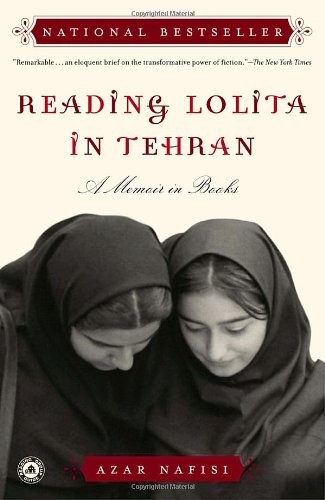
Reading Lolita in Tehran: A Memoir in Books
Azar Nafisi
