Talk to Happy City like its author wrote you back.
Get the ideas that fit your life — not generic summaries.
- Chat with the book
- Audiobook-style main ideas
- Adapts to your life and goals
- Helps you take action
What it argues
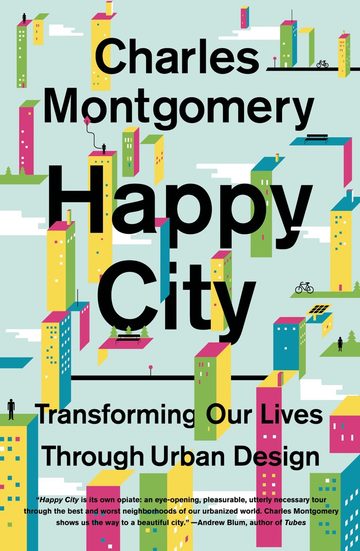
Happy City is Charles Montgomery's investigation into the relationship between the design of cities and the psychological well-being of their inhabitants. Drawing on urban planning, environmental psychology, neuroscience, and extensive travel to cities across North America, South America, and Europe, Montgomery argues that the shape of the places we live in — the layout of streets, the presence or absence of public space, the degree to which we walk or drive — has a measurable and underappreciated effect on happiness, health, and social connection.
The book begins with a basic empirical claim: commuting, and particularly long car commutes in sprawling suburbs, makes people demonstrably less happy. The research is consistent. No adaptation occurs: the unpleasantness of a long drive to work remains as acute in year ten as in year one. From there Montgomery expands the argument to show how car-dependent urban design separates people from their neighbors, reduces incidental social contact, and creates environments that are hostile to walking, cycling, and the kind of unscripted interaction that builds trust in communities.
What it gets right
- 1.
Car commuting is one of the few daily activities to which people do not psychologically adapt. Long commutes reliably reduce well-being even after years.
- 2.
Urban density, when well-designed, increases social connection and incidental interaction — the low-level encounters that build community trust over time.
- 3.
Bogotá's transformation under Enrique Peñalosa shows that car-dependent cities are a political choice, not an economic inevitability, and can be rapidly changed with political will.
What it covers
Who wrote it
Charles Montgomery is a Canadian journalist and urban experimenter based in Vancouver. He has written about urban design and happiness for The Atlantic, The Guardian, and The New York Times Magazine, among other publications. Happy City, published in 2013, grew out of a decade of reporting on the science and politics of urban well-being. Montgomery also runs a consultancy called Happy City that works with governments and developers on applying the book's principles to real cities. He is a frequent speaker at urban planning and public health conferences internationally.
