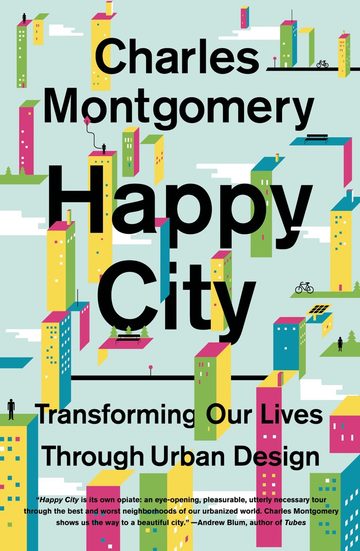
Happy City by Charles Montgomery is a 2013 science book about urban design, well-being, community. Car commuting is one of the few daily activities to which people do not psychologically adapt. Long commutes reliably reduce well-being even after years.
Summary
Happy City is Charles Montgomery's investigation into the relationship between the design of cities and the psychological well-being of their inhabitants. Drawing on urban planning, environmental psychology, neuroscience, and extensive travel to cities across North America, South America, and Europe, Montgomery argues that the shape of the places we live in — the layout of streets, the presence or absence of public space, the degree to which we walk or drive — has a measurable and underappreciated effect on happiness, health, and social connection.
The book begins with a basic empirical claim: commuting, and particularly long car commutes in sprawling suburbs, makes people demonstrably less happy. The research is consistent. No adaptation occurs: the unpleasantness of a long drive to work remains as acute in year ten as in year one. From there Montgomery expands the argument to show how car-dependent urban design separates people from their neighbors, reduces incidental social contact, and creates environments that are hostile to walking, cycling, and the kind of unscripted interaction that builds trust in communities.
Montgomery traveled to Bogotá under the progressive mayorship of Enrique Peñalosa, who transformed a city with chaotic traffic and deep inequality by building ciclovías, widening footpaths, and creating a world-class bus rapid transit system — all on the premise that public space is democratizing and that good urban design is a matter of social justice as much as aesthetics. Montgomery uses Bogotá as a sustained counterexample to the assumption that car-centric cities are a natural consequence of wealth and preference.
The last part of the book turns practical, examining what individuals and communities can do without waiting for governments: tactical urbanism, pop-up plazas, neighbor-to-neighbor organizing around street redesign. Montgomery is honest that individual action is limited without policy change, but his argument throughout is optimistic — cities have been built for cars for barely a century, and they can be rebuilt. The evidence that doing so would make their inhabitants healthier and happier is substantial.
Talk to Happy City like its author wrote you back.
Get the ideas that fit your life — not generic summaries.
- Chat with the book
- Audiobook-style main ideas
- Adapts to your life and goals
- Helps you take action
Key takeaways
- 1.
Car commuting is one of the few daily activities to which people do not psychologically adapt. Long commutes reliably reduce well-being even after years.
- 2.
Urban density, when well-designed, increases social connection and incidental interaction — the low-level encounters that build community trust over time.
- 3.
Bogotá's transformation under Enrique Peñalosa shows that car-dependent cities are a political choice, not an economic inevitability, and can be rapidly changed with political will.
- 4.
Public space — plazas, parks, wide footpaths — is inherently democratic. It gives the poor access to the same environment as the rich in a way that private car infrastructure does not.
- 5.
Walkability is strongly correlated with lower rates of obesity, cardiovascular disease, and depression. The design of a street is a public health decision.
- 6.
The illusion of car freedom is partly exactly that: drivers in car-centric cities spend a significant portion of their time and income on infrastructure that consumes much of the space they might otherwise enjoy.
- 7.
Tactical urbanism — temporary, low-cost interventions like pop-up plazas and painted bike lanes — allows communities to test changes before committing to permanent infrastructure.
- 8.
People rate social contact and having neighbors they trust as highly important to their sense of happiness, yet urban design decisions routinely undermine both.
Discussion questions
Use these on your own, with a book club, or as chat starters in Superbook. Book club version, ready to copy or print →
- 1.
Montgomery argues that the daily commute is uniquely resistant to adaptation. Does your own experience confirm or challenge this? What conditions make a commute more or less bearable?
- 2.
Enrique Peñalosa framed public space as a democratic right. Do you think the design of your city reflects a similar belief, or a different set of priorities?
- 3.
The book suggests that car-dependent sprawl was not inevitable but the result of specific political choices in the mid-twentieth century. What would need to change politically for those choices to be revisited now?
- 4.
Montgomery describes weak and strong social ties in urban settings. Which type of connection does your neighborhood support, and what would need to be different to support more of each?
- 5.
The research on walkability and health outcomes is robust. Why do you think that evidence has so little influence on mainstream housing and urban development decisions?
- 6.
Happy City is largely about North American cities. To what extent do its arguments apply to European or Asian urban contexts where car dependence was never as complete?
- 7.
Tactical urbanism — pop-up interventions before permanent change — is one of Montgomery's more actionable suggestions. Have you seen examples in your own city? Did they work?
- 8.
The book argues that the suburbs, as typically built, are bad for happiness. How would you respond to someone who grew up in a suburb and disputes that?
- 9.
Montgomery argues that a long commute is worse for well-being than a pay cut of equivalent economic magnitude. How would you weigh those factors in a job decision?
- 10.
How does Montgomery's framing of urban design as a public health issue change — or not change — how you think about planning disputes in your own community?
- 11.
What is the single change to the street, block, or building where you live that would most improve your daily experience? Is there anything stopping you from pursuing it?
- 12.
The relationship between urban form and greenhouse gas emissions is significant. Does Montgomery make the case for dense, walkable cities compellingly on purely environmental grounds, or does the happiness argument matter more to you?
Themes
Frequently asked questions
-
What is Happy City about?
Charles Montgomery's argument that the physical design of cities — how they handle cars, pedestrians, public space, and density — has a measurable effect on the happiness, health, and social connection of the people who live in them. It draws on psychology, urban planning research, and visits to cities from Bogotá to Copenhagen.
-
Is Happy City worth reading for non-planners?
Yes. The book is aimed at general readers, not specialists. Most of what Montgomery describes is visible in everyday experience — the misery of a long commute, the difference between a street with café tables and one without — and the science he invokes is accessible and credibly presented.
-
How long does Happy City take to read?
About seven hours at an average pace. The chapters are organized around distinct themes — commuting, public space, density, community — and can be read in any order after the opening chapters.
-
What is Enrique Peñalosa's role in the book?
The former mayor of Bogotá is the book's central case study. He transformed the city's public space and transit infrastructure on the explicit premise that public space is a democratic right. Montgomery returns to Bogotá's example repeatedly as evidence that car-centric cities are a political choice, not an economic destiny.
-
Does Happy City have practical advice for individuals?
Partially. The last section covers tactical urbanism and community organizing. But Montgomery is honest that individual action has limited leverage without policy change. The book's greater utility is in changing how readers understand urban decisions and what they demand from elected officials and developers.