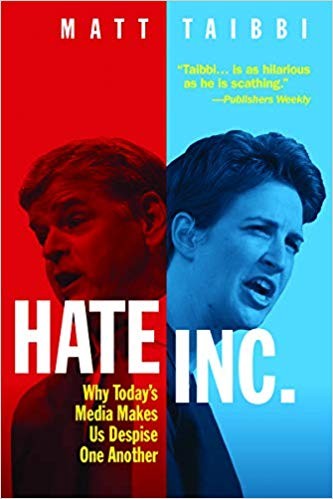
Talk to Hate, Inc. like its author wrote you back.
Get the ideas that fit your life — not generic summaries.
- Chat with the book
- Audiobook-style main ideas
- Adapts to your life and goals
- Helps you take action
Hate, Inc., in detail
Hate, Inc. is Matt Taibbi's argument that the American news media's business model is built on producing and amplifying outrage rather than informing audiences. Taibbi, a longtime Rolling Stone journalist who covered Wall Street and Washington, extends and updates the argument of his intellectual predecessor Noam Chomsky, whose Manufacturing Consent examined how media serves elite interests. Where Chomsky wrote about propaganda for consensus, Taibbi argues the system has evolved: media now manufactures dissent — artificial tribal conflict that keeps audiences furious, engaged, and returning daily for the next episode.
The book's first half is diagnostic. Taibbi traces the evolution of the cable news business model from the 1990s through the Trump era. Roger Ailes at Fox News figured out that anger is more addictive than information, that audiences who feel their identity is under attack will tune in with the loyalty of sports fans. MSNBC and CNN adapted the formula to different audiences. The result is an industry that has an economic interest in political catastrophe: better Trump's chaos than competent governance, because chaos drives ratings.
The second half is more theoretical, drawing on Chomsky and Edward Herman's propaganda model to analyze what's selected and what's ignored. Taibbi argues that the media's obsession with domestic partisan conflict crowds out coverage of the foreign policy, corporate power, and institutional corruption that actually affect most people's lives. The "hate" of the title is not incidental — it is the product, the emotional state that keeps the business viable.
Taibbi is an entertaining polemicist, and the book is consistently readable. His political position is heterodox — equally contemptuous of liberal and conservative media — which gives the argument unusual reach but also makes it easy to dismiss from either side. The critique of outrage economics is essentially correct, but the book is less useful on what journalism should look like. Readers looking for solutions will find the final chapters somewhat thin. As a diagnosis of what happened to American media and why, it's hard to beat.
The big ideas
- 1.
The news media's business model has evolved from selling information to selling emotional engagement — specifically outrage and tribal identity reinforcement.
- 2.
Fox News, MSNBC, and CNN serve different audiences but run the same basic product: a narrative in which the viewer's side is under existential threat from the other side.
- 3.
Political outrage is more reliably addictive than information. Audiences who feel identity-threat return more consistently than audiences who simply want to be informed.
