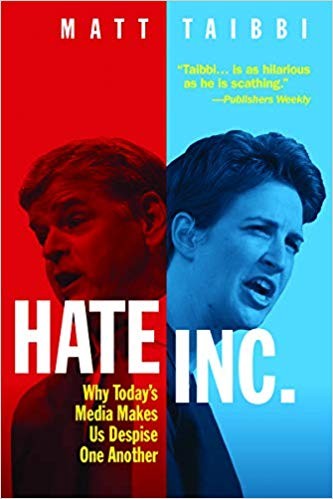
Hate, Inc. by Matt Taibbi is a 2019 politics book about media criticism, polarization, journalism. The news media's business model has evolved from selling information to selling emotional engagement — specifically outrage and tribal identity reinforcement.
Summary
Hate, Inc. is Matt Taibbi's argument that the American news media's business model is built on producing and amplifying outrage rather than informing audiences. Taibbi, a longtime Rolling Stone journalist who covered Wall Street and Washington, extends and updates the argument of his intellectual predecessor Noam Chomsky, whose Manufacturing Consent examined how media serves elite interests. Where Chomsky wrote about propaganda for consensus, Taibbi argues the system has evolved: media now manufactures dissent — artificial tribal conflict that keeps audiences furious, engaged, and returning daily for the next episode.
The book's first half is diagnostic. Taibbi traces the evolution of the cable news business model from the 1990s through the Trump era. Roger Ailes at Fox News figured out that anger is more addictive than information, that audiences who feel their identity is under attack will tune in with the loyalty of sports fans. MSNBC and CNN adapted the formula to different audiences. The result is an industry that has an economic interest in political catastrophe: better Trump's chaos than competent governance, because chaos drives ratings.
The second half is more theoretical, drawing on Chomsky and Edward Herman's propaganda model to analyze what's selected and what's ignored. Taibbi argues that the media's obsession with domestic partisan conflict crowds out coverage of the foreign policy, corporate power, and institutional corruption that actually affect most people's lives. The "hate" of the title is not incidental — it is the product, the emotional state that keeps the business viable.
Taibbi is an entertaining polemicist, and the book is consistently readable. His political position is heterodox — equally contemptuous of liberal and conservative media — which gives the argument unusual reach but also makes it easy to dismiss from either side. The critique of outrage economics is essentially correct, but the book is less useful on what journalism should look like. Readers looking for solutions will find the final chapters somewhat thin. As a diagnosis of what happened to American media and why, it's hard to beat.
Talk to Hate, Inc. like its author wrote you back.
Get the ideas that fit your life — not generic summaries.
- Chat with the book
- Audiobook-style main ideas
- Adapts to your life and goals
- Helps you take action
Key takeaways
- 1.
The news media's business model has evolved from selling information to selling emotional engagement — specifically outrage and tribal identity reinforcement.
- 2.
Fox News, MSNBC, and CNN serve different audiences but run the same basic product: a narrative in which the viewer's side is under existential threat from the other side.
- 3.
Political outrage is more reliably addictive than information. Audiences who feel identity-threat return more consistently than audiences who simply want to be informed.
- 4.
Media coverage of domestic partisan conflict crowds out coverage of foreign policy, corporate power, and economic inequality — the topics that most directly affect ordinary life.
- 5.
The Trump presidency was, from a pure media economics standpoint, a windfall: constant chaos, constant outrage, constant ratings. Media has an economic interest in political dysfunction.
- 6.
Chomsky and Herman's 'propaganda model' was built on elite consensus manufacturing; Taibbi argues the system has evolved to manufacture dissent — tribal conflict — instead.
- 7.
Social media algorithms amplify the same dynamics as cable news, but faster and with more granular targeting. The outrage economics that built cable news have been turbocharged online.
- 8.
The reporters and editors who produce outrage-driven content are often not cynical — they believe what they're producing. The business model shapes belief as well as incentives.
Discussion questions
Use these on your own, with a book club, or as chat starters in Superbook. Book club version, ready to copy or print →
- 1.
Taibbi argues there is no meaningful difference between Fox News and MSNBC in terms of business model, only in the audience they're targeting. Is that a fair comparison?
- 2.
The book claims that political outrage is more addictive than information. Reflect on your own media consumption — what emotions does it most reliably produce in you?
- 3.
Taibbi draws heavily on Chomsky's Manufacturing Consent. How does 'manufacturing dissent' differ from 'manufacturing consent,' and which is a more accurate description of current media?
- 4.
The book argues that media's obsession with partisan conflict crowds out coverage of corporate power and foreign policy. What important stories do you think are systematically underreported?
- 5.
Taibbi is equally critical of left-leaning and right-leaning media. Is that symmetry intellectually honest, or does it understate real differences in accuracy and accountability?
- 6.
If media companies profit from outrage, and outrage is a genuine emotional response to real events, at what point is the anger manufactured versus reported?
- 7.
What would a journalism business model that doesn't rely on outrage look like? What are the real obstacles to building it?
- 8.
Taibbi focuses primarily on television and digital media. How does his argument apply or fail to apply to print journalism, local news, or international media?
- 9.
The book was published in 2019, before the COVID pandemic and the 2020 election. Has the media landscape it describes gotten better or worse since then?
- 10.
How much responsibility do audiences bear for the current state of media? If people consistently chose less emotionally engaging but more informative journalism, would the industry adapt?
- 11.
Taibbi is a polemicist as much as an analyst. Does his rhetorical style strengthen or undermine the argument?
- 12.
What would it take for you personally to change your media diet, and what would you lose?
Themes
Frequently asked questions
-
What is Hate, Inc. about?
It argues that the American news media's business model is built on producing outrage and tribal identity reinforcement rather than informing audiences. Taibbi traces how cable news, and then social media, evolved an outrage economics that profits from political division.
-
Is Hate, Inc. a left-wing or right-wing book?
Neither, at least in intent. Taibbi is equally critical of Fox News, MSNBC, and CNN. His critique targets the business model, not any particular political side. Some readers on both ends of the spectrum find this evenhandedness suspicious.
-
Is Hate, Inc. worth reading?
Yes, if you want a clear and entertaining diagnosis of how cable news and social media evolved their current form. The outrage economics argument is essentially correct. The prescriptive section is thin, and the tone can be more satisfyingly indignant than analytically precise.
-
How does this compare to other media criticism books?
It's more readable and more fun than Manufacturing Consent, which it explicitly updates and extends. It covers similar territory to The Shallows but focuses on business incentives rather than cognition. For pure outrage-economics analysis, it's the most direct treatment available.
-
Who should read this book?
Anyone who consumes American news media regularly and wants to understand why it feels the way it does. Particularly useful for people who are already skeptical of one side and want a framework for applying that skepticism more consistently to media they trust.
Similar books
The Shallows: What the Internet Is Doing to Our Brains
Nicholas Carr
Indistractable: How to Control Your Attention and Choose Your Life
Nir Eyal

Age of Propaganda: The Everyday Use and Abuse of Persuasion
Anthony Pratkanis and Elliot Aronson
Twilight of Democracy: The Seductive Lure of Authoritarianism
Anne Applebaum
