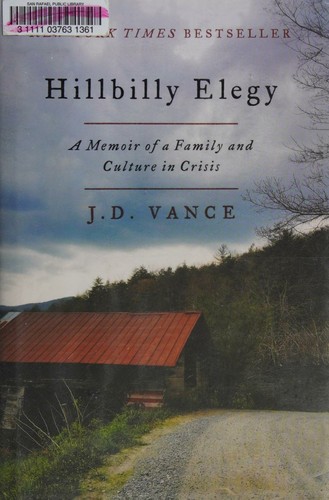
Talk to Hillbilly Elegy: A Memoir of a Family and Culture in Crisis like its author wrote you back.
Get the ideas that fit your life — not generic summaries.
- Chat with the book
- Audiobook-style main ideas
- Adapts to your life and goals
- Helps you take action
What it argues
Hillbilly Elegy is J. D. Vance's memoir of growing up in Middletown, Ohio, among a family whose roots were in the Appalachian hills of Kentucky. His grandmother — Mamaw — was the anchor of the family, a fierce, profane woman who raised him through high school when his mother's addiction made her unable to. His grandfather was a steelworker whose world disappeared. His mother cycled through boyfriends and husbands, ODed multiple times, and could not sustain the stability Vance needed. The memoir traces his path from that chaos to Yale Law School.
The book made Vance famous when it was published in 2016, weeks before Trump's election, because it appeared to explain — to a coastal readership that had no direct experience of such communities — how deindustrialized white working-class America thinks and feels. Vance draws a portrait of a culture shaped by honor, loyalty, pride, and a profound suspicion of outsiders and institutions. He describes a place where hardship is met with resilience and also with self-destructive behavior, and where the line between those two responses is often invisible from outside.
What it gets right
- 1.
Growing up in chaos creates specific survival strategies — hypervigilance, distrust of authority, hair-trigger responses to perceived disrespect — that are adaptive in childhood and costly in adulthood.
- 2.
Social capital is often invisible until you leave the world that gave it to you. Vance's Yale classmates had networks and norms he had to learn explicitly, while they absorbed them by osmosis.
- 3.
Mamaw's unwavering belief in him and her insistence on a stable home in high school may have been the decisive factor in his ability to leave. One anchor person can change outcomes.
What it covers
Who wrote it
J. D. Vance grew up in Middletown, Ohio, and Jackson, Kentucky, and served in the Marine Corps before attending Ohio State University and Yale Law School. Hillbilly Elegy, published in 2016, was his first book. After practicing law and working in venture capital in San Francisco and then Ohio, he entered politics, winning election to the US Senate from Ohio in 2022 and becoming the 50th Vice President of the United States in January 2025. The book was adapted into a Netflix film in 2020.
