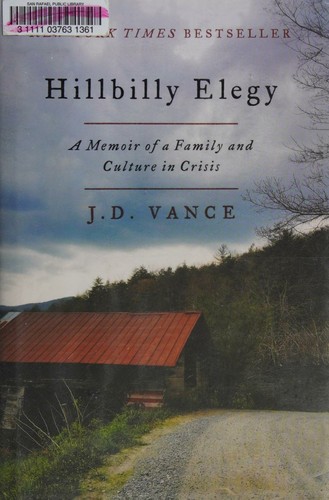
Talk to Hillbilly Elegy: A Memoir of a Family and Culture in Crisis like its author wrote you back.
Get the ideas that fit your life — not generic summaries.
- Chat with the book
- Audiobook-style main ideas
- Adapts to your life and goals
- Helps you take action
Hillbilly Elegy: A Memoir of a Family and Culture in Crisis, in detail
Hillbilly Elegy is J. D. Vance's memoir of growing up in Middletown, Ohio, among a family whose roots were in the Appalachian hills of Kentucky. His grandmother — Mamaw — was the anchor of the family, a fierce, profane woman who raised him through high school when his mother's addiction made her unable to. His grandfather was a steelworker whose world disappeared. His mother cycled through boyfriends and husbands, ODed multiple times, and could not sustain the stability Vance needed. The memoir traces his path from that chaos to Yale Law School.
The book made Vance famous when it was published in 2016, weeks before Trump's election, because it appeared to explain — to a coastal readership that had no direct experience of such communities — how deindustrialized white working-class America thinks and feels. Vance draws a portrait of a culture shaped by honor, loyalty, pride, and a profound suspicion of outsiders and institutions. He describes a place where hardship is met with resilience and also with self-destructive behavior, and where the line between those two responses is often invisible from outside.
The book's argument is partly personal and partly cultural. Vance does not blame structural forces, though he acknowledges them. He focuses instead on what he calls the "learned helplessness" of a culture that attributes its problems to external enemies while resisting the personal changes that might help. The conclusion is essentially self-help inflected with nostalgia: the advice is to show up for work, stay sober, maintain relationships, and take responsibility. That prescription has struck many readers as inadequate given the structural forces he describes — the closing of factories, the destruction of communities, the underfunding of schools and public services.
Since publication and especially since Vance's entry into politics, the book has become contested territory. Supporters point to its intimacy and its portrait of a world rarely depicted with this kind of insider knowledge. Critics argue that it overgeneralizes from one family's experience, underplays structural economic causes, and has been weaponized by conservative politicians to dismiss the case for public investment in struggling communities. Both readings have merit. Read as memoir, it is honest and affecting; read as policy analysis, it is inadequate.
The big ideas
- 1.
Growing up in chaos creates specific survival strategies — hypervigilance, distrust of authority, hair-trigger responses to perceived disrespect — that are adaptive in childhood and costly in adulthood.
- 2.
Social capital is often invisible until you leave the world that gave it to you. Vance's Yale classmates had networks and norms he had to learn explicitly, while they absorbed them by osmosis.
- 3.
Mamaw's unwavering belief in him and her insistence on a stable home in high school may have been the decisive factor in his ability to leave. One anchor person can change outcomes.
