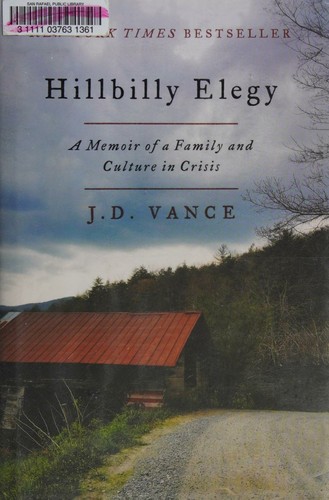
Hillbilly Elegy: A Memoir of a Family and Culture in Crisis by J. D. Vance is a 2016 memoir book about class, family dysfunction, appalachian identity. Growing up in chaos creates specific survival strategies — hypervigilance, distrust of authority, hair-trigger responses to perceived disrespect — that are adaptive in childhood and costly in adulthood.
Summary
Hillbilly Elegy is J. D. Vance's memoir of growing up in Middletown, Ohio, among a family whose roots were in the Appalachian hills of Kentucky. His grandmother — Mamaw — was the anchor of the family, a fierce, profane woman who raised him through high school when his mother's addiction made her unable to. His grandfather was a steelworker whose world disappeared. His mother cycled through boyfriends and husbands, ODed multiple times, and could not sustain the stability Vance needed. The memoir traces his path from that chaos to Yale Law School.
The book made Vance famous when it was published in 2016, weeks before Trump's election, because it appeared to explain — to a coastal readership that had no direct experience of such communities — how deindustrialized white working-class America thinks and feels. Vance draws a portrait of a culture shaped by honor, loyalty, pride, and a profound suspicion of outsiders and institutions. He describes a place where hardship is met with resilience and also with self-destructive behavior, and where the line between those two responses is often invisible from outside.
The book's argument is partly personal and partly cultural. Vance does not blame structural forces, though he acknowledges them. He focuses instead on what he calls the "learned helplessness" of a culture that attributes its problems to external enemies while resisting the personal changes that might help. The conclusion is essentially self-help inflected with nostalgia: the advice is to show up for work, stay sober, maintain relationships, and take responsibility. That prescription has struck many readers as inadequate given the structural forces he describes — the closing of factories, the destruction of communities, the underfunding of schools and public services.
Since publication and especially since Vance's entry into politics, the book has become contested territory. Supporters point to its intimacy and its portrait of a world rarely depicted with this kind of insider knowledge. Critics argue that it overgeneralizes from one family's experience, underplays structural economic causes, and has been weaponized by conservative politicians to dismiss the case for public investment in struggling communities. Both readings have merit. Read as memoir, it is honest and affecting; read as policy analysis, it is inadequate.
Talk to Hillbilly Elegy: A Memoir of a Family and Culture in Crisis like its author wrote you back.
Get the ideas that fit your life — not generic summaries.
- Chat with the book
- Audiobook-style main ideas
- Adapts to your life and goals
- Helps you take action
Key takeaways
- 1.
Growing up in chaos creates specific survival strategies — hypervigilance, distrust of authority, hair-trigger responses to perceived disrespect — that are adaptive in childhood and costly in adulthood.
- 2.
Social capital is often invisible until you leave the world that gave it to you. Vance's Yale classmates had networks and norms he had to learn explicitly, while they absorbed them by osmosis.
- 3.
Mamaw's unwavering belief in him and her insistence on a stable home in high school may have been the decisive factor in his ability to leave. One anchor person can change outcomes.
- 4.
Learned helplessness — attributing misfortune entirely to external enemies rather than considering personal agency — is the cultural pattern Vance identifies as most corrosive.
- 5.
Addiction and instability in a parent's home creates a specific developmental environment that follows children into adult relationships, employment, and responses to stress.
- 6.
Military service functioned for Vance as a finishing school in adult norms: punctuality, accountability, care of equipment, and working within institutions he had not previously trusted.
- 7.
The gap between the stated values of working-class honor culture — hard work, self-reliance — and the actual behavior of many community members is itself a source of the culture's anguish.
- 8.
Structural economic decline and cultural pathology are not opposites: the loss of stable industrial work destabilizes families, and destabilized families produce children who struggle with stable work.
Discussion questions
Use these on your own, with a book club, or as chat starters in Superbook. Book club version, ready to copy or print →
- 1.
Vance emphasizes personal responsibility and cultural factors while acknowledging structural forces. Where does he draw the line, and do you draw it in the same place?
- 2.
Mamaw is the most compelling figure in the book. What made her different from the other adults in Vance's life, and what does her success at supporting him tell us about what children need?
- 3.
He describes learning middle-class norms almost like a foreign language. What norms did you absorb without knowing it, and what would it cost to not have them?
- 4.
The book was published weeks before Trump's election and treated as an explanation of Trump voters. Does it hold up as that? What does it explain and what does it miss?
- 5.
Vance's prescription is essentially individual: take responsibility, show up, stay sober. Is that a sufficient response to the conditions he describes? What would a structural prescription look like?
- 6.
He says that honor culture — the insistence on respect and the willingness to fight for it — is both a source of pride and a source of serious harm. Can you think of cases where that's true in communities you know?
- 7.
The book has been criticized for overgeneralizing from one family. Does that criticism seem fair to you, reading it as memoir rather than sociology?
- 8.
Vance joined the Marines and credits military service with teaching him things his upbringing didn't. What institutions play that role for people in different circumstances?
- 9.
What does the concept of 'hillbilly' do in this book? Is Vance reclaiming it, critiquing it, or something more complicated?
- 10.
Since publication, Vance became a senator and then vice president. Does knowing his subsequent political career change how you read the book?
- 11.
Which of the people in the book do you most want to know what happened to after it ended?
Themes
Frequently asked questions
-
What is Hillbilly Elegy about?
It is a memoir about growing up poor and chaotic in Appalachian Ohio, centered on Vance's relationship with his grandmother, his mother's addiction, and his eventual path to Yale Law School. It also functions as an argument about culture, class, and personal responsibility in working-class white America.
-
Is Hillbilly Elegy worth reading?
Yes, as memoir. The family portrait is honest and the writing is clear. As sociology or policy analysis, it has significant weaknesses, and those weaknesses have become more visible since Vance entered politics. Reading it alongside a more structurally focused book like Evicted or Strangers in Their Own Land is worthwhile.
-
Is Hillbilly Elegy accurate about Appalachia?
It is accurate about one family's experience. Critics — including Appalachian writers and scholars — have argued that it overgeneralizes and reinforces stereotypes about a diverse region, and that its focus on culture and individual responsibility underweights the economic devastation of deindustrialization.
-
Who should read Hillbilly Elegy?
Readers interested in American class and social mobility, and anyone wanting to understand how upbringing shapes adult life. The memoir is accessible and fast-moving. Readers should come with some awareness of its limitations as a representative account.
-
How long does it take to read Hillbilly Elegy?
Around five hours at average reading pace for the 270-page book. It reads quickly — the voice is direct and the story moves.