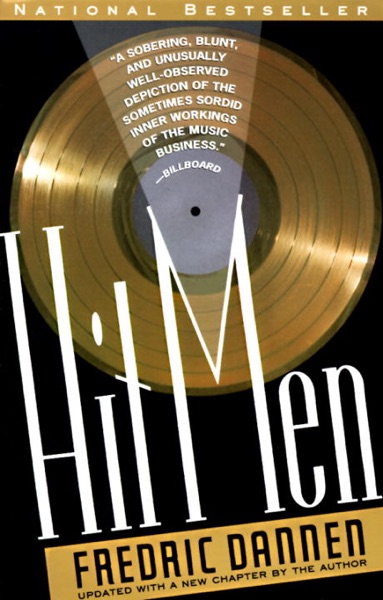
Talk to Hit Men: Power Brokers and Fast Money Inside the Music Business like its author wrote you back.
Get the ideas that fit your life — not generic summaries.
- Chat with the book
- Audiobook-style main ideas
- Adapts to your life and goals
- Helps you take action
Hit Men: Power Brokers and Fast Money Inside the Music Business, in detail
Hit Men is Fredric Dannen's investigative account of the major record labels from the 1950s through the late 1980s, with particular focus on the network of independent promoters who controlled radio airplay through a system of payments that amounted to a legalized — and sometimes illegal — form of payola. Dannen spent years reporting on the industry and produced one of the most detailed and credibly sourced accounts of how the business actually worked behind its public face.
The book's central subject is the "Network" — a group of independent radio promoters, led by figures like Joe Isgro, who served as intermediaries between the record labels and radio stations. Labels paid these promoters substantial fees; the promoters paid radio stations and program directors to add records to playlists. This was the mechanism by which certain records became hits regardless of public demand. Dannen traces how the major labels — CBS Records, Warner, MCA — understood what the promoters were doing, depended on it, and chose not to ask questions that would force them to stop.
The broader portrait of the record industry is equally unflattering. The executives Dannen profiles — Walter Yetnikoff at CBS, Mo Ostin and Joe Smith at Warner, David Geffen — are portrayed with a mix of genuine admiration for their instincts and sharp critique of their methods. Yetnikoff in particular is rendered as a brilliant, destructive force whose personal deterioration mirrored CBS Records' eventual collapse. The book documents how artist contracts worked to the labels' advantage, how accounting practices made it difficult for artists to verify royalties, and how the industry's economics rewarded short-term extraction over long-term artist development.
Hit Men holds up as a document of how the music industry worked in its pre-digital peak. The promotional system it describes was subsequently reformed under congressional pressure, and the rise of streaming has changed the economics entirely. But the book's deeper theme — that industries built on cultural production tend to attract both genuine passion and remarkable predation — remains as relevant as ever. It reads as narrative journalism at its best: specific, surprising, and consistently entertaining in the way that detailed accounts of institutional corruption tend to be.
The big ideas
- 1.
The 'Network' of independent radio promoters functioned as a payola mechanism that allowed labels to buy chart positions while maintaining enough distance to claim ignorance.
- 2.
Major record labels understood the promotional system they were funding and chose to continue because the alternative — competing for airplay on merit — was less reliable and more expensive.
- 3.
Standard artist contracts in the major label era gave labels the right to recoup recording costs, promotional expenses, and various other charges before paying royalties, making it difficult for mid-tier artists to ever see meaningful income.
