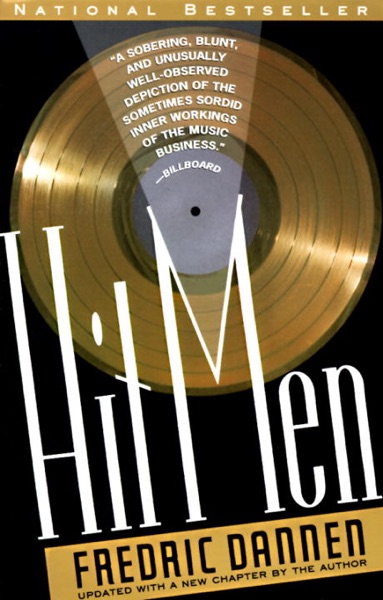
Hit Men: Power Brokers and Fast Money Inside the Music Business by Fredric Dannen is a 1990 business book about music industry, corruption and payola, corporate power. The 'Network' of independent radio promoters functioned as a payola mechanism that allowed labels to buy chart positions while maintaining enough distance to claim ignorance.
Summary
Hit Men is Fredric Dannen's investigative account of the major record labels from the 1950s through the late 1980s, with particular focus on the network of independent promoters who controlled radio airplay through a system of payments that amounted to a legalized — and sometimes illegal — form of payola. Dannen spent years reporting on the industry and produced one of the most detailed and credibly sourced accounts of how the business actually worked behind its public face.
The book's central subject is the "Network" — a group of independent radio promoters, led by figures like Joe Isgro, who served as intermediaries between the record labels and radio stations. Labels paid these promoters substantial fees; the promoters paid radio stations and program directors to add records to playlists. This was the mechanism by which certain records became hits regardless of public demand. Dannen traces how the major labels — CBS Records, Warner, MCA — understood what the promoters were doing, depended on it, and chose not to ask questions that would force them to stop.
The broader portrait of the record industry is equally unflattering. The executives Dannen profiles — Walter Yetnikoff at CBS, Mo Ostin and Joe Smith at Warner, David Geffen — are portrayed with a mix of genuine admiration for their instincts and sharp critique of their methods. Yetnikoff in particular is rendered as a brilliant, destructive force whose personal deterioration mirrored CBS Records' eventual collapse. The book documents how artist contracts worked to the labels' advantage, how accounting practices made it difficult for artists to verify royalties, and how the industry's economics rewarded short-term extraction over long-term artist development.
Hit Men holds up as a document of how the music industry worked in its pre-digital peak. The promotional system it describes was subsequently reformed under congressional pressure, and the rise of streaming has changed the economics entirely. But the book's deeper theme — that industries built on cultural production tend to attract both genuine passion and remarkable predation — remains as relevant as ever. It reads as narrative journalism at its best: specific, surprising, and consistently entertaining in the way that detailed accounts of institutional corruption tend to be.
Talk to Hit Men: Power Brokers and Fast Money Inside the Music Business like its author wrote you back.
Get the ideas that fit your life — not generic summaries.
- Chat with the book
- Audiobook-style main ideas
- Adapts to your life and goals
- Helps you take action
Key takeaways
- 1.
The 'Network' of independent radio promoters functioned as a payola mechanism that allowed labels to buy chart positions while maintaining enough distance to claim ignorance.
- 2.
Major record labels understood the promotional system they were funding and chose to continue because the alternative — competing for airplay on merit — was less reliable and more expensive.
- 3.
Standard artist contracts in the major label era gave labels the right to recoup recording costs, promotional expenses, and various other charges before paying royalties, making it difficult for mid-tier artists to ever see meaningful income.
- 4.
Walter Yetnikoff's tenure at CBS Records illustrates how a single dominant personality can drive a business to extraordinary success and then, as that personality disintegrates, accelerate its decline.
- 5.
The relationship between organized crime and the music industry, particularly in distribution and promotion, was more direct and more sustained than the industry's public statements acknowledged.
- 6.
Radio airplay was not a reflection of popular taste in this era — it was a product of who could pay most effectively to put a record on a playlist. The chart positions reflected promotional spending as much as demand.
- 7.
The congressional investigations and FCC scrutiny that followed the payola revelations changed the industry's formal practices but not necessarily its underlying incentive structures.
- 8.
The artists most consistently exploited were those without the leverage to negotiate better terms — mid-tier acts who needed the label more than the label needed them.
Discussion questions
Use these on your own, with a book club, or as chat starters in Superbook. Book club version, ready to copy or print →
- 1.
The payola system described in the book was conducted with enough ambiguity that most participants could plausibly deny explicit wrongdoing. How does that kind of deniability function in industries you're familiar with?
- 2.
Dannen portrays Walter Yetnikoff as simultaneously one of the most effective executives in music history and a figure whose behavior caused enormous harm. How do you evaluate legacies that combine genuine achievement with serious misconduct?
- 3.
The record labels knew what their promotional spending was funding. What institutional pressures make it rational for companies to sustain systems they know are corrupt?
- 4.
Independent radio promoters served as intermediaries precisely because they provided legal distance between the labels and the payments. Where else do you see that kind of structured distance from accountability?
- 5.
The book was published in 1990 before the internet, Napster, or streaming. Which parts of the dynamic it describes — the concentration of distribution power, the extraction of artist value — survived the digital transition?
- 6.
Artist contracts that made recoupment nearly impossible were standard practice. What kept artists from collectively refusing those terms, and what finally did change the balance of power?
- 7.
How much of the music industry's corruption reflects something specific to that industry, and how much is a predictable consequence of any business built on gatekeeping scarce distribution?
- 8.
Dannen had extensive access to major industry figures who knew he was writing a critical book. What does that willingness to participate tell you about how power in that industry was exercised and perceived?
- 9.
The book focuses on corporate executives and promoters, not on artists. What would the story look like told primarily from the perspective of the artists who were being promoted or ignored?
- 10.
The promotional system ultimately collapsed under legal and regulatory pressure. What was it about that specific moment in the 1980s that made reform possible?
- 11.
Mo Ostin at Warner is presented more favorably than most other executives in the book, as someone who genuinely cared about artists. Does the existence of outliers change how you evaluate a corrupt system?
- 12.
What parallels do you see between the radio payola system and how algorithmic playlist placement and recommendation systems work in the streaming era?
Themes
Frequently asked questions
-
Is Hit Men still relevant now that the music industry has changed so much?
As a historical document, absolutely. It captures in detail how the music industry worked at the peak of the CD era, and the structural dynamics — gatekeeping, promotional spending, artist contract exploitation — have shifted more than they've disappeared. Understanding the old system illuminates how the new one evolved from it.
-
How well-sourced is Hit Men?
Very well-sourced for its time. Dannen had access to major label executives, promoters, and industry insiders, and the book includes detailed sourcing. Some subjects disputed specific characterizations, but the book's core account of the promotional system has held up and was broadly confirmed by subsequent investigations.
-
What is payola?
Payola is the practice of paying radio stations or program directors to play specific records, without disclosing the payment to listeners. It was declared illegal under FCC regulations in 1960 following the first major payola scandal. The system Dannen describes in the 1970s and 1980s was engineered to be technically legal by using independent intermediaries rather than direct payments from labels to stations.
-
Who is the most interesting person in the book?
Walter Yetnikoff is the most fully drawn character — a savant about popular music who helped build CBS Records into the most powerful label of the era, and whose personal problems eventually led to his removal. His combination of brilliance and self-destruction gives the book its most novelistic thread.
-
Is the book biased against the music industry?
It is critical, but the criticisms are documented rather than ideological. Dannen gives credit where he finds it — Mo Ostin and David Geffen's artist instincts are acknowledged. The overall picture is unflattering because the overall record he documents is unflattering.
Similar books
Bad Blood: Secrets and Lies in a Silicon Valley Startup
John Carreyrou
Empire of Pain: The Secret History of the Sackler Dynasty
Patrick Radden Keefe
Liar's Poker
Michael Lewis
Moneyball: The Art of Winning an Unfair Game
Michael Lewis
