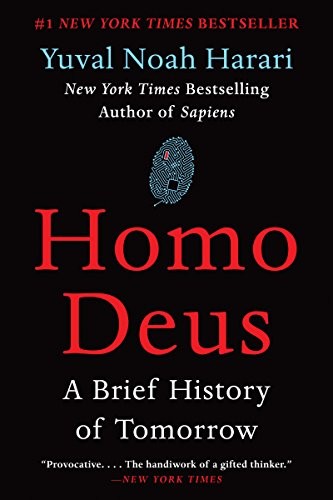
Talk to Homo Deus: A Brief History of Tomorrow like its author wrote you back.
Get the ideas that fit your life — not generic summaries.
- Chat with the book
- Audiobook-style main ideas
- Adapts to your life and goals
- Helps you take action
What it argues
Homo Deus picks up where Sapiens left off, but turns to face the other direction. Having traced how Homo sapiens climbed to the top of the food chain, Harari asks what comes next. His answer is unsettling: for most of history humans battled famine, plague, and war. Those three horsemen are not yet defeated, but for the first time in history they are manageable problems rather than incomprehensible forces. The agenda for the twenty-first century is set by a different set of ambitions — immortality, bliss, and divinity. Harari calls the potential endpoint Homo Deus: a species that has upgraded itself so thoroughly it no longer resembles the one that built the pyramids.
The book's central tension is between humanism and what Harari calls Dataism. Humanism — the religion of the modern age — holds that human experience and individual feeling are the ultimate source of authority and meaning. But the same digital revolution that empowered individuals is now eroding the foundations of humanism. Algorithms are becoming better than humans at predicting our preferences, diagnosing our ailments, and choosing our partners. If an algorithm can know what you want before you consciously know it, what exactly does human choice mean? Harari is not predicting a robot uprising. He is arguing something more quietly disturbing: that we may voluntarily hand authority over our lives to systems that process data more efficiently than we do.
What it gets right
- 1.
Humanity has largely tamed famine, plague, and war. The new agenda — immortality, bliss, and engineered divinity — is already being pursued by the wealthiest individuals and institutions on the planet.
- 2.
Harari separates intelligence from consciousness. Algorithms can be vastly more intelligent than humans without experiencing anything. The question is whether systems built for intelligence will continue to value consciousness at all.
- 3.
Humanism is the dominant religion of the modern era, but it rests on the belief that human feelings are the supreme source of authority. That foundation erodes when algorithms predict your feelings better than you do.
What it covers
Who wrote it
Yuval Noah Harari is an Israeli historian and professor at the Hebrew University of Jerusalem. His Sapiens: A Brief History of Humankind became one of the most widely read nonfiction books of the twenty-first century, translated into more than sixty languages. Homo Deus, published in Hebrew in 2015 and in English in 2016, is its sequel and counterpart. His third major work, 21 Lessons for the 21st Century, addresses the present. Harari is a co-founder of Sapienship, a social impact company focused on the challenges posed by technological disruption.
