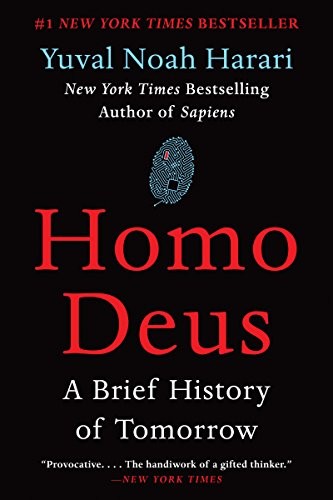
Homo Deus: A Brief History of Tomorrow by Yuval Noah Harari is a 2016 history book about futurism, technology and humanity, artificial intelligence. Humanity has largely tamed famine, plague, and war. The new agenda — immortality, bliss, and engineered divinity — is already being pursued by the wealthiest individuals and institutions on the planet.
Summary
Homo Deus picks up where Sapiens left off, but turns to face the other direction. Having traced how Homo sapiens climbed to the top of the food chain, Harari asks what comes next. His answer is unsettling: for most of history humans battled famine, plague, and war. Those three horsemen are not yet defeated, but for the first time in history they are manageable problems rather than incomprehensible forces. The agenda for the twenty-first century is set by a different set of ambitions — immortality, bliss, and divinity. Harari calls the potential endpoint Homo Deus: a species that has upgraded itself so thoroughly it no longer resembles the one that built the pyramids.
The book's central tension is between humanism and what Harari calls Dataism. Humanism — the religion of the modern age — holds that human experience and individual feeling are the ultimate source of authority and meaning. But the same digital revolution that empowered individuals is now eroding the foundations of humanism. Algorithms are becoming better than humans at predicting our preferences, diagnosing our ailments, and choosing our partners. If an algorithm can know what you want before you consciously know it, what exactly does human choice mean? Harari is not predicting a robot uprising. He is arguing something more quietly disturbing: that we may voluntarily hand authority over our lives to systems that process data more efficiently than we do.
Harari separates intelligence from consciousness, a distinction that carries most of the book's weight. Intelligence is the ability to solve problems; consciousness is the capacity to feel. Algorithms are becoming extraordinarily intelligent. They are not conscious. The question the book raises but does not fully answer is whether consciousness — felt experience, suffering, joy — matters to the economic and political systems we are building. If it does not, the cognitive elite and their algorithms will concentrate power in ways that make past inequality look modest. If it does, we face the challenge of encoding that judgment into systems that currently optimize for clicks and conversions.
Homo Deus is a broader and more speculative book than Sapiens, and that breadth costs it some precision. Harari moves quickly across neuroscience, economics, political theory, and computer science, and experts in each field will find things to contest. But the questions he forces into view — about the value of human experience in an algorithmic world, about what democracy means when data replaces deliberation, about who owns the data that increasingly defines us — are not going away. The book functions best as a provocation: a coherent, disturbing scenario designed to make you argue back.
Talk to Homo Deus: A Brief History of Tomorrow like its author wrote you back.
Get the ideas that fit your life — not generic summaries.
- Chat with the book
- Audiobook-style main ideas
- Adapts to your life and goals
- Helps you take action
Key takeaways
- 1.
Humanity has largely tamed famine, plague, and war. The new agenda — immortality, bliss, and engineered divinity — is already being pursued by the wealthiest individuals and institutions on the planet.
- 2.
Harari separates intelligence from consciousness. Algorithms can be vastly more intelligent than humans without experiencing anything. The question is whether systems built for intelligence will continue to value consciousness at all.
- 3.
Humanism is the dominant religion of the modern era, but it rests on the belief that human feelings are the supreme source of authority. That foundation erodes when algorithms predict your feelings better than you do.
- 4.
Dataism is the emerging worldview that treats the universe as a flow of data and organisms as algorithms. Under Dataism, a human being is less a subject than a data-processing node — valuable insofar as it generates and transmits information.
- 5.
The divide between the upgraded and the unupgraded could dwarf previous inequality. Those who can afford cognitive and biological enhancement will not merely be richer; they will be a different kind of entity.
- 6.
Free will, in Harari's account, is already a suspect concept. Brain scans reveal decisions before people are consciously aware of making them. If free will is an illusion, the moral and political architecture built on it requires rethinking.
- 7.
The most dangerous scenario is not a robot takeover but a voluntary transfer of authority: humans choosing to defer to algorithms because they give better answers, until human judgment atrophies from disuse.
- 8.
Homo Deus ends without a prescription. Harari positions himself as a historian raising questions, not an engineer proposing solutions. That honesty is either the book's integrity or its evasion, depending on what you want from it.
Discussion questions
Use these on your own, with a book club, or as chat starters in Superbook. Book club version, ready to copy or print →
- 1.
Harari argues that famine, plague, and war have been reduced to manageable problems. Does that framing feel accurate from where you sit, or does it require a kind of global perspective that obscures what's still urgent locally?
- 2.
The book claims humanism is a religion — a set of beliefs rather than self-evident truths. What assumptions about human uniqueness do you hold that you've never examined as assumptions?
- 3.
If an algorithm could reliably predict your political preferences, career satisfaction, and romantic compatibility better than your own introspection, would you use it? Where does that decision lead over time?
- 4.
Harari separates intelligence from consciousness. Should a system that is vastly more intelligent but not conscious have rights? Does the answer depend on how it behaves, or on what it experiences?
- 5.
The book suggests that free will is likely an illusion constructed after the fact by the conscious mind. If that's true, how does it change how you think about accountability — your own or others'?
- 6.
Who currently owns the data generated by your body, your behavior, and your relationships? Who should own it, and what kind of power does ownership actually confer?
- 7.
Dataism values organisms by how much data they process and transmit. Name a human activity you value that produces no useful data. How would it fare under a Dataist system?
- 8.
Harari describes a potential split between a small class of upgraded humans and the rest. Is there a point at which enhancement crosses from individual choice into a collective problem requiring regulation?
- 9.
The book is more interested in posing questions than answering them. Is that a strength — intellectual honesty about genuine uncertainty — or an evasion of responsibility for a public intellectual with this kind of reach?
- 10.
Sapiens argued that shared fictions hold societies together. Homo Deus suggests those fictions are beginning to dissolve under algorithmic pressure. What shared fictions are you aware of depending on right now?
- 11.
Harari ends without a clear program. If you had to draft one concrete policy that responds to the risks he identifies, what would it be?
- 12.
Compare Homo Deus to Sapiens. Which book changed how you think more, and why? If you've only read one, what drew you to it over the other?
Themes
Frequently asked questions
-
What is Homo Deus about?
Homo Deus is Harari's attempt to map where humanity is headed after solving its ancient problems of famine, plague, and war. The book argues that the twenty-first century agenda is dominated by the pursuit of immortality, engineered happiness, and godlike powers — and that algorithms and biotechnology are the tools most likely to get us there, for better or worse.
-
Do I need to read Sapiens before Homo Deus?
No, but it helps. Homo Deus assumes some familiarity with Harari's argument that human civilization is built on shared fictions. Readers who come in cold may find the early chapters faster if they have that context, but the book stands on its own.
-
Is Homo Deus worth reading?
Yes, if you want a coherent framework for thinking about AI, biotechnology, and the future of human agency. Harari is a better question-asker than answer-giver, and experts will find things to dispute. But the questions he raises — about consciousness, free will, and who controls data — are ones the next few decades will force on everyone.
-
Who should not read this book?
Readers who want precise technical predictions or policy recommendations will be frustrated. Homo Deus is a work of historical philosophy, not futurology. It gestures at scenarios rather than modeling them, and it ends without a prescription. If you need actionable takeaways, look elsewhere.
-
How long does it take to read Homo Deus?
Roughly seven hours at average reading pace for the 450-page book. The chapters are longer and denser than in Sapiens, and the speculative sections in the second half reward slower reading and periodic pauses to test the arguments against your own experience.
Similar books
Sapiens: A Brief History of Humankind
Yuval Noah Harari
Thinking, Fast and Slow
Daniel Kahneman
Outliers: The Story of Success
Malcolm Gladwell
Range: Why Generalists Triumph in a Specialized World
David Epstein
