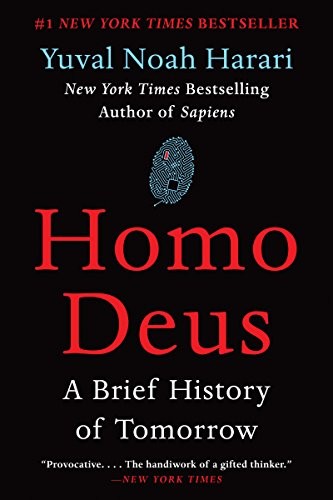
Talk to Homo Deus: A Brief History of Tomorrow like its author wrote you back.
Get the ideas that fit your life — not generic summaries.
- Chat with the book
- Audiobook-style main ideas
- Adapts to your life and goals
- Helps you take action
Homo Deus: A Brief History of Tomorrow, in detail
Homo Deus picks up where Sapiens left off, but turns to face the other direction. Having traced how Homo sapiens climbed to the top of the food chain, Harari asks what comes next. His answer is unsettling: for most of history humans battled famine, plague, and war. Those three horsemen are not yet defeated, but for the first time in history they are manageable problems rather than incomprehensible forces. The agenda for the twenty-first century is set by a different set of ambitions — immortality, bliss, and divinity. Harari calls the potential endpoint Homo Deus: a species that has upgraded itself so thoroughly it no longer resembles the one that built the pyramids.
The book's central tension is between humanism and what Harari calls Dataism. Humanism — the religion of the modern age — holds that human experience and individual feeling are the ultimate source of authority and meaning. But the same digital revolution that empowered individuals is now eroding the foundations of humanism. Algorithms are becoming better than humans at predicting our preferences, diagnosing our ailments, and choosing our partners. If an algorithm can know what you want before you consciously know it, what exactly does human choice mean? Harari is not predicting a robot uprising. He is arguing something more quietly disturbing: that we may voluntarily hand authority over our lives to systems that process data more efficiently than we do.
Harari separates intelligence from consciousness, a distinction that carries most of the book's weight. Intelligence is the ability to solve problems; consciousness is the capacity to feel. Algorithms are becoming extraordinarily intelligent. They are not conscious. The question the book raises but does not fully answer is whether consciousness — felt experience, suffering, joy — matters to the economic and political systems we are building. If it does not, the cognitive elite and their algorithms will concentrate power in ways that make past inequality look modest. If it does, we face the challenge of encoding that judgment into systems that currently optimize for clicks and conversions.
Homo Deus is a broader and more speculative book than Sapiens, and that breadth costs it some precision. Harari moves quickly across neuroscience, economics, political theory, and computer science, and experts in each field will find things to contest. But the questions he forces into view — about the value of human experience in an algorithmic world, about what democracy means when data replaces deliberation, about who owns the data that increasingly defines us — are not going away. The book functions best as a provocation: a coherent, disturbing scenario designed to make you argue back.
The big ideas
- 1.
Humanity has largely tamed famine, plague, and war. The new agenda — immortality, bliss, and engineered divinity — is already being pursued by the wealthiest individuals and institutions on the planet.
- 2.
Harari separates intelligence from consciousness. Algorithms can be vastly more intelligent than humans without experiencing anything. The question is whether systems built for intelligence will continue to value consciousness at all.
- 3.
Humanism is the dominant religion of the modern era, but it rests on the belief that human feelings are the supreme source of authority. That foundation erodes when algorithms predict your feelings better than you do.
