Talk to How Buildings Learn like its author wrote you back.
Get the ideas that fit your life — not generic summaries.
- Chat with the book
- Audiobook-style main ideas
- Adapts to your life and goals
- Helps you take action
How Buildings Learn, in detail
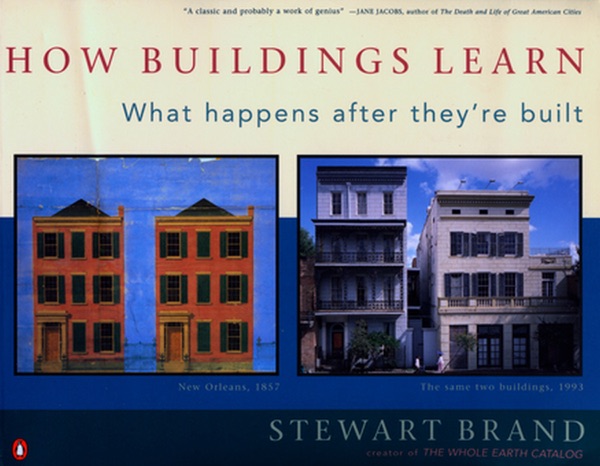
How Buildings Learn is Stewart Brand's argument that buildings are not finished products but ongoing processes — and that the buildings most valued over time are those designed to change gracefully rather than resist change defensively. Brand wrote it after observing that the canonical works of twentieth-century architecture aged badly, while vernacular and industrial buildings often became more useful and beloved over decades. The central problem with architectural theory, he argues, is that it treats buildings as photographs when they should be treated as time-lapse films.
The book introduces the Shearing Layers concept, Brand's most durable contribution to thinking about buildings. A building is really six layers operating at different timescales: Site (virtually permanent), Structure (decades to centuries), Skin (decades), Services (fifteen years), Space plan (years to decades), and Stuff (daily to monthly). When these layers are allowed to change at their own rates, buildings flourish. When a fast layer is locked to a slow one — when you can't rewire without demolishing the ceiling — buildings become expensive to maintain and eventually get torn down.
Brand walks through case studies: MIT's Building 20, a plywood "temporary" structure erected for World War II radar research that became one of the most innovative buildings in university history precisely because nobody cared about it; Frank Lloyd Wright's beautiful but famously unlivable houses; commercial loft buildings that have housed factories, warehouses, offices, and residences in succession. The pattern is consistent: low-status buildings that allow tinkering outlast prestigious ones that forbid it.
The final argument is about humility in design. Architects are trained to think of their work as complete at delivery. Brand argues this is wrong from the start — the building you hand over is always just the beginning, and the users who inhabit it over time are its real designers. The most valuable gift a building can offer is the capacity for its occupants to make it their own.
The big ideas
- 1.
Buildings are not finished objects but ongoing processes. The question is not what a building looks like at delivery but how well it learns over time.
- 2.
The Shearing Layers framework divides a building into six layers — Site, Structure, Skin, Services, Space Plan, Stuff — each changing at a different timescale. Good buildings allow each layer to evolve independently.
- 3.
Low-status, unloved buildings often outlast prestigious ones because occupants feel free to modify them. Revered buildings are frozen by their own reputation.
