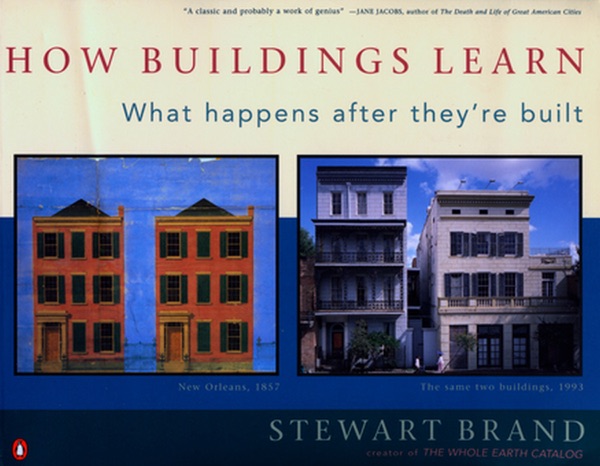
How Buildings Learn by Stewart Brand is a 1994 science book about architecture, adaptation, systems thinking. Buildings are not finished objects but ongoing processes. The question is not what a building looks like at delivery but how well it learns over time.
Summary
How Buildings Learn is Stewart Brand's argument that buildings are not finished products but ongoing processes — and that the buildings most valued over time are those designed to change gracefully rather than resist change defensively. Brand wrote it after observing that the canonical works of twentieth-century architecture aged badly, while vernacular and industrial buildings often became more useful and beloved over decades. The central problem with architectural theory, he argues, is that it treats buildings as photographs when they should be treated as time-lapse films.
The book introduces the Shearing Layers concept, Brand's most durable contribution to thinking about buildings. A building is really six layers operating at different timescales: Site (virtually permanent), Structure (decades to centuries), Skin (decades), Services (fifteen years), Space plan (years to decades), and Stuff (daily to monthly). When these layers are allowed to change at their own rates, buildings flourish. When a fast layer is locked to a slow one — when you can't rewire without demolishing the ceiling — buildings become expensive to maintain and eventually get torn down.
Brand walks through case studies: MIT's Building 20, a plywood "temporary" structure erected for World War II radar research that became one of the most innovative buildings in university history precisely because nobody cared about it; Frank Lloyd Wright's beautiful but famously unlivable houses; commercial loft buildings that have housed factories, warehouses, offices, and residences in succession. The pattern is consistent: low-status buildings that allow tinkering outlast prestigious ones that forbid it.
The final argument is about humility in design. Architects are trained to think of their work as complete at delivery. Brand argues this is wrong from the start — the building you hand over is always just the beginning, and the users who inhabit it over time are its real designers. The most valuable gift a building can offer is the capacity for its occupants to make it their own.
Talk to How Buildings Learn like its author wrote you back.
Get the ideas that fit your life — not generic summaries.
- Chat with the book
- Audiobook-style main ideas
- Adapts to your life and goals
- Helps you take action
Key takeaways
- 1.
Buildings are not finished objects but ongoing processes. The question is not what a building looks like at delivery but how well it learns over time.
- 2.
The Shearing Layers framework divides a building into six layers — Site, Structure, Skin, Services, Space Plan, Stuff — each changing at a different timescale. Good buildings allow each layer to evolve independently.
- 3.
Low-status, unloved buildings often outlast prestigious ones because occupants feel free to modify them. Revered buildings are frozen by their own reputation.
- 4.
MIT's Building 20 — a cheaply built World War II temporary structure — became one of the most productive research buildings in history because nobody protected it from change.
- 5.
Frank Lloyd Wright's most celebrated houses were often unlivable and required constant costly repairs. Beauty optimized for the opening day photograph is a different thing from durability.
- 6.
When fast-changing layers (wiring, plumbing, partition walls) are locked into slow-changing ones (structure), maintenance costs explode and buildings age badly.
- 7.
Vernacular architecture — the farm building, the warehouse, the Victorian terrace house — embeds accumulated wisdom about what actually works across a range of uses.
- 8.
Users are always the real designers. Every building is renovated by the people who occupy it, and the best buildings are designed to make that renovation cheap and easy.
Discussion questions
Use these on your own, with a book club, or as chat starters in Superbook. Book club version, ready to copy or print →
- 1.
Brand argues that the most admired buildings often age worst. Does that match your experience of buildings you've lived or worked in?
- 2.
The Shearing Layers concept applies beyond buildings — to organizations, software, even relationships. What else in your life has layers changing at different rates?
- 3.
Have you ever inhabited a building that felt impossible to make your own? What made it feel that way?
- 4.
MIT's Building 20 thrived because it was considered dispensable. Where in your work or life do the low-status, unprotected things outperform the prestigious ones?
- 5.
Brand is critical of architecture as a profession for treating users as passive. What other professions have the same problem — designing for the moment of delivery rather than for ongoing use?
- 6.
The book was published in 1994. How has commercial real estate, open-plan offices, and smart-building technology changed the arguments Brand makes?
- 7.
He argues that old buildings are often more sustainable than new ones because the energy cost of demolition and construction is enormous. How does this change how you think about renovation versus replacement?
- 8.
What's the most heavily modified building you know — home, school, office — and what does the accumulation of changes tell you about the people who used it?
- 9.
Brand is sympathetic to vernacular architecture and skeptical of architectural celebrity. Is that fair? Are there celebrated architects who do design for longevity?
- 10.
If you were renovating a home or office, how would you apply the Shearing Layers concept? Which layers would you invest in making more adaptable?
- 11.
The book argues that users are always the real designers. Does that make the initial architect's role less important, or just differently important?
- 12.
Brand ends with an argument for humility in design. Where in your own work do you impose a finished solution where openness to ongoing modification would serve better?
Themes
Frequently asked questions
-
Is How Buildings Learn only for architects and designers?
No. Brand writes for a general audience and the arguments are about systems, time, and adaptation as much as about buildings specifically. The Shearing Layers concept is widely used in software engineering and organizational design. Anyone who thinks about complex systems that change over time will find the framework useful.
-
How long is How Buildings Learn?
Around 240 pages of main text, richly illustrated with photographs. At average reading pace it takes roughly six hours, though readers who spend time on the photographs and diagrams will take longer. The chapters are self-contained enough that it rewards slow, non-linear reading.
-
What is the Shearing Layers concept?
Brand's framework for understanding buildings as composed of six layers — Site, Structure, Skin, Services, Space Plan, and Stuff — each changing at a different timescale from centuries to days. The key insight is that when these layers are allowed to change independently, buildings stay useful; when they're locked together, they age badly and expensively.
-
Is the book still relevant given how much building technology has changed since 1994?
The core argument has only become more relevant. Sustainable construction, adaptive reuse, and the massive cost of demolition all support Brand's case for designing buildings that learn. Smart-building technology adds new service layers but doesn't change the underlying logic.
-
What building does Brand most admire?
MIT's Building 20 is his clearest example of a building that worked through being unloved and freely modified. He also writes admiringly of Georgian terraces, industrial loft buildings, and New England farmsteads as examples of vernacular architecture that accumulates wisdom through use.