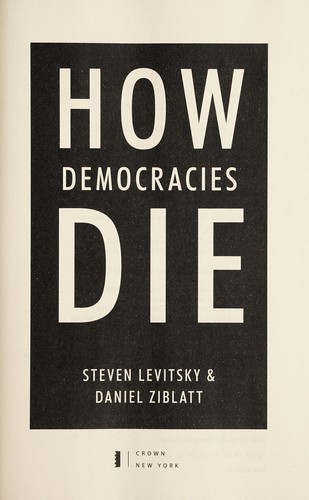
How Democracies Die by Steven Levitsky and Daniel Ziblatt is a 2018 politics book about democracy, authoritarianism, political norms. Modern democracies typically die not through military coups but through the incremental undermining of institutions by elected leaders who retain democratic legitimacy.
Summary
Steven Levitsky and Daniel Ziblatt are Harvard comparative politics scholars who have spent their careers studying how democracies break down in Latin America and Europe. How Democracies Die, published in January 2018, applies that scholarship directly to the United States. Its central argument is that democracies today rarely end in coups — they die gradually, through the incremental erosion of the norms and institutions that make them function, usually carried out by elected leaders who retain democratic legitimacy while dismantling democratic constraints.
The book introduces two behavioral tests for identifying authoritarian leaders: rejection of democratic rules of the game, denial of the legitimacy of political opponents, toleration or encouragement of violence, and willingness to curtail civil liberties. These indicators, drawn from twentieth-century failures in Europe and Latin America, allow comparison across cases that might seem geographically and culturally remote from the United States. The authors argue that Latin American experience is particularly instructive because it shows what democratic erosion looks like when the gatekeeping institutions that historically protected American democracy — particularly the Republican and Democratic parties — fail to do their job.
The structural diagnosis centers on two unwritten rules they call mutual toleration — accepting the legitimacy of political opponents — and institutional forbearance — restraint in using legal powers to their maximum extent. These norms have enforced a kind of self-limitation that prevented American politics from becoming zero-sum. When those norms erode, the institutions that seemed robust reveal themselves as dependent on the goodwill of the people operating them. Courts can be packed, oversight bodies can be ignored, emergency powers can be stretched — all legally, within the rules.
Published before the end of Trump's first term, the book has been credited with providing a framework that proved prescient. Its limitation, acknowledged by the authors in later work, is that it focuses more on diagnosis than remedy. The mechanisms of democratic erosion are described clearly; the mechanisms of democratic recovery are less developed. The comparison with other countries where democratic erosion has been reversed — South Korea, Brazil — suggests recovery is possible but requires exactly the kinds of coalition-building and norm enforcement that are hardest when norms are already under stress.
Talk to How Democracies Die like its author wrote you back.
Get the ideas that fit your life — not generic summaries.
- Chat with the book
- Audiobook-style main ideas
- Adapts to your life and goals
- Helps you take action
Key takeaways
- 1.
Modern democracies typically die not through military coups but through the incremental undermining of institutions by elected leaders who retain democratic legitimacy.
- 2.
Four behavioral warning signs identify authoritarian leaders: rejection of democratic rules, denial of opponent legitimacy, toleration of political violence, and willingness to restrict civil liberties.
- 3.
Mutual toleration — accepting rivals as legitimate — and institutional forbearance — restraining use of legal powers — are the unwritten norms that hold competitive democracy together.
- 4.
Political parties have historically served as gatekeepers, refusing to nominate or normalize candidates who display authoritarian tendencies. When they fail at this function, the risk of democratic erosion rises sharply.
- 5.
Polarization is not just a social phenomenon but a structural threat: when opponents become enemies, the mutual toleration that makes democratic competition sustainable collapses.
- 6.
Constitutions and laws do not protect democracy by themselves. They depend on the willingness of political actors to honor their spirit rather than exploit every legal opening.
- 7.
Historical precedents from Europe and Latin America show that democracies can erode quickly once erosion begins, because each norm violation by one side justifies escalation by the other.
- 8.
Outsider candidates who campaign against the political establishment are not necessarily authoritarian, but the combination of outsider status with the four behavioral indicators is a reliable danger signal.
Discussion questions
Use these on your own, with a book club, or as chat starters in Superbook. Book club version, ready to copy or print →
- 1.
Levitsky and Ziblatt argue that party gatekeeping is democracy's first line of defense. By that standard, how have the two major American parties performed over the last decade?
- 2.
The four behavioral indicators of authoritarian tendencies are designed to be observable before an election. How useful are they as a practical checklist for voters?
- 3.
The book distinguishes between hardball politics — aggressive but within norms — and norm-breaking. Where do you draw that line, and is the distinction as clear in practice as it sounds in theory?
- 4.
The authors use Latin American and European examples heavily. Do you find those comparisons persuasive, or do American institutional differences make the analogies break down?
- 5.
Mutual toleration requires accepting that your opponents are legitimate even when you believe their policies are deeply harmful. What are the limits of that norm?
- 6.
The book was written in 2017–2018. Which of its predictions have proved accurate and which have not?
- 7.
Levitsky and Ziblatt argue that polarization is a structural threat to democracy even when it reflects genuine disagreement about important issues. How do you think about that tradeoff?
- 8.
The diagnosis in the book is clearer than the remedy. What would a convincing theory of democratic recovery look like, and does the book gesture toward one?
- 9.
The authors discuss how ruling parties in other countries — Hungary, Turkey — have used legal tools to lock in electoral advantages. Which of those tools are available in the American system?
- 10.
How Democracies Die focuses on executive overreach. What would a version of the argument focused on legislative or judicial dysfunction look like?
- 11.
The book emphasizes elites — party leaders, institutions, prominent politicians — as the main actors who protect or fail to protect democracy. What role does it assign to ordinary voters?
- 12.
Which unwritten norm that the authors describe as important seems most fragile to you today?
Themes
Frequently asked questions
-
Is How Democracies Die worth reading?
Yes. It is one of the clearest applications of comparative political science to contemporary American democracy. The writing is accessible without being simplistic, and the historical examples from Europe and Latin America provide concrete reference points for abstract arguments about norms and institutions.
-
When was How Democracies Die published?
January 2018. It was written during the first year of the Trump administration and became a widely read framework for understanding democratic erosion in the United States, though it draws primarily on historical cases from Europe and Latin America.
-
What is the main argument of How Democracies Die?
That democracies today rarely collapse through coups. They erode gradually when elected leaders chip away at the norms — mutual toleration and institutional forbearance — and institutions that make competitive democracy function. The process is incremental and often legal, which makes it harder to identify and resist.
-
How does How Democracies Die compare to Tyranny of the Minority?
How Democracies Die focuses on behavioral norms — what politicians do — and argues that norm erosion is the primary threat. Tyranny of the Minority shifts to constitutional structure, arguing that counter-majoritarian features of the American system create vulnerabilities that behavioral norms cannot compensate for.
-
Who should read How Democracies Die?
Anyone trying to understand why democratic norms matter and how democracies fail. The book is most valuable for readers willing to sit with uncomfortable comparisons between the United States and countries that have experienced democratic backsliding — the comparison is the argument.
Similar books
Tyranny of the Minority: Why American Democracy Reached the Breaking Point
Steven Levitsky and Daniel Ziblatt
21 Lessons for the 21st Century
Yuval Noah Harari

Sapiens: A Brief History of Humankind
Yuval Noah Harari
