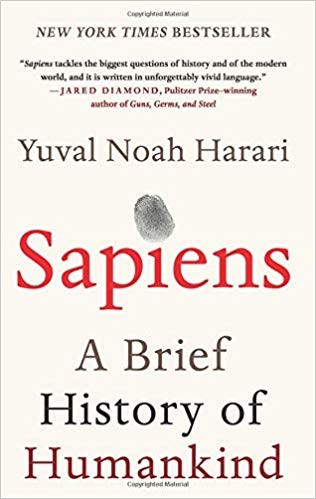
Sapiens: A Brief History of Humankind by Yuval Noah Harari is a 2014 history book about history, evolution, cognition. The Cognitive Revolution around 70,000 years ago gave Homo sapiens the ability to believe in shared fictions — gods, nations, money — which enabled mass cooperation on a scale no other animal can match.
Summary
Sapiens traces the full arc of human history from the emergence of Homo sapiens in Africa roughly 70,000 years ago to the present. Harari's organizing argument is that what made humans dominant wasn't physical strength or intelligence but the capacity for shared fiction. Only Homo sapiens can convince millions of strangers to cooperate around ideas — nations, currencies, religions, corporations — that exist nowhere in the natural world. The Cognitive Revolution, which gave us language and abstract thought, is Harari's first pivot point.
The second is the Agricultural Revolution, which Harari treats not as progress but as a trap. Farming produced more calories, which produced more people, which required more farming. By his reading, the average wheat farmer was worse off than the average forager — harder physical work, a narrower diet, more disease — but there was no collective mechanism to reverse course. Agriculture made civilization possible, but it did so partly by degrading the daily lives of the people who built it. Harari names this one of history's great ironies.
The third pivot is the Scientific Revolution, which Harari links to a European willingness to admit ignorance and finance the exploration of unknowns. He connects science to capitalism and imperialism as mutually reinforcing forces: capital funded voyages, voyages found resources, resources funded more science, and the whole system ran on a shared belief that investment today produces returns tomorrow. This section is the most contested in the book — critics argue Harari compresses four centuries into a single causation story — but it's also the most readable.
The book closes with a look at where Homo sapiens is heading: genetic engineering, cyborg technology, the potential end of biological limits. Harari is genuinely uncertain whether these futures are good or bad, and that uncertainty is one of Sapiens' more honest qualities. It asks large questions — Did the Agricultural Revolution make humans happier? Does economic growth require suffering? — without pretending to resolve them cleanly. The book works best as a provocation: a fast, opinionated map of the entire human story designed to make readers question what they think progress means.
Talk to Sapiens: A Brief History of Humankind like its author wrote you back.
Get the ideas that fit your life — not generic summaries.
- Chat with the book
- Audiobook-style main ideas
- Adapts to your life and goals
- Helps you take action
Key takeaways
- 1.
The Cognitive Revolution around 70,000 years ago gave Homo sapiens the ability to believe in shared fictions — gods, nations, money — which enabled mass cooperation on a scale no other animal can match.
- 2.
The Agricultural Revolution produced more food but not more wellbeing. Harari argues it was a trap: population growth locked humans into farming before anyone could choose otherwise.
- 3.
Money, nations, and corporations are all shared myths. They have no physical existence, but they are among the most powerful forces in human history because enough people act as if they are real.
- 4.
The Scientific Revolution was built on an admission of ignorance. European powers funded exploration precisely because they acknowledged they did not know what was out there.
- 5.
Capitalism runs on credit — a collective belief that future value justifies present investment. Without this story, the modern global economy cannot function.
- 6.
Imperialism and science reinforced each other. Conquest funded research; research made conquest more efficient. The two cannot be cleanly separated in the historical record.
- 7.
Harari argues that happiness may not have increased with material progress. Biology sets a hedonic baseline; people adapt quickly to new conditions and return to roughly where they started.
- 8.
The book ends with a genuine open question: as humans acquire godlike technologies, there is no agreed-upon framework for deciding what we should do with them.
Discussion questions
Use these on your own, with a book club, or as chat starters in Superbook. Book club version, ready to copy or print →
- 1.
Harari argues that shared fictions — money, laws, corporations — are what make civilization possible. Which of the fictions you live inside is hardest to see as a fiction?
- 2.
His take on the Agricultural Revolution is that it was bad for most individuals while being good for populations. Can you think of modern equivalents — systems that benefit the aggregate at the expense of the individual?
- 3.
Harari claims Homo sapiens drove most large mammals to extinction during the prehistoric period. Does attributing this to humans 70,000 years ago change how you think about current environmental destruction?
- 4.
The book treats religion, money, and nationalism as functionally similar: shared stories that enable cooperation. Is there a meaningful moral difference between them, or only a practical one?
- 5.
If the Agricultural Revolution made average people worse off, what does that tell you about how collective decisions get made? Can you identify a contemporary equivalent?
- 6.
Harari is skeptical that economic growth has made humans happier. What evidence from your own life supports or challenges that view?
- 7.
The book covers 70,000 years in under 500 pages. What gets lost in that kind of compression, and does the loss matter for the argument Harari is making?
- 8.
Sapiens links the Scientific Revolution specifically to European culture and institutions. Is that argument convincing, or does it leave too much out?
- 9.
Harari draws a connection between capitalism and the belief that tomorrow will be better than today. Where did you get that belief, and do you actually hold it?
- 10.
The book ends with humans on the verge of redesigning life itself. Harari asks whether we know what we want to become. What would your answer be?
- 11.
Which of the three revolutions — Cognitive, Agricultural, Scientific — do you think had the largest net negative effect on human experience? Why?
- 12.
Harari suggests the most important things in history are not the facts themselves but the stories people told about them. Do you find that view persuasive, or does it undervalue material causation?
Themes
Frequently asked questions
-
What is Sapiens about?
Sapiens is a history of Homo sapiens from prehistoric times to the present. Its central argument is that humans became dominant through the ability to believe in and organize around shared fictions — language, religion, money, nations — rather than through physical superiority.
-
Is Sapiens worth reading?
Yes, if you want a fast, opinionated map of human history. It's more useful as a provocation than as a definitive account. Historians frequently challenge Harari's compression and causal claims, but those arguments are worth having, and the book frames them clearly enough to argue back.
-
How long does it take to read Sapiens?
Roughly eight to nine hours at average reading pace. The 443-page book covers a lot of ground but moves quickly. Most readers find it easier to finish than its scope suggests.
-
Who should read Sapiens?
Anyone curious about how human societies got to where they are and willing to engage with sweeping, simplified arguments. It works especially well for readers who haven't done much history and want a single opinionated framework to build from.
-
What's the most controversial idea in Sapiens?
Harari's claim that the Agricultural Revolution was a mistake — or at least a trap — for the individual humans who lived through it. He argues that farmers worked harder, ate worse, and died younger than the foragers they replaced, and that the revolution succeeded demographically while failing personally.
Similar books


Sapiens vs.
Deciding between two books? Sapiens vs Guns, Germs, and Steel .
