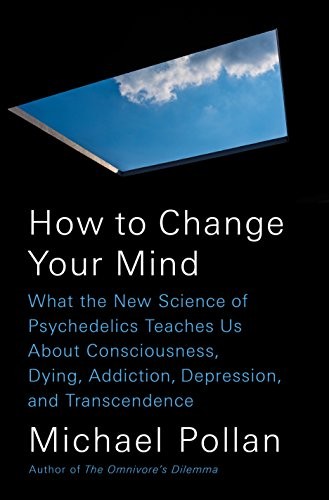
Talk to How to Change Your Mind like its author wrote you back.
Get the ideas that fit your life — not generic summaries.
- Chat with the book
- Audiobook-style main ideas
- Adapts to your life and goals
- Helps you take action
How to Change Your Mind, in detail
Michael Pollan came to psychedelics late in life, as a skeptic. How to Change Your Mind is his attempt to understand what LSD and psilocybin actually do — to the brain, to consciousness, and to people who use them therapeutically. The book is simultaneously a cultural history of psychedelic research, a neuroscience explainer, a series of portraits of researchers and guides, and a first-person account of Pollan's own experiences with psilocybin, LSD, and 5-MeO-DMT. The combination is unusual and mostly works.
The historical sections cover the first wave of psychedelic research in the 1950s and 1960s, when LSD was an active area of psychiatric inquiry with thousands of published papers and serious clinical interest, and then the abrupt shutdown that followed Timothy Leary's cultural detonation and the Nixon administration's scheduling decisions. Pollan's reporting makes clear that the shutdown was politically rather than scientifically motivated — the evidence base that was accumulating in the mid-1960s was stronger than most people now assume. He then covers the second wave beginning in the 1990s and accelerating through the 2010s, centered at Johns Hopkins, NYU, and Imperial College London, where psilocybin has shown striking results in clinical trials for treatment-resistant depression, addiction, and end-of-life anxiety.
The neuroscience sections are perhaps the most surprising. Drawing on the work of Robin Carhart-Harris and others, Pollan explains the default mode network — the self-referential brain circuitry that underlies the narrative sense of self — and how psychedelics dramatically suppress its activity. This suppression is associated with the dissolution of ego that users report, and potentially with the lasting changes in cognition and mood that follow. The brain enters a more plastic state during the experience, and new patterns of neural connection form that can persist for weeks or months. This mechanism may explain why a single dose can produce lasting behavioral change in ways that daily medication does not.
Pollan's own experiences are described with reportorial honesty rather than evangelism. He found them profound and disorienting in ways he didn't fully expect, and he's candid about what was difficult alongside what was illuminating. The book doesn't advocate for recreational use and takes seriously the potential for harm in unsupported settings. The central argument is more modest: that a class of substances dismissed for fifty years as dangerous counterculture artifacts deserves rigorous scientific attention, and that the early results of the second wave of research are too significant to ignore.
The big ideas
- 1.
Psilocybin and LSD suppress the default mode network, the brain circuitry underlying the sense of self. The dissolution of ego that results may be the mechanism through which lasting psychological change occurs.
- 2.
The first wave of psychedelic research in the 1950s and 1960s produced thousands of peer-reviewed papers. The Nixon-era scheduling of these substances as Schedule I was a political rather than scientific decision.
- 3.
In Johns Hopkins and NYU clinical trials, a single guided psilocybin session produced sustained reductions in depression and anxiety in cancer patients — results that antidepressants taken daily did not achieve.
