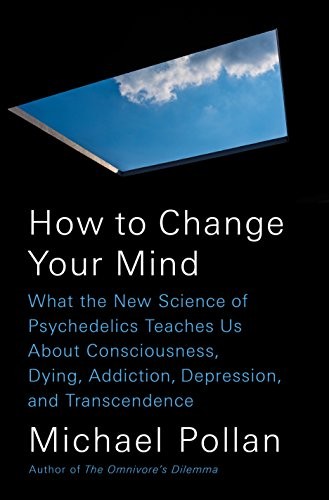
How to Change Your Mind by Michael Pollan is a 2018 science book about psychedelics, consciousness, neuroscience. Psilocybin and LSD suppress the default mode network, the brain circuitry underlying the sense of self. The dissolution of ego that results may be the mechanism through which lasting psychological change occurs.
Summary
Michael Pollan came to psychedelics late in life, as a skeptic. How to Change Your Mind is his attempt to understand what LSD and psilocybin actually do — to the brain, to consciousness, and to people who use them therapeutically. The book is simultaneously a cultural history of psychedelic research, a neuroscience explainer, a series of portraits of researchers and guides, and a first-person account of Pollan's own experiences with psilocybin, LSD, and 5-MeO-DMT. The combination is unusual and mostly works.
The historical sections cover the first wave of psychedelic research in the 1950s and 1960s, when LSD was an active area of psychiatric inquiry with thousands of published papers and serious clinical interest, and then the abrupt shutdown that followed Timothy Leary's cultural detonation and the Nixon administration's scheduling decisions. Pollan's reporting makes clear that the shutdown was politically rather than scientifically motivated — the evidence base that was accumulating in the mid-1960s was stronger than most people now assume. He then covers the second wave beginning in the 1990s and accelerating through the 2010s, centered at Johns Hopkins, NYU, and Imperial College London, where psilocybin has shown striking results in clinical trials for treatment-resistant depression, addiction, and end-of-life anxiety.
The neuroscience sections are perhaps the most surprising. Drawing on the work of Robin Carhart-Harris and others, Pollan explains the default mode network — the self-referential brain circuitry that underlies the narrative sense of self — and how psychedelics dramatically suppress its activity. This suppression is associated with the dissolution of ego that users report, and potentially with the lasting changes in cognition and mood that follow. The brain enters a more plastic state during the experience, and new patterns of neural connection form that can persist for weeks or months. This mechanism may explain why a single dose can produce lasting behavioral change in ways that daily medication does not.
Pollan's own experiences are described with reportorial honesty rather than evangelism. He found them profound and disorienting in ways he didn't fully expect, and he's candid about what was difficult alongside what was illuminating. The book doesn't advocate for recreational use and takes seriously the potential for harm in unsupported settings. The central argument is more modest: that a class of substances dismissed for fifty years as dangerous counterculture artifacts deserves rigorous scientific attention, and that the early results of the second wave of research are too significant to ignore.
Talk to How to Change Your Mind like its author wrote you back.
Get the ideas that fit your life — not generic summaries.
- Chat with the book
- Audiobook-style main ideas
- Adapts to your life and goals
- Helps you take action
Key takeaways
- 1.
Psilocybin and LSD suppress the default mode network, the brain circuitry underlying the sense of self. The dissolution of ego that results may be the mechanism through which lasting psychological change occurs.
- 2.
The first wave of psychedelic research in the 1950s and 1960s produced thousands of peer-reviewed papers. The Nixon-era scheduling of these substances as Schedule I was a political rather than scientific decision.
- 3.
In Johns Hopkins and NYU clinical trials, a single guided psilocybin session produced sustained reductions in depression and anxiety in cancer patients — results that antidepressants taken daily did not achieve.
- 4.
The brain's default mode network is associated with rumination, self-criticism, and rigid thought patterns. Its suppression during a psychedelic experience may explain the lasting reduction in depression and addiction that trials have documented.
- 5.
Mystical experiences — a sense of unity, sacredness, and deep meaning — correlate strongly with therapeutic outcomes in clinical trials. The more profound the experience, the better the results.
- 6.
Neuroplasticity increases during and after psychedelic experiences. The brain forms new connections during the experience, and the period following is characterized by unusual receptivity to behavioral and cognitive change.
- 7.
Set and setting — the participant's mindset and the physical and relational environment — are as important as the chemical itself in determining the character and outcome of an experience.
- 8.
The second wave of psychedelic research has expanded to include psilocybin for depression, MDMA for PTSD, and ketamine for treatment-resistant cases, with a growing evidence base supporting their efficacy.
Discussion questions
Use these on your own, with a book club, or as chat starters in Superbook. Book club version, ready to copy or print →
- 1.
Pollan argues that the shutdown of psychedelic research was politically rather than scientifically driven. What would the state of psychiatric treatment look like if that research had continued uninterrupted?
- 2.
The mystical experience correlates with therapeutic outcomes in the clinical trials. What do you make of the fact that a subjective, hard-to-quantify experience is a measurable predictor of medical results?
- 3.
Pollan describes the default mode network as the neural substrate of the ego. How does understanding the ego as a brain structure — rather than as a fixed identity — change how you think about the self?
- 4.
The book presents psychedelics as potentially useful tools for mental health while acknowledging significant risks in unsupported settings. Where do you draw the line between personal freedom and public health concern in how these substances are regulated?
- 5.
Pollan came to the subject as a skeptic and left convinced the research merited attention. What would it take for you to update your own priors on a topic this culturally loaded?
- 6.
The clinical trials require significant preparation, a trained guide, and careful follow-up. How much of the result do you think comes from those conditions versus the drug itself?
- 7.
What's the difference between a mystical experience induced by a drug and one that arises from years of meditation practice? Does the origin change the value?
- 8.
The research on psilocybin for addiction — particularly smoking cessation, where results have been exceptionally strong — suggests the drug can interrupt entrenched behaviors. How does that work mechanistically, and what does it suggest about addiction?
- 9.
Pollan interviews elderly psychedelic researchers who describe the 1960s research as genuinely promising science destroyed by cultural panic. How do you evaluate scientific consensus when it forms around a politically charged subject?
- 10.
The dose, set, and setting model for psychedelic therapy is very different from how most pharmaceuticals are administered. What does that difference imply about how we think about drug treatment generally?
- 11.
Pollan's own experiences were profound and disorienting. What does it mean for a science journalist to put himself in the story in this way?
- 12.
How does reading about the neuroscience of ego dissolution change how you think about the self in everyday life — not in extreme altered states, but in ordinary consciousness?
Themes
Frequently asked questions
-
Is How to Change Your Mind an argument for taking psychedelics?
Not exactly. Pollan argues that the research on therapeutic uses deserves serious attention and that the scheduling of these substances was politically motivated. He's candid about his own experiences but doesn't advocate for recreational use. The book is more of a case for scientific openness than a prescription for what readers should do.
-
How long does How to Change Your Mind take to read?
Around nine hours. At roughly 480 pages it's one of Pollan's longer books, and it covers a lot of ground — cultural history, neuroscience, clinical trials, and personal narrative. The pacing varies; the history sections move quickly and the first-person experience sections are denser.
-
Do you need to know anything about neuroscience to follow the book?
No. Pollan explains the default mode network, neuroplasticity, and other concepts clearly for a general audience. The neuroscience sections are among the clearest explanations of those topics available in trade nonfiction.
-
What is the most surprising research finding Pollan covers?
Probably the psilocybin smoking cessation results from Johns Hopkins, where 80% of participants were still abstinent six months after a single guided session — far exceeding any other intervention. That result, if it holds up in larger trials, would be one of the most significant findings in addiction medicine in decades.
-
Is this book suitable for someone skeptical about psychedelics?
Yes, and Pollan would say that's his ideal reader. He writes explicitly as someone who came in skeptical and was surprised by the science. The book makes the historical and neurological case carefully and doesn't require the reader to embrace the more mystical framing some participants describe.
Similar books

Sapiens: A Brief History of Humankind
Yuval Noah Harari

Waking Up: A Guide to Spirituality Without Religion
Sam Harris
The Body Keeps the Score
Bessel van der Kolk
Thinking, Fast and Slow
Daniel Kahneman
