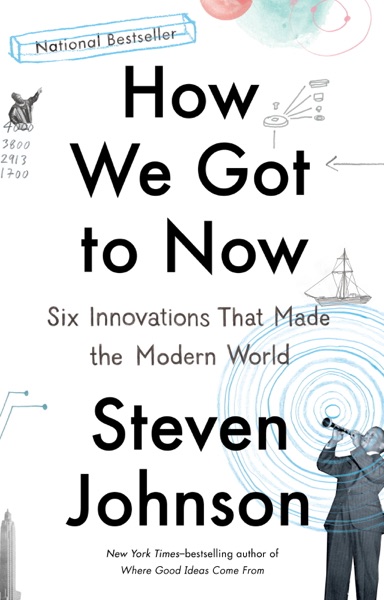
Talk to How We Got to Now like its author wrote you back.
Get the ideas that fit your life — not generic summaries.
- Chat with the book
- Audiobook-style main ideas
- Adapts to your life and goals
- Helps you take action
How We Got to Now, in detail
How We Got to Now traces six innovations — glass, cold, sound, clean, time, and light — and follows each one through unexpected chains of consequence into the present. Steven Johnson's argument is that the most important effects of a new technology are often the ones nobody predicted. The invention of glass didn't just give people windows; it created spectacles, which extended working lives, which changed the demographics of craft and scholarship. The mirror made self-portraiture possible. The telescope opened the universe.
Johnson calls these chains "hummingbird effects" — when a change in one niche creates unpredicted adaptations in a distant and apparently unrelated one. The term comes from flowers and the birds that evolved alongside them: a floral innovation changed the shape of a beak thousands of miles away. His six chapters document similar ripple effects across history. The refrigeration story moves from ice-cutting operations in New England through the transformation of American diet, migration patterns, and the death of seasonal food. The clean water chapter connects the bacteriological revolution of the nineteenth century to the infrastructure behind modern cities.
The book is explicitly popular history rather than academic analysis. Johnson writes about Lowell Thompson, Frederic Tudor, Clara Rockmore, and other obscure figures whose innovations changed the world without their names being remembered. He's interested in credit and how it's distributed, how multiple inventors often arrive at the same solution near simultaneously (what he calls the "adjacent possible"), and why some innovations get adopted immediately while others wait decades for the surrounding infrastructure to catch up.
The companion BBC documentary series gave the book unusual visual richness, and Johnson writes with the pacing and concrete detail of someone who has thought carefully about what makes historical explanation compelling. The book doesn't offer a theory of innovation so much as a sustained argument that all change is entangled — that the history of one idea cannot be told without following it into the systems it reshapes and the systems that reshape it.
The big ideas
- 1.
The 'hummingbird effect': innovations cause changes in remote, apparently unrelated domains in ways that are impossible to predict at the point of invention.
- 2.
The 'adjacent possible' describes the set of innovations that are achievable at any given moment given existing materials, knowledge, and infrastructure. Progress happens at its edge.
- 3.
Glass didn't just create windows — it led to spectacles, then telescopes and microscopes, then modern astronomy, bacteriology, and chemistry. One material unlocked multiple sciences.
