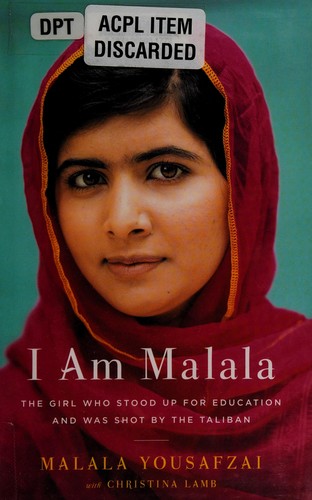
Talk to I Am Malala like its author wrote you back.
Get the ideas that fit your life — not generic summaries.
- Chat with the book
- Audiobook-style main ideas
- Adapts to your life and goals
- Helps you take action
What it argues
I Am Malala is the memoir of Malala Yousafzai, the Pakistani activist who was shot by the Taliban on her school bus in October 2012 at age fifteen, and who survived to become the youngest recipient of the Nobel Peace Prize. Written with journalist Christina Lamb, the book moves between Malala's childhood in the Swat Valley, the Taliban's progressive takeover of the region, and the years leading up to the assassination attempt. It is a book about one girl's education, one family's values, and one society's disintegration under ideological violence.
The heart of the book is the relationship between Malala and her father, Ziauddin, a school founder and education activist who raised his daughter to speak publicly at a time and in a place where girls were expected to disappear from public life. The Yousafzai family's Pashtun culture, their attachment to the Swat Valley's landscape, and their particular version of Islam — one that Malala argues is incompatible with what the Taliban practiced — are rendered with specificity and genuine warmth. This is not a book that traffics in abstractions about "Muslim societies." It is about one family's specific life.
What it gets right
- 1.
Education is not a neutral good in contexts of ideological control. The Taliban targeted schools precisely because literacy and learning are tools of resistance.
- 2.
Malala's activism was shaped by her father's belief that his daughter should have a public voice, at a time when Pashtun custom and Taliban pressure both argued for silence.
- 3.
The Taliban's takeover of Swat was incremental — radio broadcasts, then threats, then executions — and ordinary life continued alongside the violence longer than outside observers tend to imagine.
What it covers
Who wrote it
Malala Yousafzai was born in 1997 in the Swat Valley of Pakistan. She began speaking publicly about the Taliban's ban on girls' education as a child, and wrote anonymously for the BBC about life under Taliban rule in 2009. She survived an assassination attempt in 2012 and has since become a global advocate for girls' education through the Malala Fund, which she co-founded. In 2014 she became the youngest-ever recipient of the Nobel Peace Prize. She studied at Oxford University and continues to lead the Malala Fund's campaigns in Pakistan, Afghanistan, and elsewhere.
